

Blog
Decision Intelligence insights, structured thinking frameworks, and best practices for organizations that take their decisions seriously.
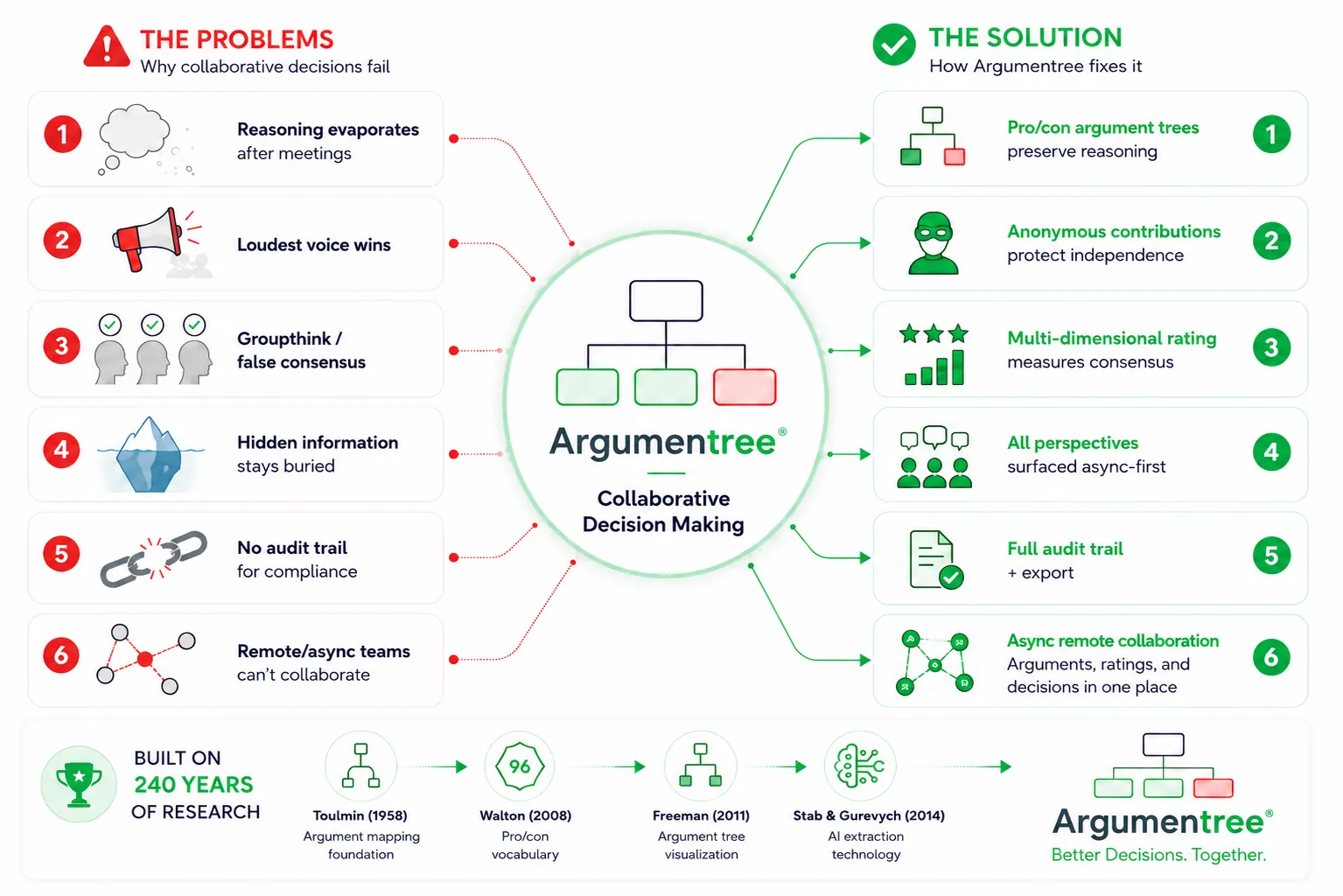
Collaborative Decision Making: 240 Years of Proof That Groups Beat Individuals
In 1785, Condorcet proved mathematically that groups outperform individuals when perspectives are properly aggregated. Google's Project Aristotle confirmed it: psychological safety predicts team effectiveness better than who's on the team. Here's what the science says — and when NOT to collaborate.
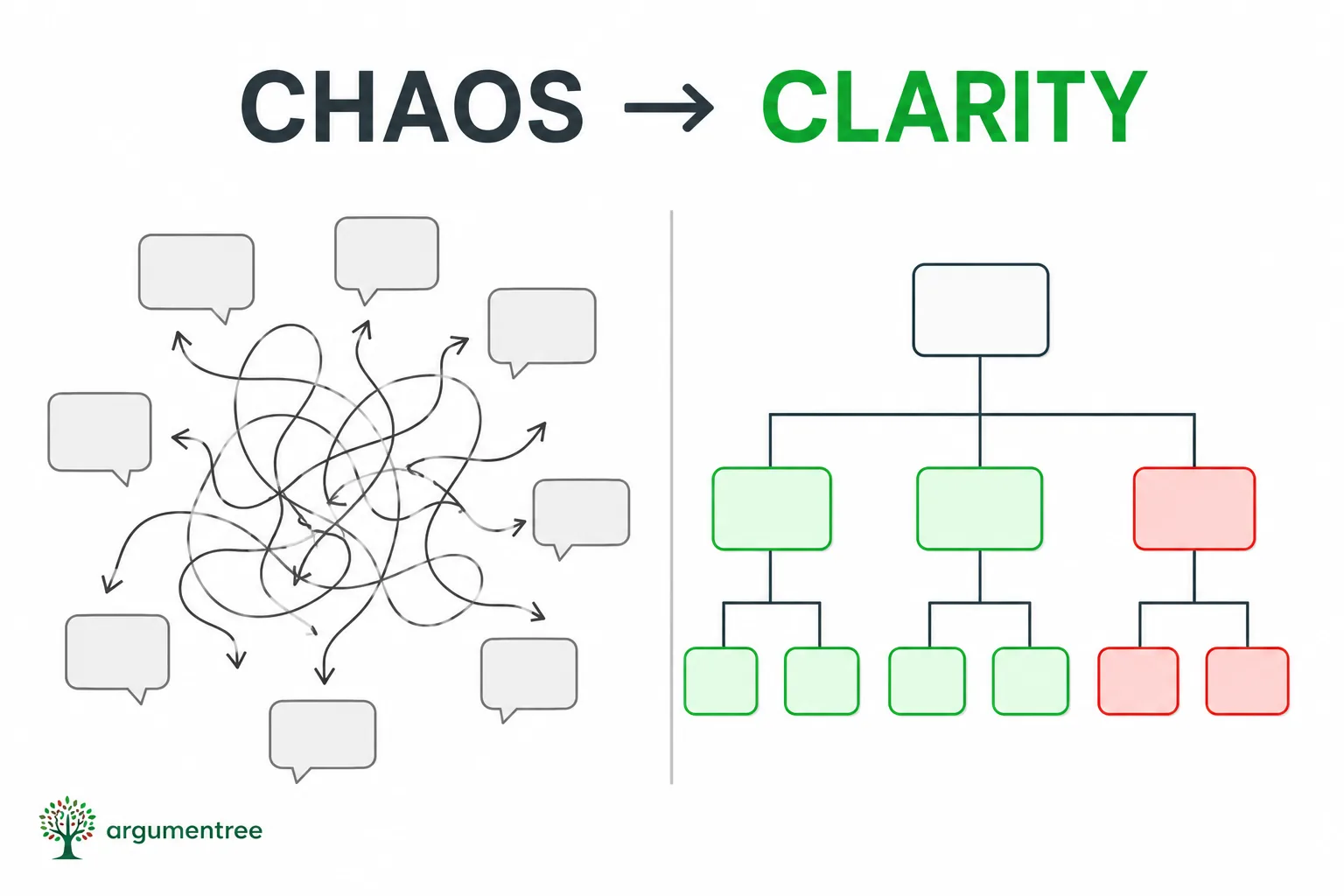
The Meeting Intelligence Revolution: Turning Meetings Into Traceable Decisions
Tired of meetings where people talk without saying anything? Learn how to transform wasted meeting time into focused, efficient decisions with pre-meeting argument preparation, real-time rating, and full decision traceability — grounded in the published research on meeting waste.
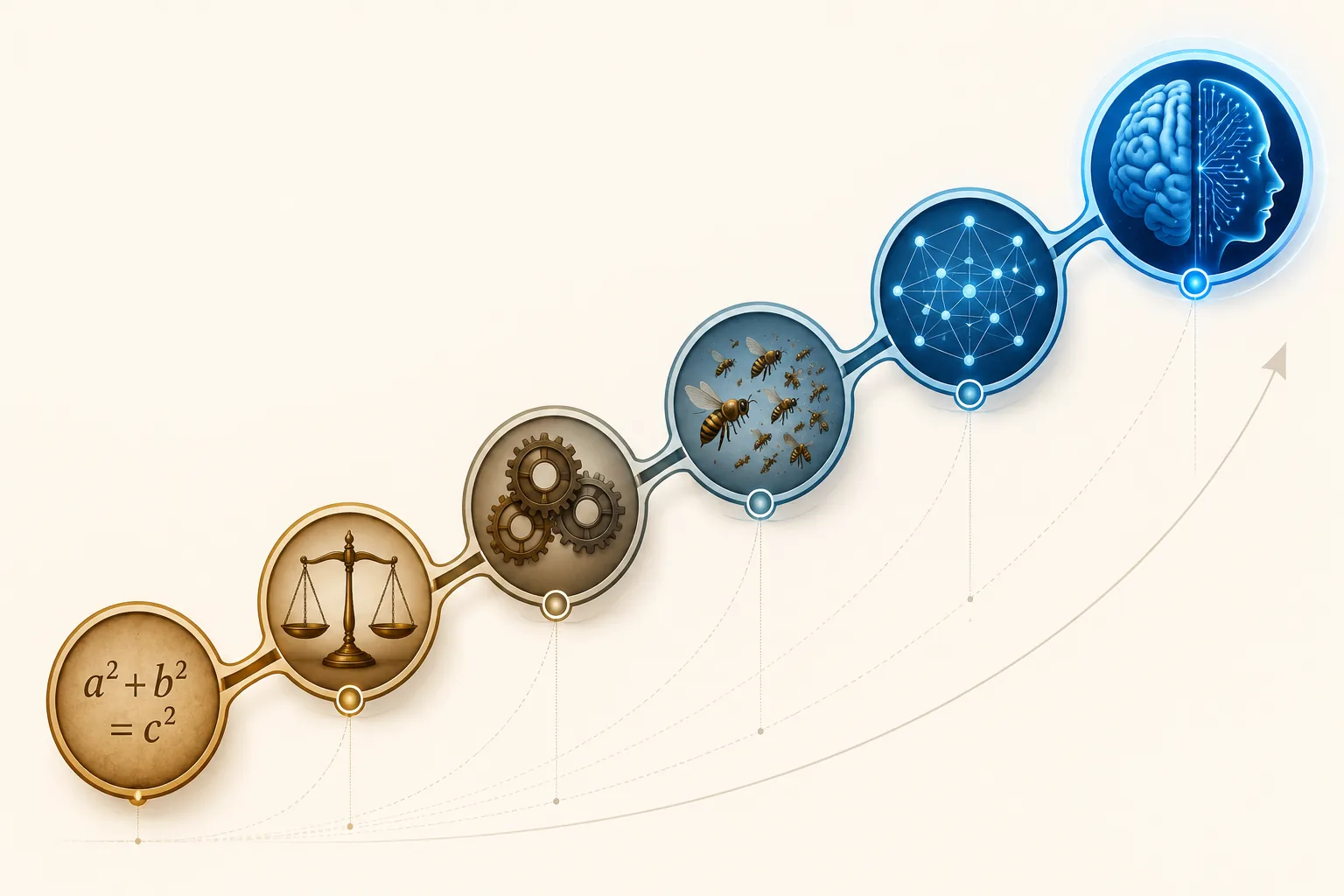
Collective Intelligence: 240 Years of Research — From Condorcet to AI
From an 18th-century French mathematician to MIT AI labs, the science of group intelligence has evolved through six eras. Here's the complete history.

Diversity Beats Ability: Why Your Smartest Hire Isn't Your Best Decision-Maker
Research shows teams of diverse thinkers outperform teams of high-IQ experts. Here's the science—and why it's more nuanced than the headlines suggest.
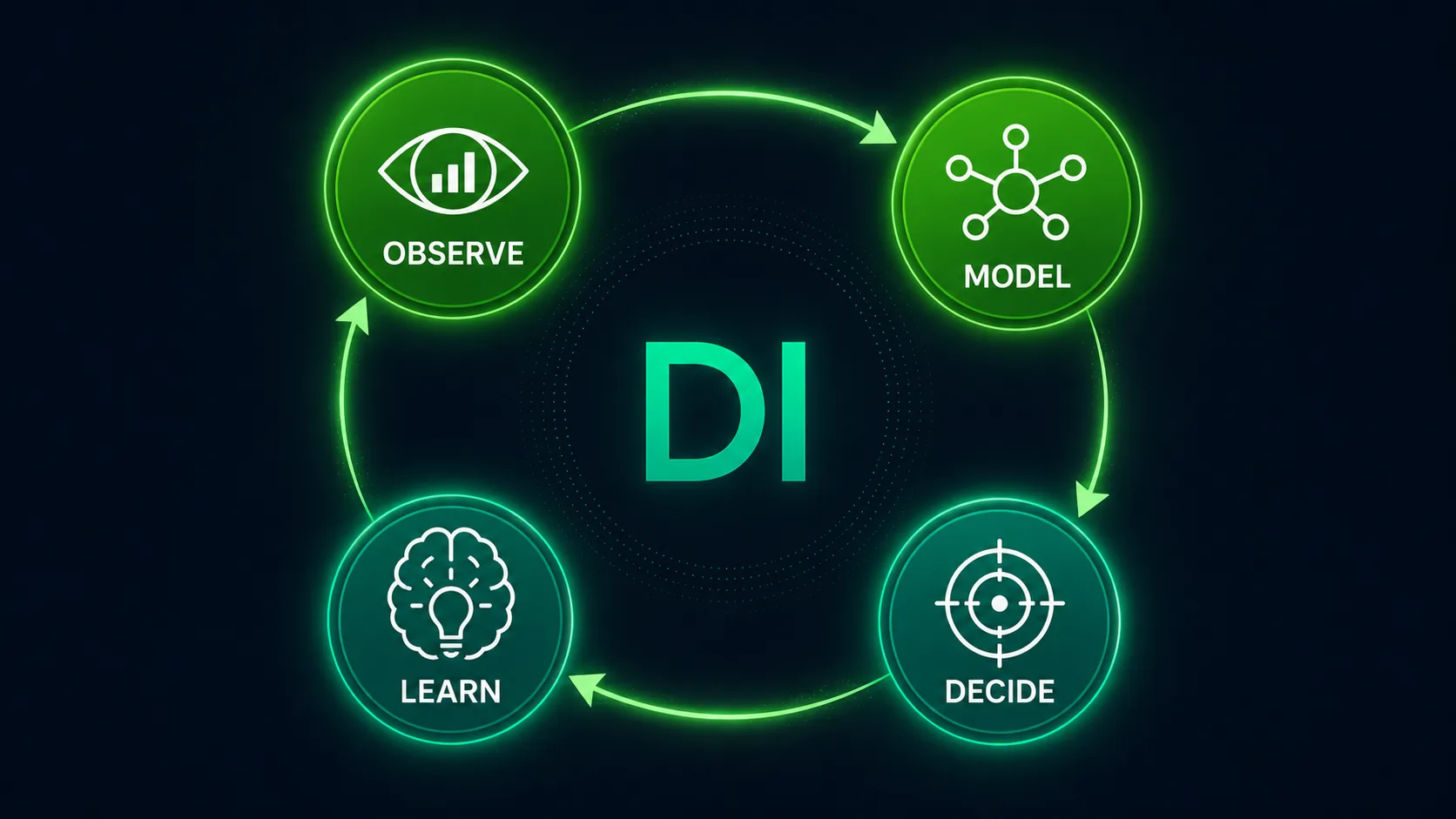
Decision Intelligence: From Data to Action at Enterprise Scale
In 2018, Google created a new job title: Chief Decision Scientist. Why? Because having data isn't the same as using data well. Decision Intelligence — coined by Lorien Pratt, operationalized by Cassie Kozyrkov — closes the gap between insight and impact. Here's the framework behind the $68B market.

Jeff Bezos's 3 Decisions a Day: The Warren Buffett Method Behind Amazon
In 2018, Jeff Bezos revealed his decision-making philosophy: "You get paid to make a small number of high-quality decisions." He credits Warren Buffett's approach. Here's the full interview, the 10am rule, and why "gut decisions" aren't what you think.
Warren Buffett's Decision Philosophy: The 20-Slot Punch Card That Built $900 Billion
Jeff Bezos credits Warren Buffett for his decision philosophy. But what does Buffett himself actually say? His 20-slot punch card rule, Ted Williams sweet spot analogy, "lethargy bordering on sloth," and why he reads 500 pages a day. The real philosophy behind $900 billion.

Elon Musk's $100 Million Decision Hour: The Lex Fridman Clip Every CEO Should See
In a recent Lex Fridman conversation, Elon Musk did the math out loud: "The marginal value of a good decision can easily be, in the course of an hour, a hundred million dollars." Bezos counts decisions per day. Buffett reads 500 pages to prepare. Musk prices the hour. Here's why the number isn't bravado—and what it means for every organization at every scale.

Steve Jobs Fired Board Members for Agreeing With Him: The Unusual Truth About Pixar's Board
During Pixar's decade as a public company, Steve Jobs removed two board members—not for incompetence, but because they never disagreed with him. Ed Catmull's firsthand account: the arenas of disagreement, the Toy Story 2 reboot, the rock tumbler metaphor, and why the "reality distortion field" caricature misses how Jobs actually decided.
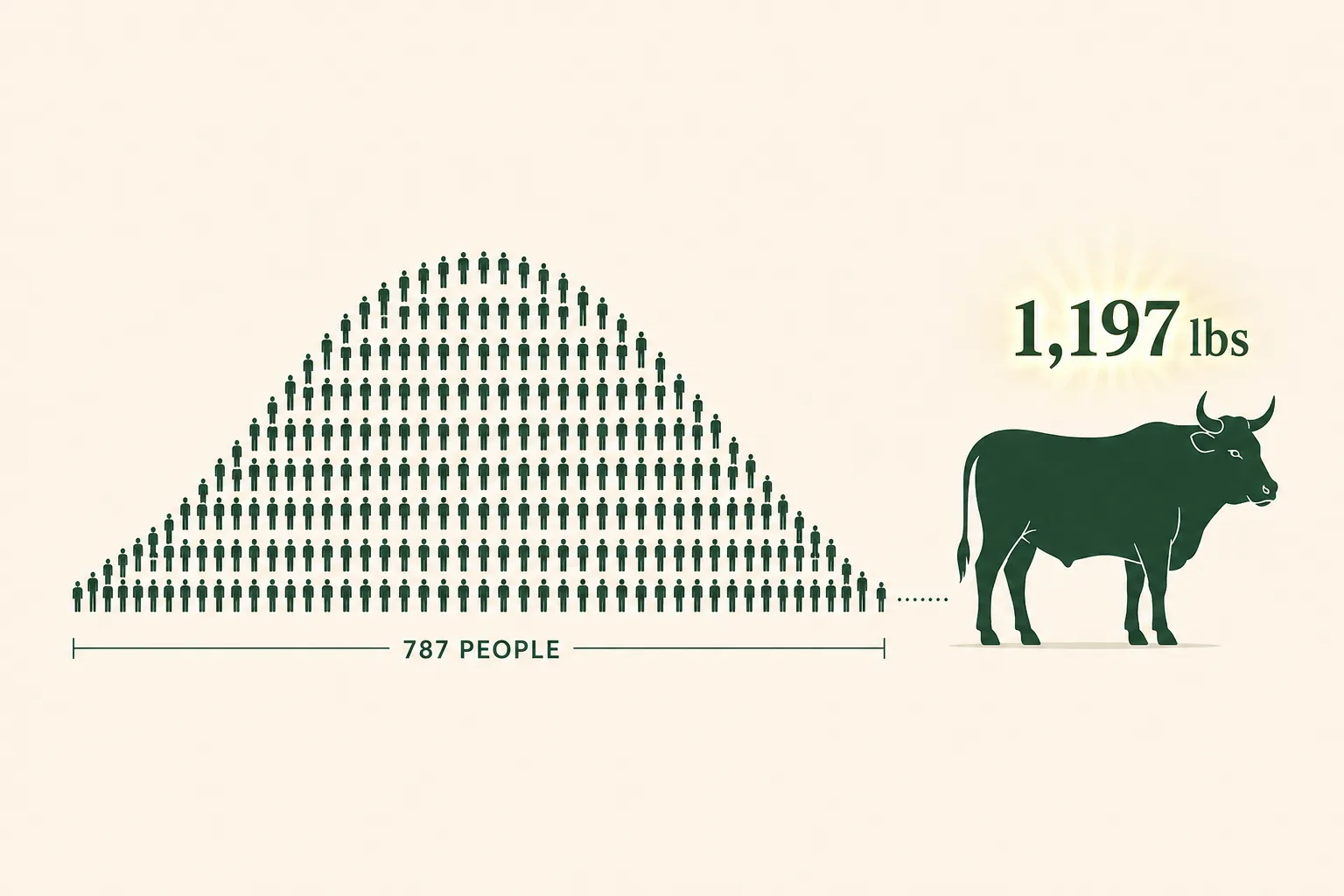
Wisdom of Crowds: Galton's Ox — The 1906 Experiment That Proved Crowds Beat Experts
Francis Galton went to a country fair expecting to prove the average voter hopeless. Instead, the median of 787 guesses at an ox's dressed weight landed within 1% of the truth — better than the cattle experts. The full story of the experiment that founded the wisdom of crowds: the methodology, the statistics, the caveats, and what it means for how teams decide today.
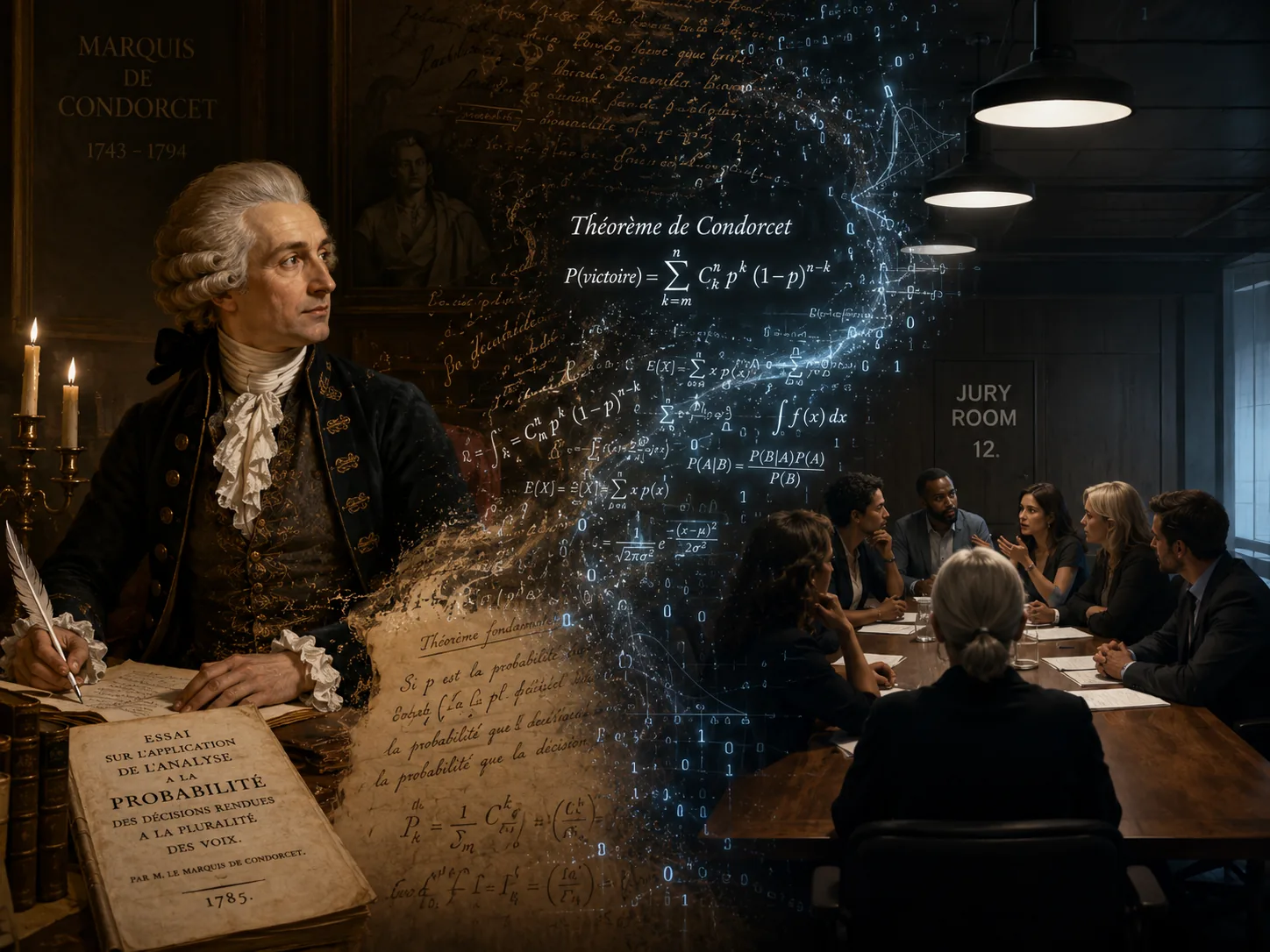
The Condorcet Jury Theorem: The 240-Year-Old Math Behind Better Decisions
In 1785, a French mathematician proved that majorities are almost always right—if each voter is more likely right than wrong. The theorem now powers ensemble AI.

When Crowds Go Wrong: Bubbles, Cascades, and the Madness of Herds
The same crowd dynamics that produce wisdom can produce madness. From tulip mania to Twitter mobs, here's the science of collective failure—and how to prevent it.

The Steel Man: Why the Best Negotiators Argue Against Themselves First
In 2013, Warren Buffett invited a short-seller betting against Berkshire on stage at his own annual meeting—to make the strongest case against him. That's steelmanning. Rapoport's rules, moot courts, McKinsey red teams, the real research—and the trap that makes performed devil's advocacy backfire.

How McKinsey, Bridgewater, and Amazon Turn Disagreement Into Decisions (The Protocol)
Bezos greenlit a show he didn't believe in with six words: "I disagree and commit"—and hoped it would succeed. McKinsey's obligation to dissent, Bridgewater's believability weighting, Amazon's 6-pager: the five structural elements all three share, and how to implement them in your next meeting.
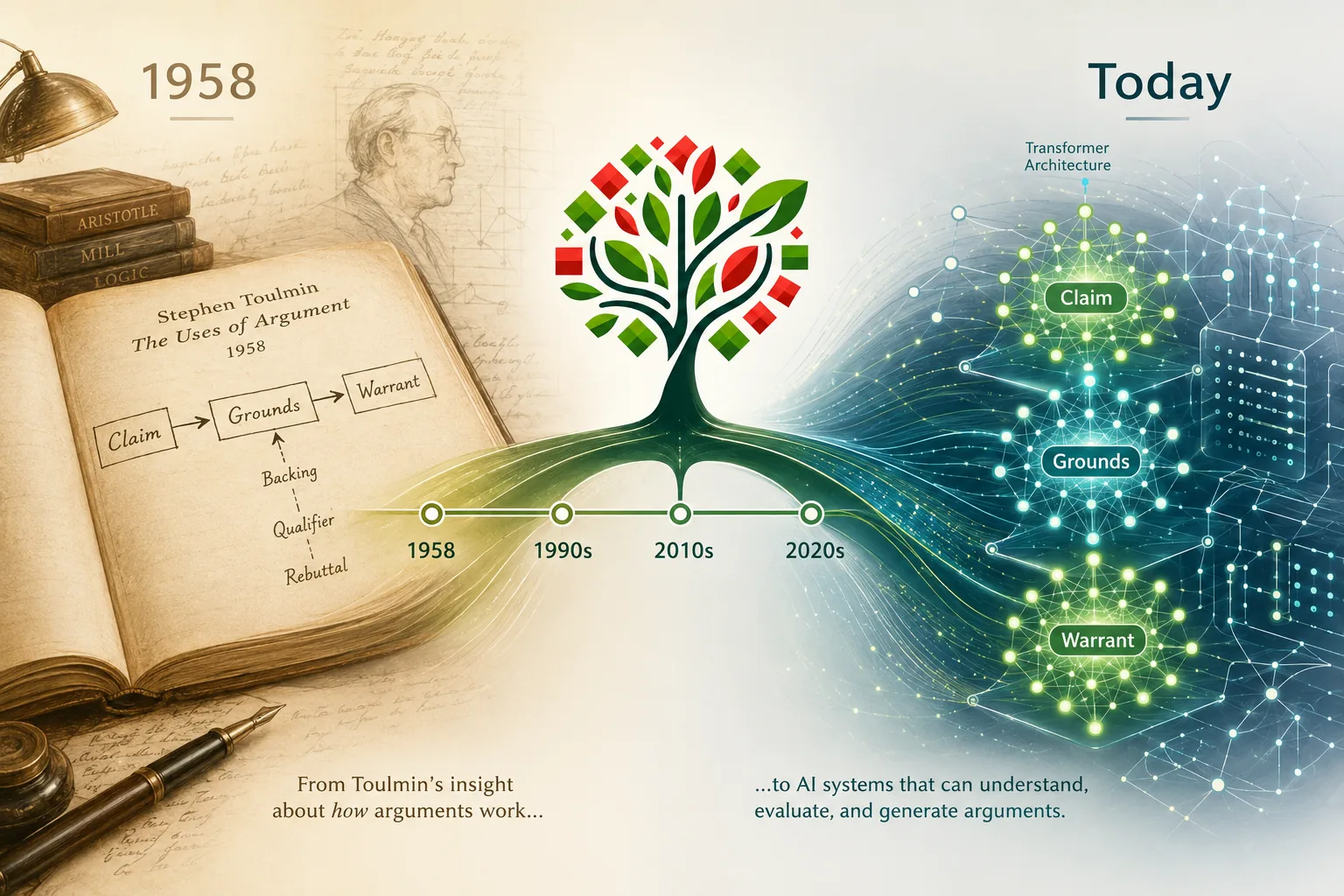
From Toulmin to Transformers: How Argument Mining Became a Technology
In 1958 a philosopher published a book about reasoning that declined to be about formal logic, and was told he had wandered off the map. Sixty years later every system that reads a transcript and tells you what was argued uses his vocabulary. The arc of argument mining: Toulmin's warrant, Walton's critical questions, Freeman's undercut, the corpora that made it measurable, and the one half that never got easier.
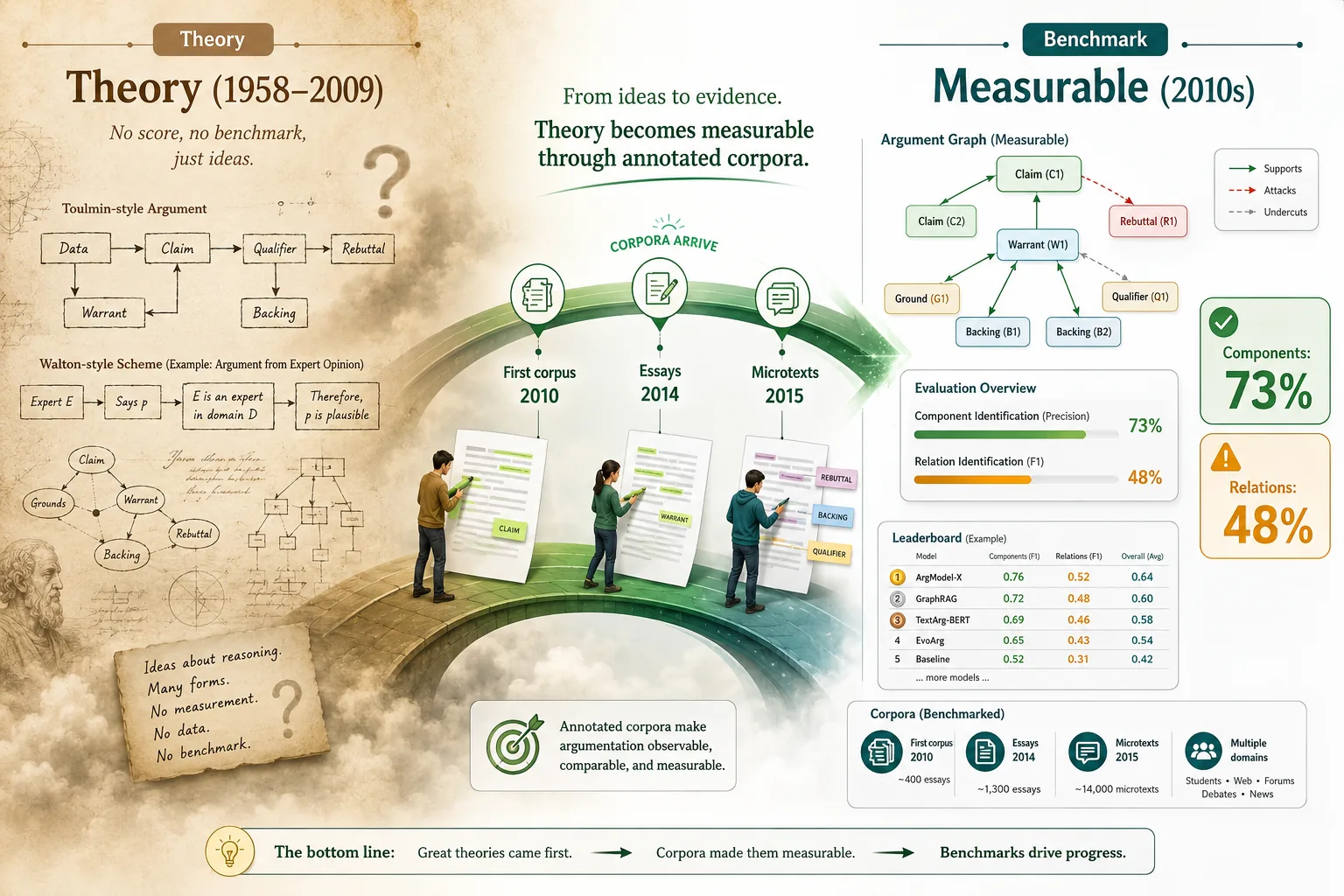
Teaching Machines to Read Arguments: The Decade of Annotated Corpora
Give two trained annotators the same paragraph and ask which sentence is the claim. They often disagree — and that single fact shaped the decade that turned argument mining from a theory into a measurable task. Why inter-annotator agreement is the real ceiling, why genre matters more than volume, and why more data never fixed relation detection.
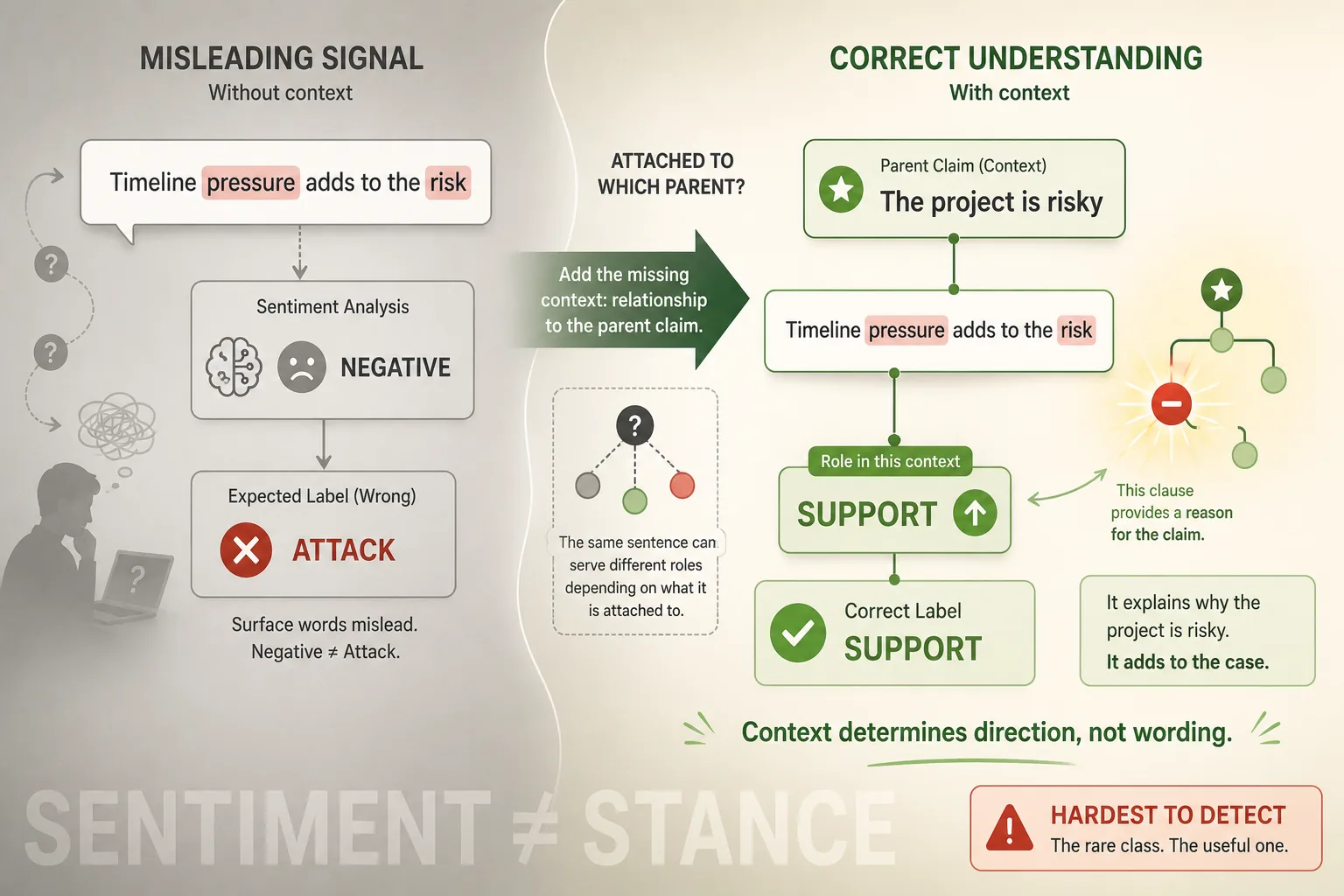
Why Attack Detection Is the Hardest Problem in Argument Mining
Disagreement is a small minority of the annotated data — in some corpora under a tenth of relations. So models learn that guessing agreement is usually safe, which is exactly backwards for the reason you would deploy one. Three structural reasons attack detection resists solution, and why the rare class is the one decisions turn on.
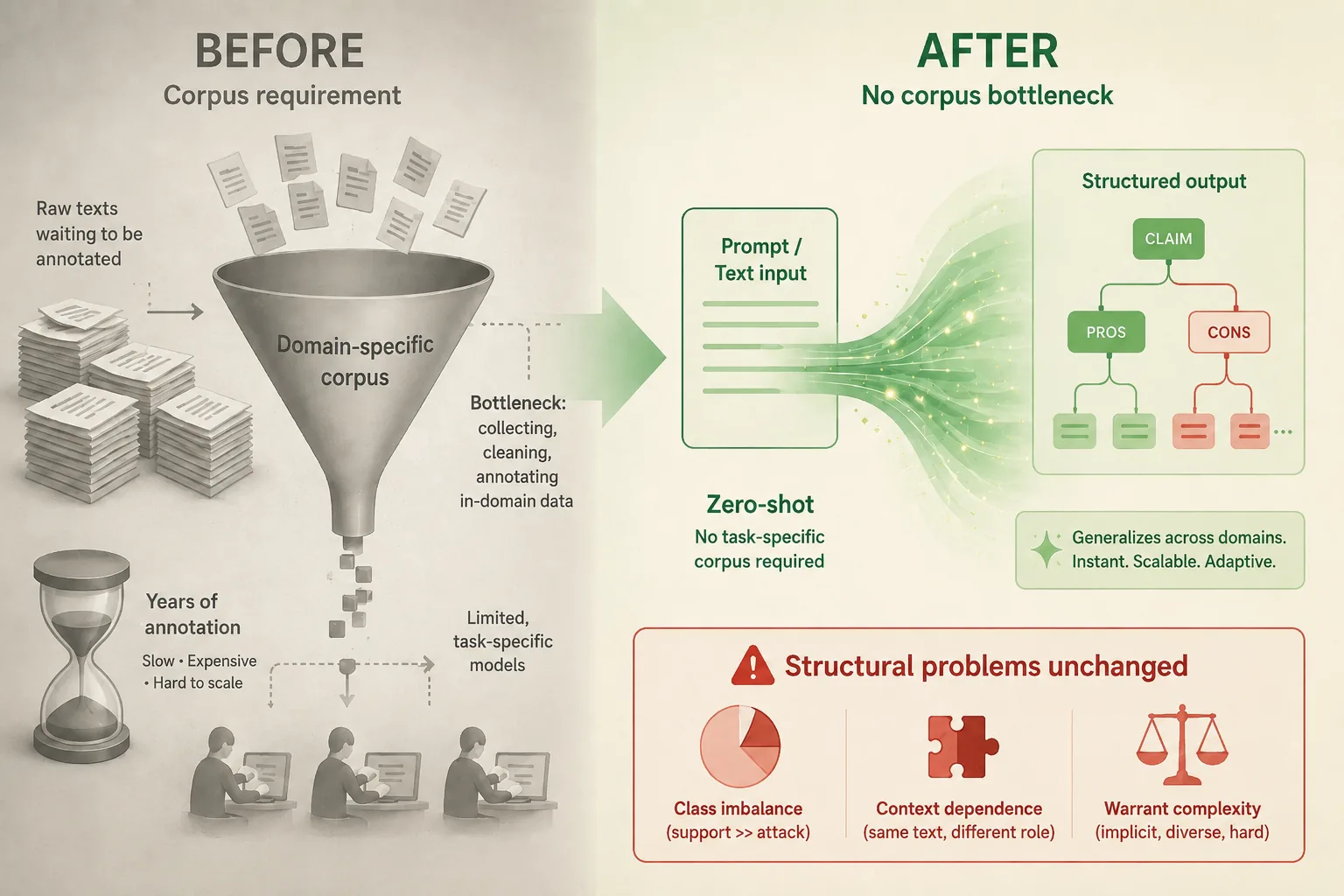
When LLMs Met Argument Mining: What Changed and What Didn't
For twenty years the answer to 'can we run argument mining on our data?' was another question: how many thousands of documents will you have annotated first? Large language models made that question stop being asked. What the corpus bottleneck's collapse actually changed, what it left exactly where it was, and the new trap that arrived wearing the costume of a solution.
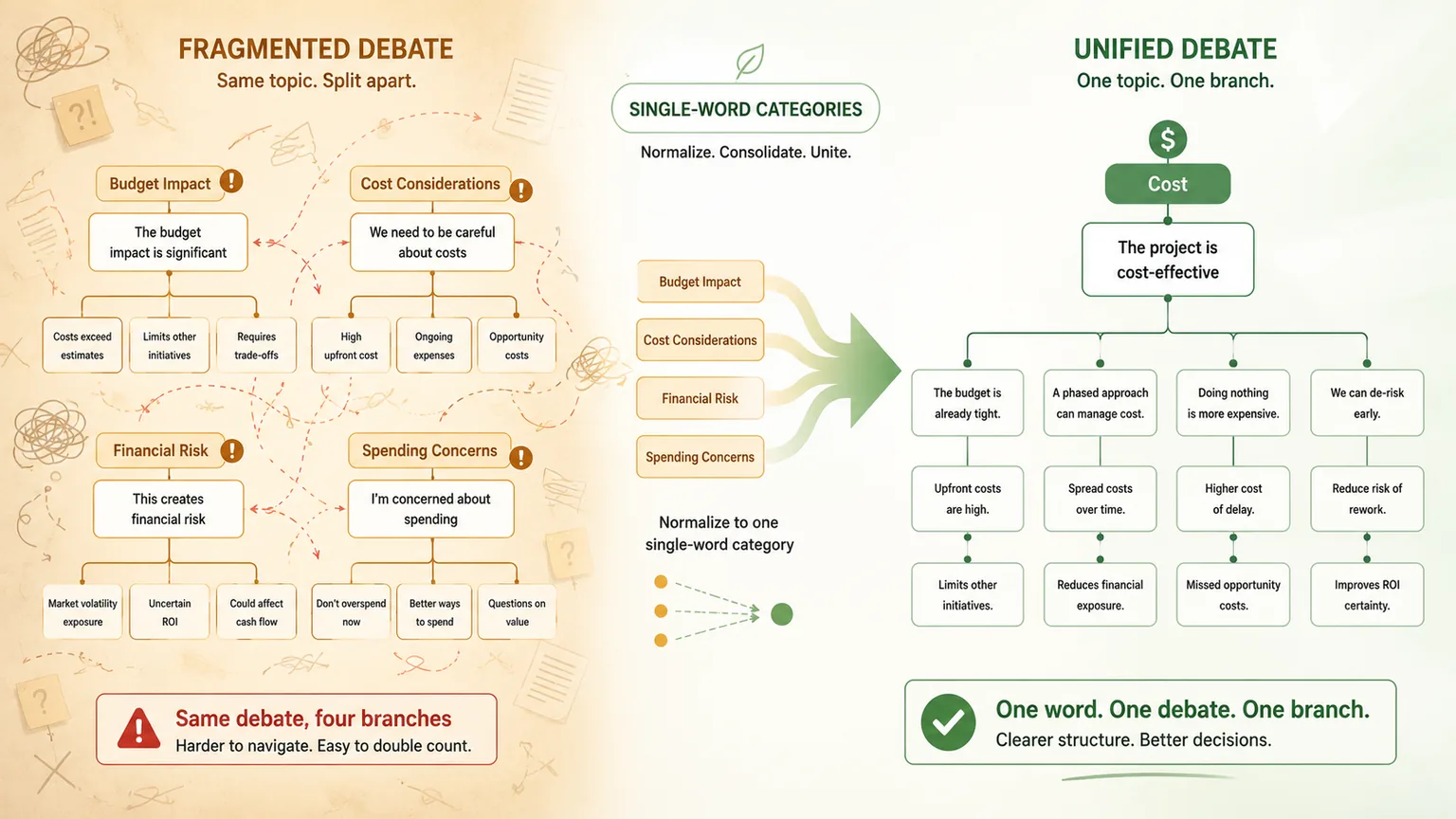
How Argumentree Turns a Transcript Into an Argument Tree
Feed a budget meeting into an extraction engine and ask which argument mattered most, and it hands you a statistic — which is exactly wrong. A high-level look at how we apply argument mining: why discussions get sorted into single-word categories, why exactly one argument per category becomes the main claim, why the model's own confidence is the wrong way to pick it, and why nothing survives that isn't quoted from your source.
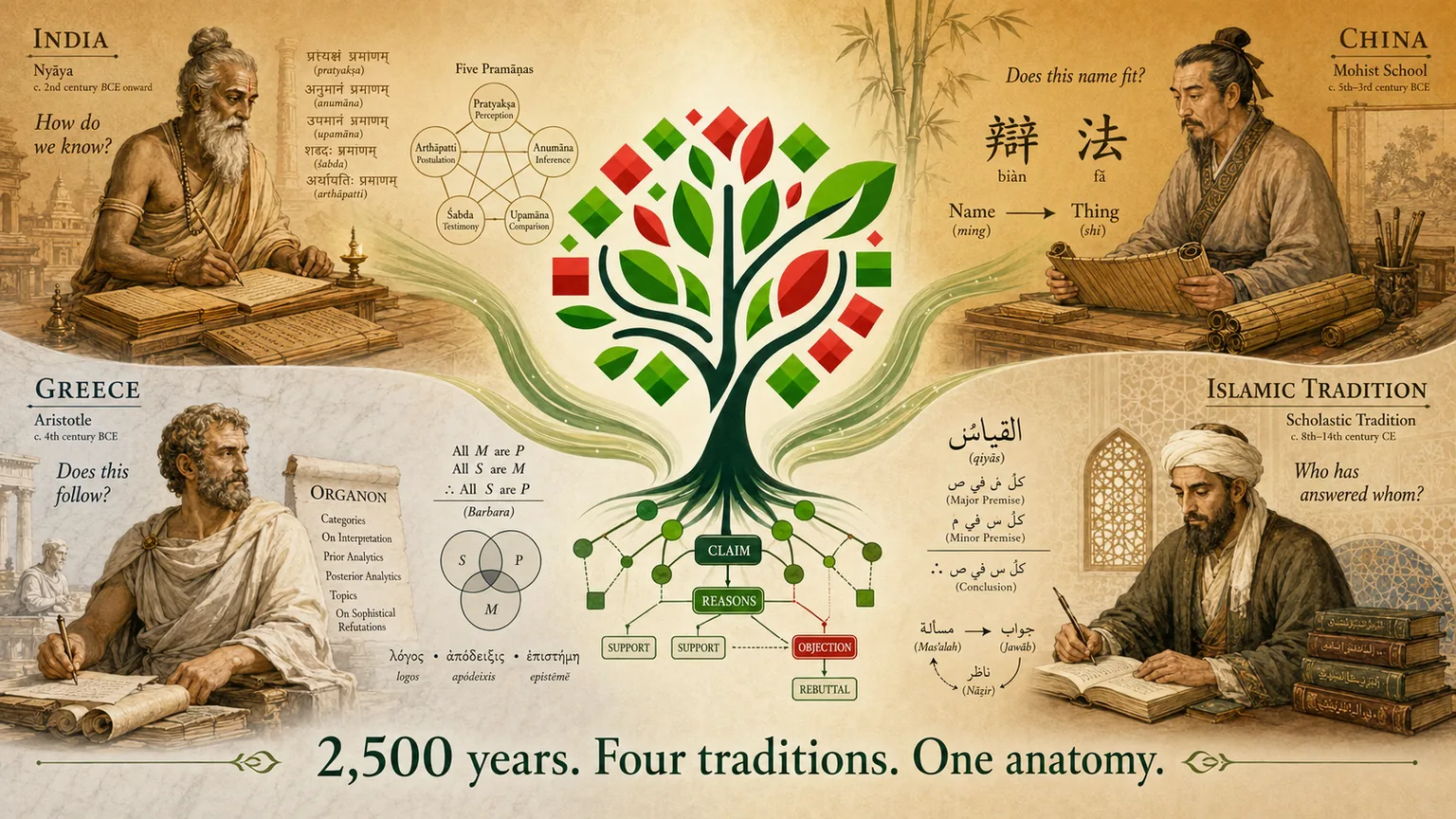
The Global Roots of Reasoned Argument: How Three Civilizations Invented Logic
Logic was not invented once. Between the 6th and 4th centuries BCE, India, China, and Greece independently developed sophisticated systems for structured argumentation — and later, Islamic scholars synthesized Greek logic with indigenous debate traditions. This is the hub of the Roots of Reasoning series: why the parallel emergence matters, what each tradition contributed, and what the global history teaches us about how to argue well.
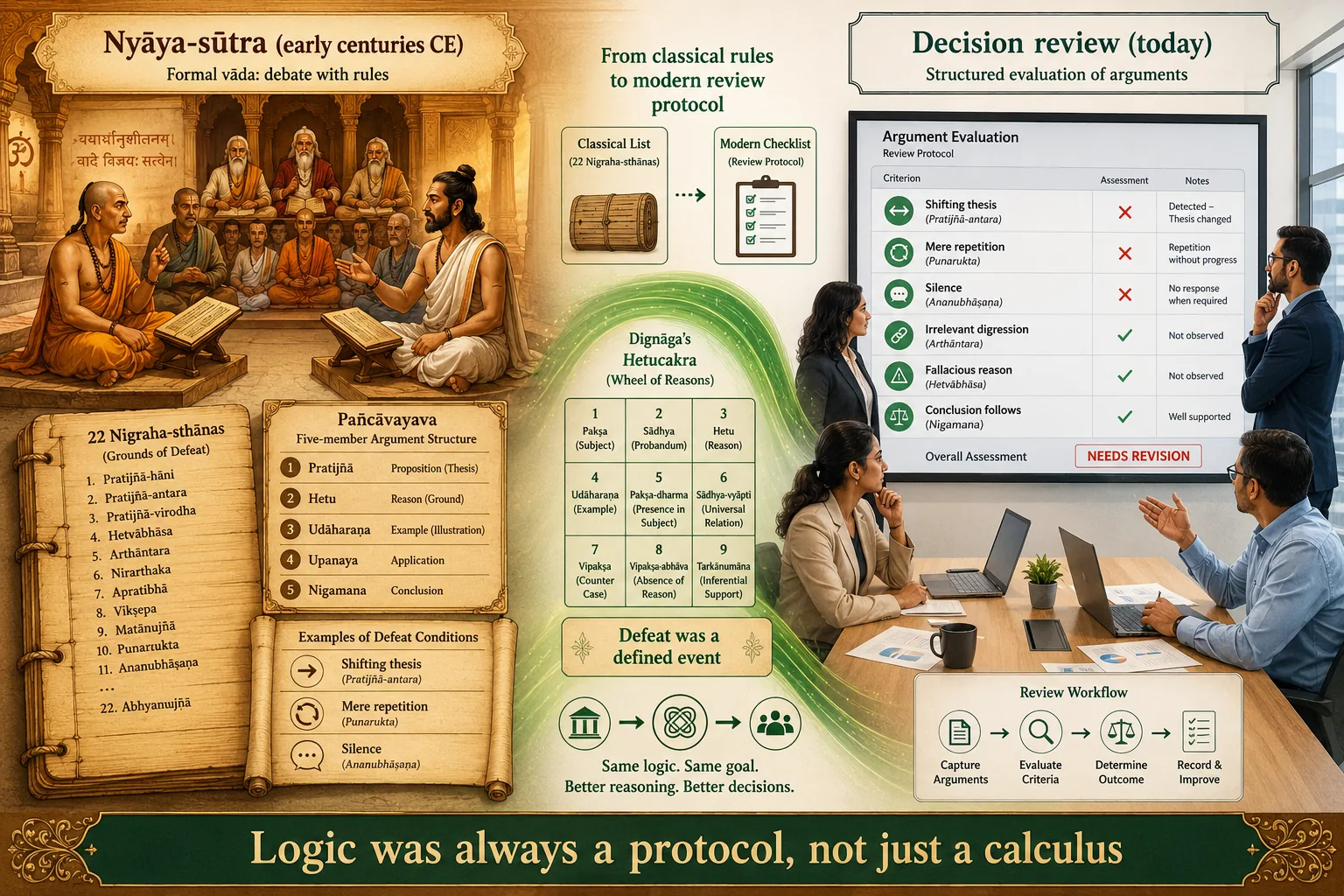
Indian Logic: The 2,500-Year Tradition from Nyāya to Buddhist Debate
Indian debate theory is old, institutional, and startlingly procedural: the Nyāya-sūtra lists 22 named ways to lose an argument. The five-member syllogism was built for public contest, not private proof. Dignāga's wheel of reasons is a nine-cell matrix that separates good evidence from bad. Buddhist prasaṅga, the tetralemma, and Jain seven-fold qualification round out a toolkit the West largely never built.
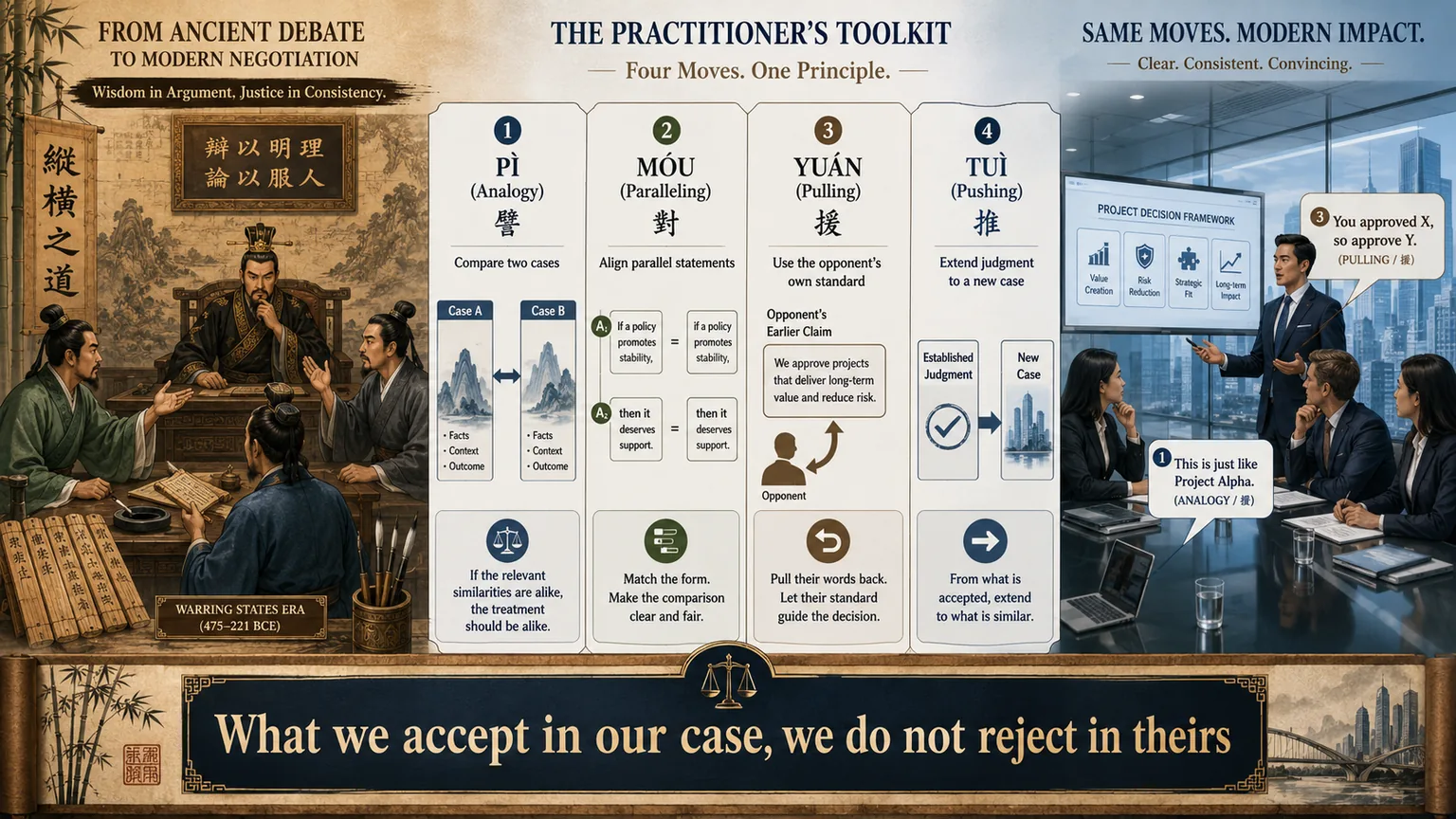
Mohist Logic: The Chinese Art of Drawing Distinctions
Classical Chinese thought developed argumentation without a formal syllogistic. The Mohist school analyzed disputation (biàn), analogy, and the correct application of names with precision the Western tradition largely lacks. Where Greek logic asked 'Does this follow?', Mohist logic asked 'Is this name correctly applied?' — a different question with different tools. Here's why Chinese logic took a different path, and what it offers today.

Islamic Dialectics: From Theological Debate to the Science of Disputation
Islamic philosophy did not just preserve Greek logic — it synthesized it with indigenous traditions of theological and legal debate to produce something new. Kalām (theology), qiyās (legal analogy), jadal (dialectic), and ultimately ʿilm al-munāẓara (the science of disputation): formalized rules for structured debate that anticipate modern argumentation protocols. Here's the tradition that transmitted Aristotle and transformed him.
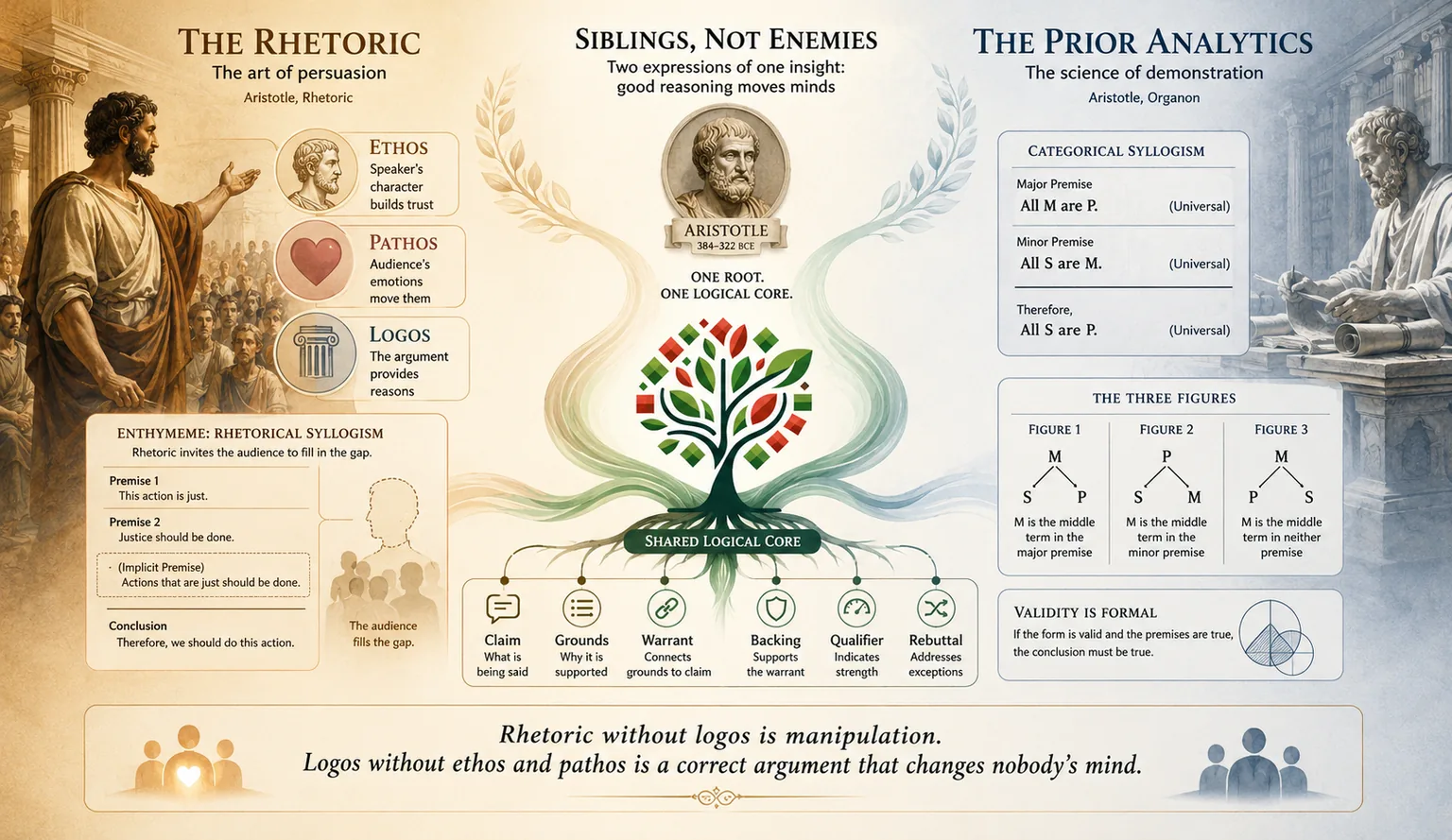
Aristotle's Logic: The Mediterranean Foundation of Western Argument
Aristotle created the formal study of logic in the Western tradition. His Organon — covering categories, syllogisms, demonstration, dialectic, and fallacies — remained the basis of logical education for two millennia. The Rhetoric added the three appeals (ethos, pathos, logos). But what did Aristotle actually build, what came before him, and what did he miss? Understanding the dominant framework is essential to seeing its limits.
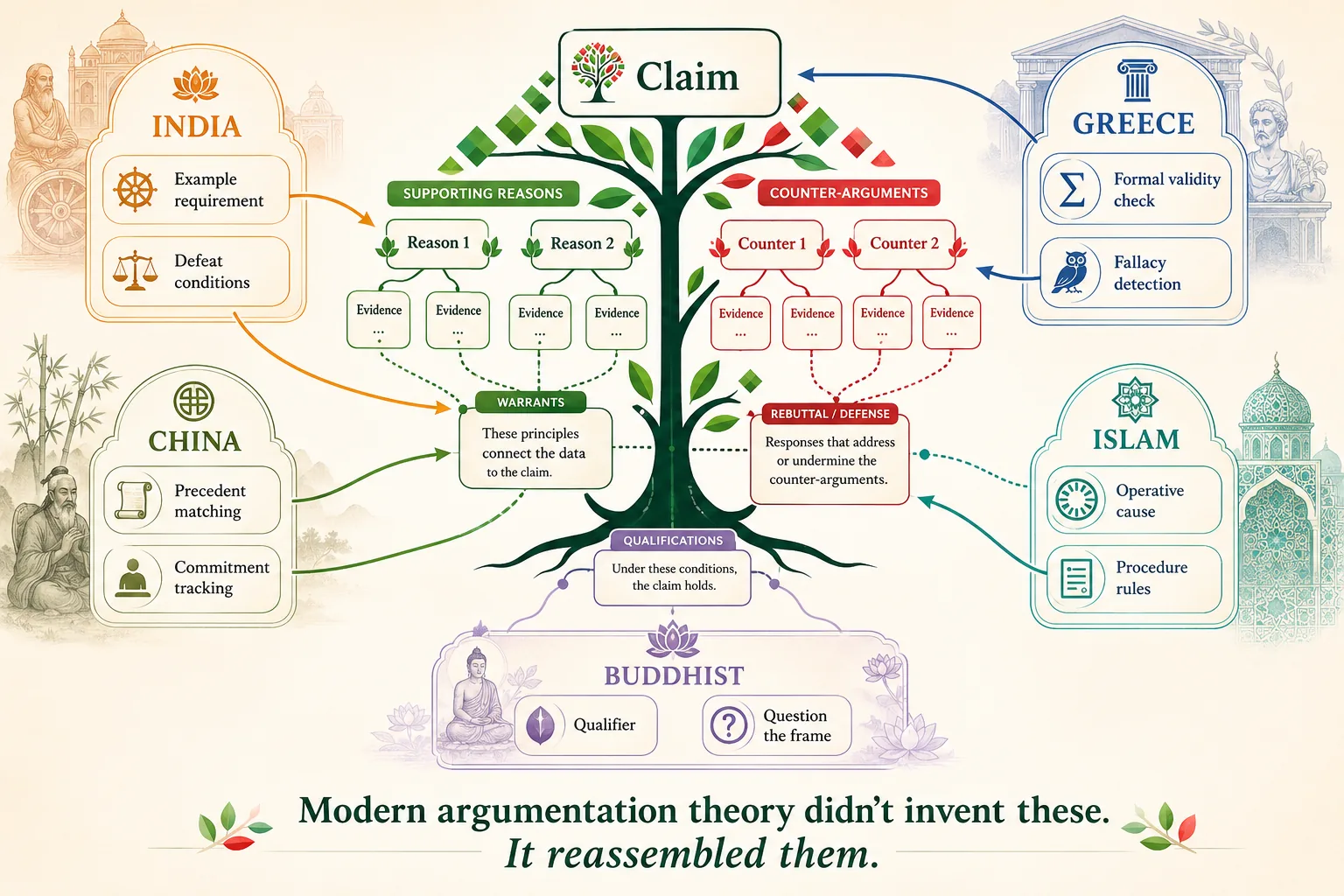
Five Syllogisms: Comparing Argument Structures Across Civilizations
The Indian five-member syllogism, the Greek three-member syllogism, Mohist argument from analogy, Islamic qiyās, and the Buddhist tetralemma — five civilizations developed five distinct structures for valid argument. Comparing them reveals that Aristotelian logic is powerful but incomplete, and that the global history of argumentation offers a fuller toolkit for reasoning than any single tradition provides.
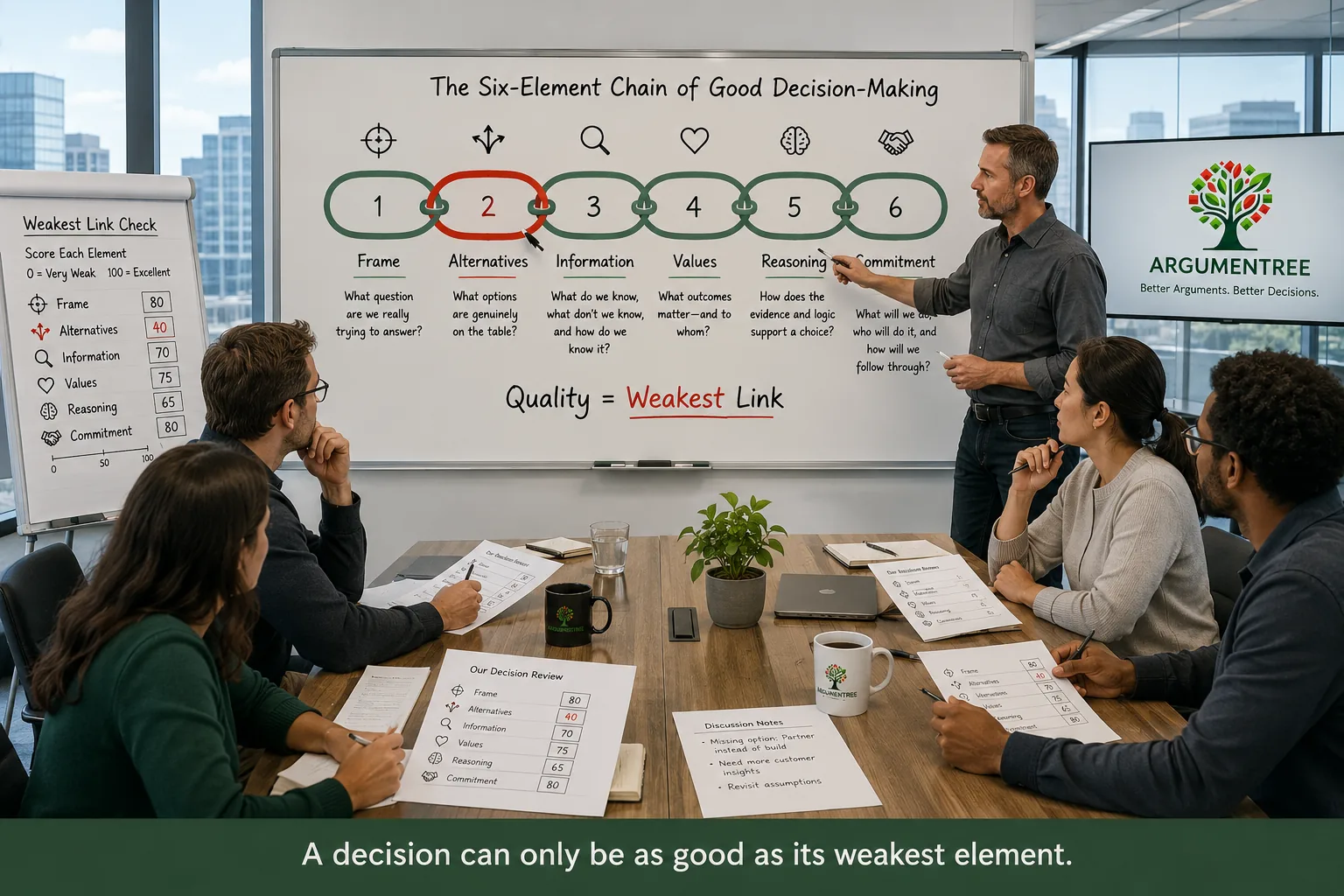
Decision Quality: The Six Elements of a Good Decision — Before You Know the Outcome
The worst play call in Super Bowl history was arguably a good decision — and that confusion has a name. Decision quality, the Stanford-lineage framework formalized by Carl Spetzler, judges decisions by six elements at the moment they're made: frame, alternatives, information, values, reasoning, commitment. The chain rule (quality = weakest link), the resulting trap, a 15-minute weakest-link check, and how improving the decision process mechanically improves the decision quality.
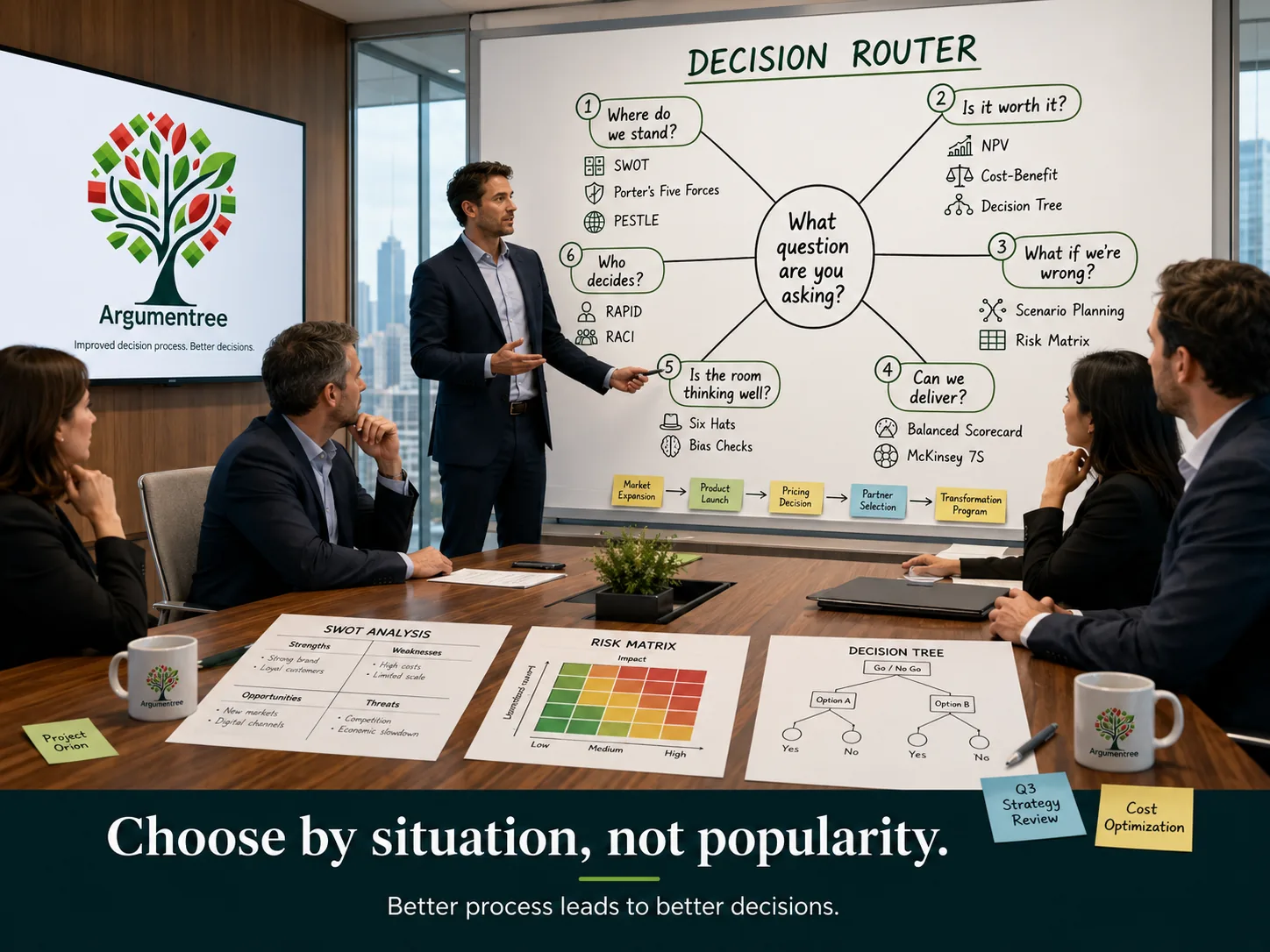
Business Decision Frameworks: Which One to Use, When — The Complete Chooser's Guide
The most-used framework in business — SWOT — has no verified inventor, and it never mattered: frameworks spread because they're useful containers. This chooser routes all of them by decision situation: strategic position (SWOT, PESTLE, Five Forces, BCG), money (CBA, NPV, decision trees, real options), uncertainty (scenario planning, ERM), execution (balanced scorecard, 7S, PDCA), group thinking (Six Hats, prospect theory), and roles (RAPID). Plus the master which-framework-when table — and the step every template skips.
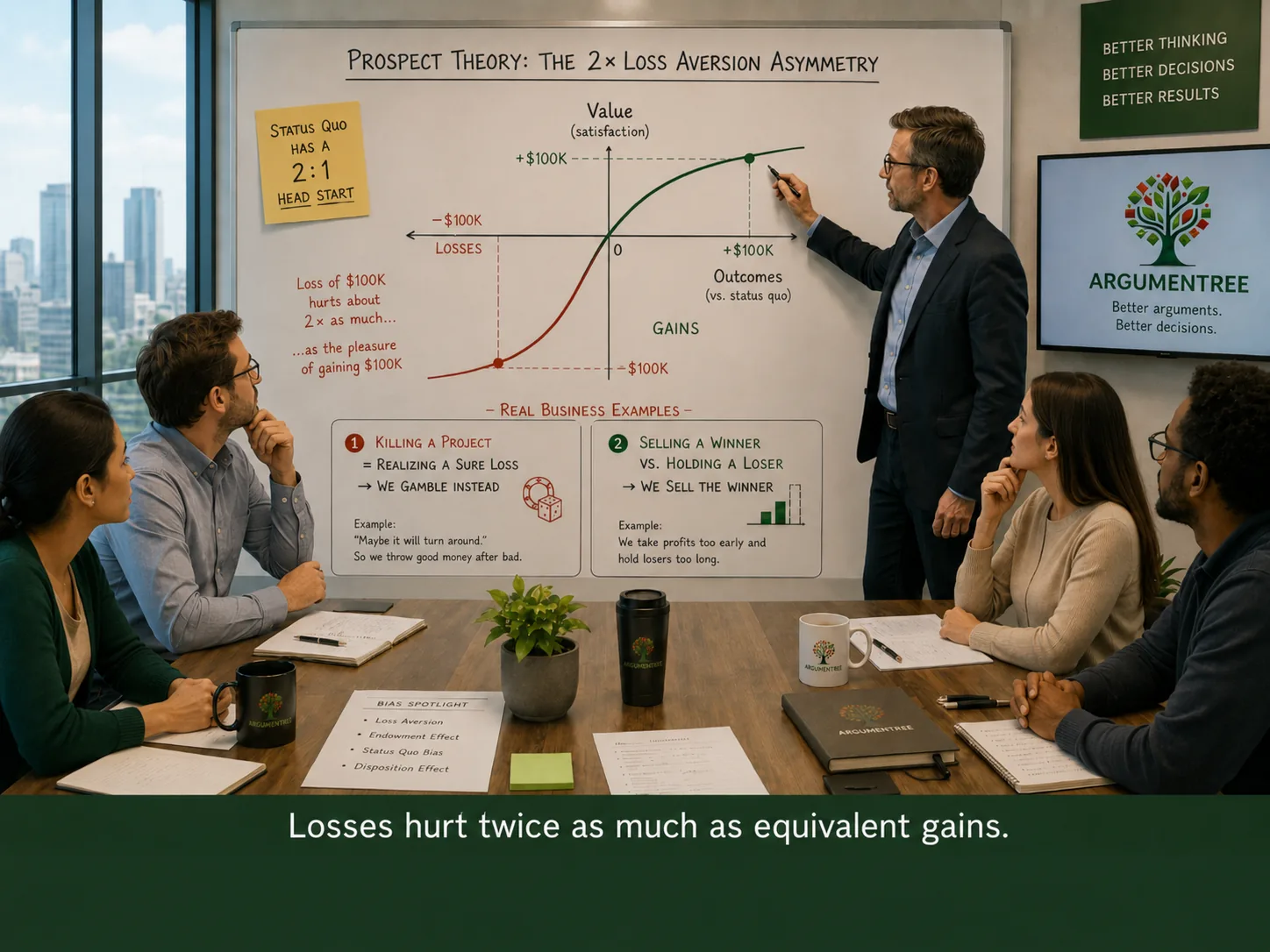
Prospect Theory: Why Your Team Fears Losses Twice as Much as It Values Wins
In Tversky and Kahneman's 1981 experiment, rewording a life-and-death choice from lives saved to lives lost flipped the majority — 72% chose safety in one frame, 78% chose the gamble in the other. Same outcomes, opposite decisions. The theory behind the flip, where it bites in business (doubling down, the disposition effect, the endowment effect), the honest state of the replication debate, and the frame-flip technique that defends your decisions.

Real Options: Why Keeping the Door Open Is a Decision Too
In 1994, Merck's CFO told Harvard Business Review the company priced its research pipeline with option mathematics — because a drug program is a chain of rights-to-continue, not one all-or-nothing bet. Real options thinking: the six option types hiding in your roadmap, why uncertainty flips from enemy to asset when downside is capped, the post-dotcom abuse that gave the method a bad name, and the kill-criteria discipline that keeps it honest.
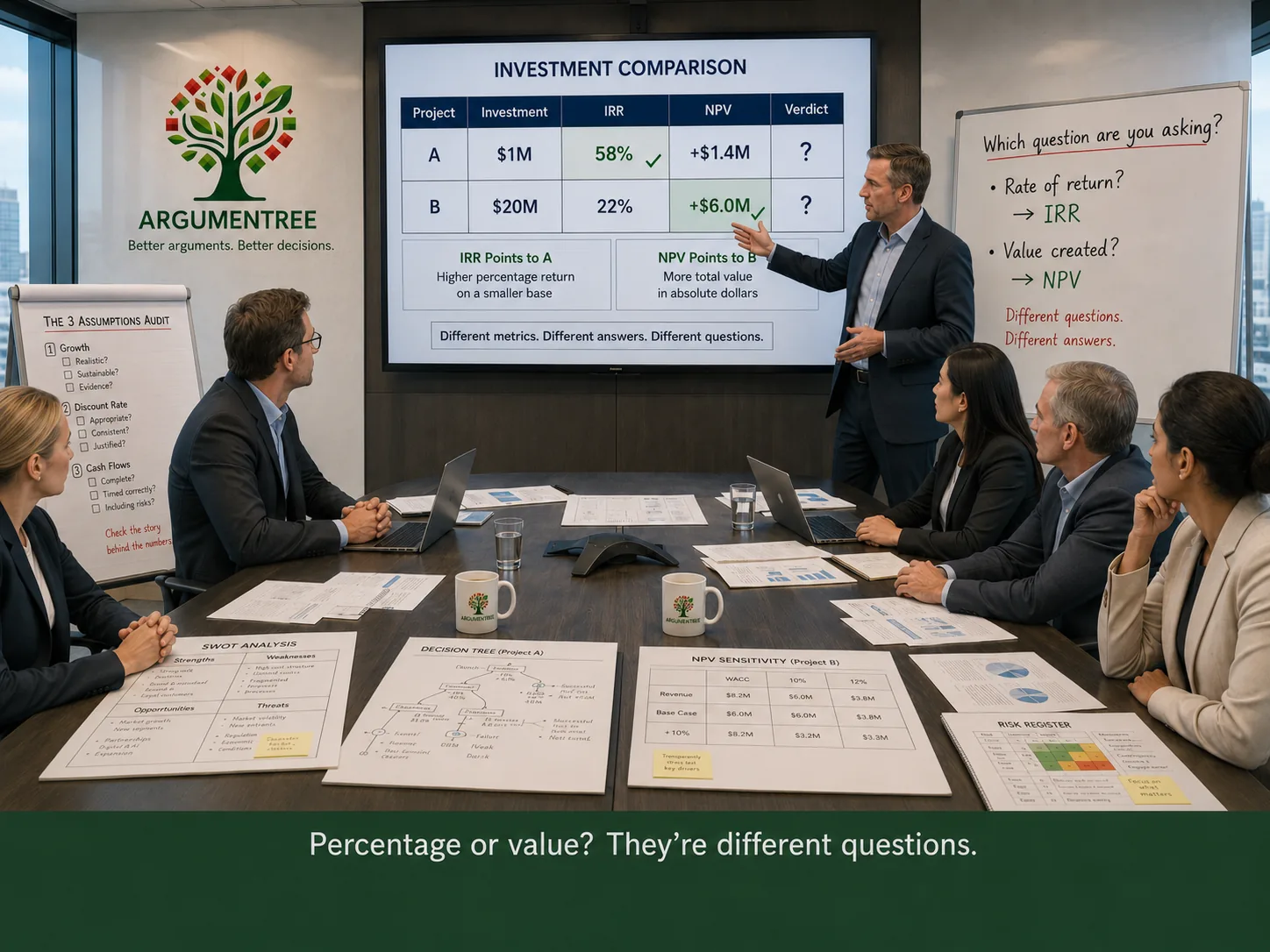
NPV Says Yes. Should You? What Discounted Cash Flow Can't Tell You
About three-quarters of CFOs run on NPV and IRR (Graham & Harvey, 2001) — and the two metrics can pick opposite winners from the same project list. IRR's reinvestment fantasy and scale blindness, NPV's hidden judgment calls (discount rate, terminal value, sponsor-authored base cases), why ditching DCF is the wrong lesson, and the three-assumption audit that turns any model into an arguable case in fifteen minutes.

This Meeting Could Have Been an Email: A Four-Question Test
Nothing happened in that meeting that needed everyone there at the same time — that is the actual complaint, and it has a test. The four questions, the five formats that almost always fail them, why email-able meetings get scheduled anyway, and the inverse error nobody notices.

Ready to Transform Your Decision-Making?
Join hundreds of organizations using Argumentree to structure arguments, track decisions, and build institutional knowledge.
Start Free 14-Day Trial