
Why Attack Detection Is the Hardest Problem in Argument Mining | Argumentree
In argument mining, identifying which sentences are claims is largely solved, while deciding whether one argument supports or attacks another is not. Three structural reasons explain the gap. First, class imbalance: in annotated corpora the overwhelming majority of relations are support, and attack relations are a small minority — in some datasets under a tenth of the labelled relations. A system that guesses support is right most of the time, so the training signal actively discourages predicting disagreement. Second, context dependence: whether a statement attacks something depends on what it is attached to rather than on how it is worded. A negatively phrased sentence frequently supports the claim above it, and a positively phrased one frequently attacks it. Third, the unstated warrant: an objection often disputes the inferential step between grounds and claim, and that step is not written down anywhere in the text. Published benchmarks show the effect consistently — component detection near 73% F1 against relation detection near 48% on the same persuasive-essay corpus, and around 34% on messier public-comment data. This matters in practice because the rare class is the useful one: the strongest objection nobody answered is exactly the thing a decision record needs to preserve.
The rare class is the useful one. Disagreement is a small minority of the data, which is precisely why models under-predict it — and precisely why it matters most.
- Attack relations are a small minority in annotated corpora. Guessing support is usually right, so models learn to under-predict disagreement.
- Whether something attacks depends on what it's attached to, not on how it's worded. Tone is an actively misleading signal.
- Many objections dispute the inferential step rather than the facts — and that step is never written down.
- Published benchmarks: ~73% F1 finding components against ~48% classifying relations on the same corpus; ~34% on messier data.
- The rare class is the one decisions turn on. An unanswered objection is the most valuable thing in any argument record.
The Class That Matters Most Is the One There's Least Of
In the corpora that argument-mining systems are trained and measured on, disagreement is rare. The overwhelming majority of annotated relations are support: this reason backs that claim. Attack relations — this objection undercuts that reason — are a small minority, in some datasets under a tenth of the labelled links.
That single fact produces the field's most stubborn failure mode. A system that simply predicts support every time is right most of the time, and any model learning from that distribution absorbs the same bias. It becomes agreeable.
Which is exactly backwards for the reason you would deploy one. Nobody revisits a decision six months later wondering what everyone agreed about. They want the objection — and the objection is the class the model is least confident about and least likely to predict.
Why Imbalance Is Worse Here Than Elsewhere
Class imbalance is an ordinary machine-learning problem with ordinary machine-learning remedies — reweight the loss, oversample the rare class, report macro-averaged scores rather than accuracy. All of that is standard practice, and all of it helps somewhat.
What makes argument mining harder is that the imbalance is not a sampling artefact you can correct by collecting more data. It reflects how people write. In a persuasive essay the author is building a case, so most sentences support the thesis by design. Scaling the corpus scales the imbalance with it.
This is why the field reports macro-F1 and separate per-class scores rather than raw accuracy. A model that never predicts attack can post a respectable-looking overall number while being useless for the thing you wanted it for. Reading only the headline figure hides the failure completely.
Tone Is Not Just Unhelpful — It's Actively Misleading
The intuitive approach is to look at the language. Negative words, hedging, adversarial phrasing — surely those signal an attack.
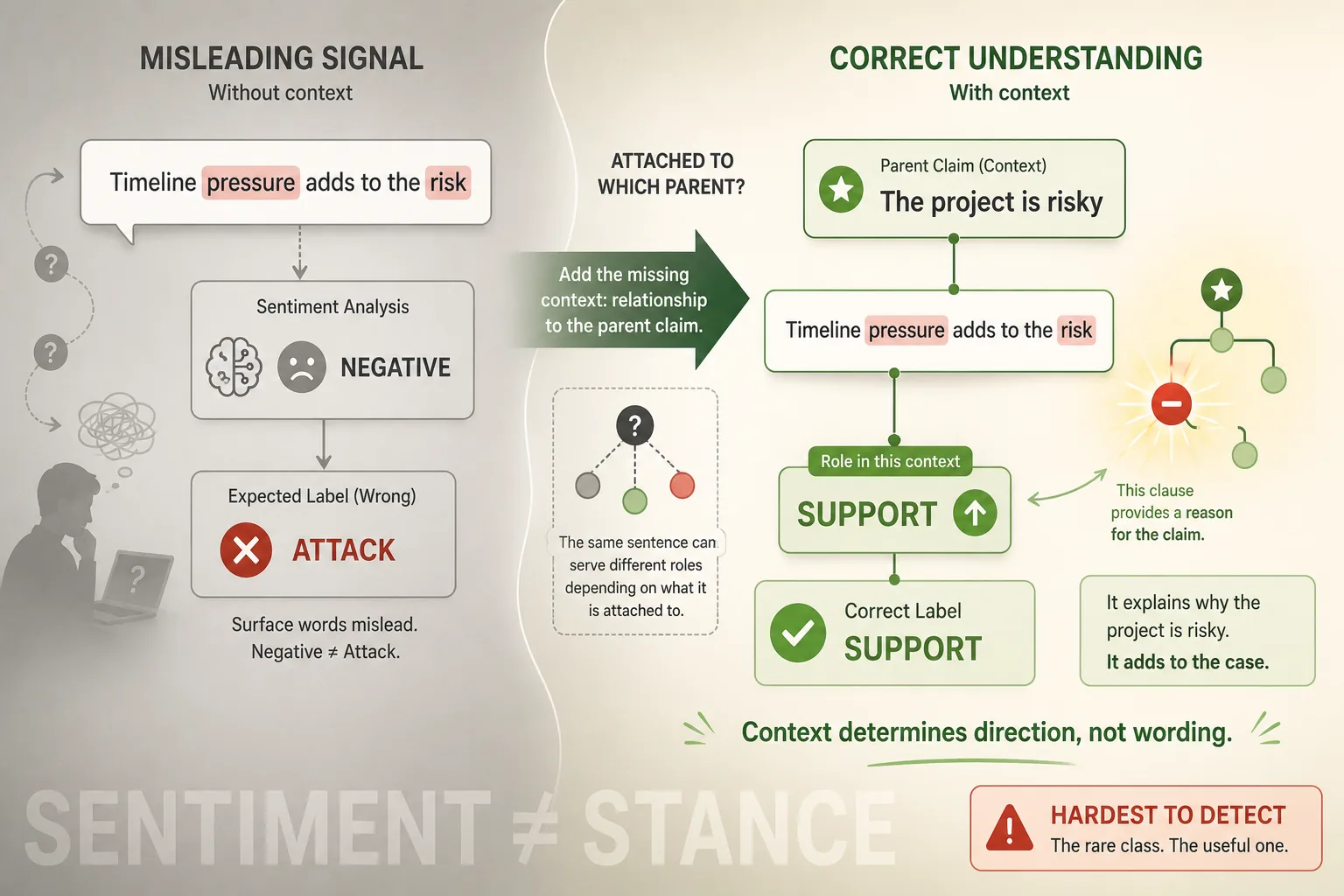
They do not, and the counterexamples are not edge cases. Consider a claim that a project is risky. The sentence timeline pressure adds to the risk is phrased negatively and supports that claim — it supplies another reason the project is risky. Now consider long-term savings will offset the initial investment, attached to a claim that the costs are prohibitive. Positive words throughout, and it attacks the claim.
Whether something supports or attacks is a property of the relation, not of the sentence. The same sentence attached to a different parent flips its label. This is why sentiment analysis, which is very good at what it does, is the wrong tool: it reads the sentence, and the answer is not in the sentence.
The Trap: Judging Stance by the Topic Instead of the Parent
There is a specific version of this error that is worth naming because it produces confidently wrong output rather than obviously wrong output.
Imagine a debate about a proposal. Someone raises an objection — the proposal concentrates too much authority in one team. A second person adds a reason that objection is correct. That second contribution supports its parent, which happens to be an objection. It is a supporting move inside an opposing branch.
A system that decides stance by asking does this sentence favour the proposal? gets it backwards, labels the reinforcement as an attack, and the error then propagates: an anti-proposal argument surfaces on the pro side of the tally. The question that has to be asked is not what the sentence thinks of the topic. It is what it does to the thing directly above it.
Find your own unanswered objection
Take a decision your team made in the last quarter. Name the strongest argument against it, and then say what the answer to that argument was. If you can name the objection but not the answer, you have just found the most valuable item in your decision record — and the one a support-biased tool would have been least likely to surface.
The Objection to a Step That Was Never Written Down
The third reason is the deepest, and it goes back to Toulmin. Many real objections do not dispute the facts at all. They dispute the <em>inference</em> — the unstated principle connecting the evidence to the conclusion.
Someone cites a study showing a 13% productivity improvement and concludes the policy should be adopted. The objection is that the study population was nothing like this organisation. No fact has been challenged. What has been challenged is the warrant: that a result there transfers to here. That principle appears nowhere in the transcript, because nobody ever said it.
As the first post in this series covered, warrant reconstruction was Toulmin's central insight and remains the field's least-solved problem. A system asked to classify a relation must sometimes reconstruct a proposition that is not in its input, and then decide whether the objection targets that proposition, the evidence, or the conclusion.
But Surely a Bigger Model Fixes This?
This is the reasonable expectation, and it has been partially wrong for long enough to be interesting.
Scale helps with knowledge and fluency, and it has genuinely improved argument mining — that story is the next post in this series. But none of the three problems above is a knowledge problem. Imbalance is a property of how people write. Context dependence is a property of the task definition. The missing warrant is a property of the text.
A larger model reading the same transcript still finds no sentence stating the principle it needs, still sees mostly agreement in whatever it was tuned on, and still has to decide which of three plausible targets an objection was aimed at. Capability rose; the structure of the problem did not move.
What Actually Helps
- Score the classes separately. A single headline number lets a model that never predicts disagreement look competent. Per-class F1 makes the failure visible immediately.
- Ask about the parent, never the topic. The only question that yields a correct label is what this contribution does to the thing directly above it.
- Make the reasoning explicit before the verdict. Forcing a written justification of the relation before committing to support or attack surfaces the error while it can still be caught.
- Keep a human in the loop for the rare class. Disagreement is where models are weakest and where the value is highest — precisely the place to spend review attention.
The Useful Class Is the Rare One
Everything about the data pushes a system toward agreement. The distribution rewards it, the phrasing misleads toward it, and the crucial connecting step is frequently absent from the text entirely.
And the one thing you actually needed was the objection nobody answered. That is why this is the hardest problem in argument mining, and why it is worth the effort: the rare class is the useful class.
The argument mining series
Five posts on how machines learned to read arguments — where the field came from, why its hard problems are hard, and how we apply it.
How a 1958 philosophy book that logicians rejected became the specification for a machine-learning task.
The decade of hand-annotated corpora that turned argument mining from an idea into a measurable task.
Zero-shot models removed the corpus bottleneck and left the structural problems exactly where they were.
Applying it: argument categories, one main claim per category, and why confidence is the wrong ranking signal.
Sources & Further Reading
The persuasive-essay results usually cited for the component-versus-relation gap.
The CDCP corpus, where relation detection drops to roughly 34% F1 on real public-comment text.
The warrant — the unstated principle linking grounds to claim, and the thing many objections actually target.
Rebuttal versus undercut: attacking a conclusion is a different move from attacking the inference to it.
The survey treatment of relation-based argument mining and its evaluation practice.
Frequently Asked Questions
Why is attack detection harder than support detection?
Three reasons compound. Attack relations are a small minority of annotated data, so models learn that guessing support is usually safe. Whether something attacks depends on what it is attached to rather than how it is worded. And many objections target an unstated inferential step rather than any stated fact.
What is class imbalance in argument mining?
In annotated corpora the overwhelming majority of relations are support rather than attack — in some datasets attacks are under a tenth of labelled relations. Because authors of persuasive text are building a case, this reflects how people write, so collecting more data scales the imbalance rather than fixing it.
Why doesn't sentiment analysis work for detecting disagreement?
Because support and attack are properties of a relation, not of a sentence. "Timeline pressure adds to the risk" is negatively phrased and supports a claim that a project is risky. Move the same sentence under a different parent and its label flips. Sentiment reads the sentence; the answer is not in the sentence.
What is the difference between rebutting and undercutting?
Rebutting disputes the conclusion — arguing it is false. Undercutting accepts the evidence and denies that the conclusion follows from it. "Your study is flawed" and "your study is fine but doesn't show that" are different moves, and collapsing them loses most of the information in a real disagreement.
How well do systems actually detect argument relations?
Published benchmarks show a consistent gap. On the persuasive-essay corpus, component identification reaches roughly 73% F1 while relation classification sits near 48%. On the messier CDCP public-comment corpus, relation detection drops to around 34%. The gap has survived successive changes in model architecture.
Do larger language models solve attack detection?
They improve it without closing the gap. None of the three underlying problems is a knowledge problem: imbalance reflects how people write, context dependence is inherent to the task, and the missing warrant is absent from the text. A bigger model reading the same transcript still faces all three.
Why does the rare class matter most?
Because decisions turn on objections rather than agreement. Nobody revisits a decision to recall what everyone concurred about; they want to know what the strongest counterargument was and whether it was ever answered. That is exactly the class a support-biased system is least likely to surface.
Argumentree Team
Decision Science
The Argumentree team explores the science of better decisions—from ancient philosophy to modern AI.
Keep the objection visible
A pro and con tree preserves which objection was raised against which reason — and which one nobody answered.
The reference page for the field — tasks, history, and why relations are the hard part.
The arc of the whole field, from a rejected 1958 philosophy book to today.
Strengthening the opposing argument before answering it — the human version of solving this problem.
Don't lose the strongest objection
Structure a discussion so the argument nobody answered is still visible six months later.
Start free