
How Argumentree Turns a Transcript Into an Argument Tree | Argumentree
Argumentree uses argument mining to convert an unstructured transcript or document into a pro and con argument tree. The extraction does four things: it finds the spans of text that carry claims or reasons, labels what each one is, works out which reason attaches to which claim, and decides whether each link supports or attacks the thing above it. Two design choices shape the output. First, arguments are grouped into single-word categories such as Cost, Risk, Timeline or Legal, and exactly one argument per category is promoted to be that category's main claim. Second, the main claim is not chosen by the model's own confidence score. Confidence measures how certain the extraction was, not how central the argument is, and verbalized LLM confidence is known to be poorly calibrated. Instead the main claim is selected from several signals at once, the strongest of which is centrality — how many other arguments attach to it — and abstractness, because a main claim is a general position while its supporting evidence is specific. An argument containing a percentage, a currency figure or a named study is treated as evidence for a claim rather than the claim itself. Every extracted argument must quote the source verbatim; anything that cannot be located in the original text is dropped before the tree is shown. The output is a draft for people to correct, re-parent and rate, not a verdict.
Extraction is the easy half. The hard half is structure — deciding what is the main point, what is merely evidence for it, and what actually argues against it.
- Arguments are grouped into single-word categories — Cost, Risk, Timeline, Legal — and exactly one per category becomes that category's main claim.
- The main claim is not the one the model was most confident about. Confidence measures extraction certainty, not importance.
- Main claims are general; evidence is specific. An argument carrying a percentage or a named study is treated as support for a claim, not the claim.
- Every argument must quote the source word for word. Anything that cannot be found in the original text is dropped before you see it.
- The result is a draft. People correct, re-parent and rate it — the machine builds the structure, the group keeps the judgement.
The Most Confident Answer Was the Wrong One
Feed a ninety-minute budget meeting into an extraction engine and ask it which argument mattered most, and it will often hand you a statistic. Something like "the finance model projects a 20% reduction in operational spend" — precise, well-evidenced, and the model is very sure about it.
It is also the wrong answer. That sentence is not the argument. It is the evidence for an argument that somebody made forty minutes earlier and phrased far more loosely: we should consolidate the two teams because it will save money. The vague sentence is the claim. The precise one is what holds it up.
This distinction is the whole problem of turning a conversation into a structure, and it is worth holding in mind the next time you read your own meeting notes. The sentences that look most quotable are usually the ones doing the least argumentative work.
What Extraction Has To Get Right
Argument mining — the research field behind this, surveyed by John Lawrence and Chris Reed in 2019 — is usually broken into four jobs, and they get harder as you go.
- Find the argumentative parts. Most sentences in a real meeting are logistics, greetings, or restatement. Only some carry a claim or a reason.
- Label what each part is. A claim is a position. A premise is a reason for it. Evidence is the data behind the reason. The same sentence can be a claim in one document and a premise in another.
- Work out what responds to what. A reason attaches to a specific claim; an objection attaches to a specific reason. This is what turns a list into a tree.
- Decide support or attack. For every link: does this strengthen what it is attached to, or weaken it?
The first two are largely solved. The last two are not, and published benchmarks show the gap plainly: on the persuasive-essay corpus Christian Stab and Iryna Gurevych annotated, component detection reaches around 73% F1 while relation detection sits near 48%. On the CDCP corpus Joonsuk Park and Claire Cardie built, relation detection drops to roughly 34%.
So the interesting design decisions are not in the finding. They are in the structuring — and that is where categories come in.
Why Arguments Get Sorted Into Categories
A real discussion is not about one thing. A decision to consolidate two teams is simultaneously about cost, about morale, about legal exposure, and about how long it takes. Those are different debates happening in the same room, and flattening them into one list produces something nobody can read.
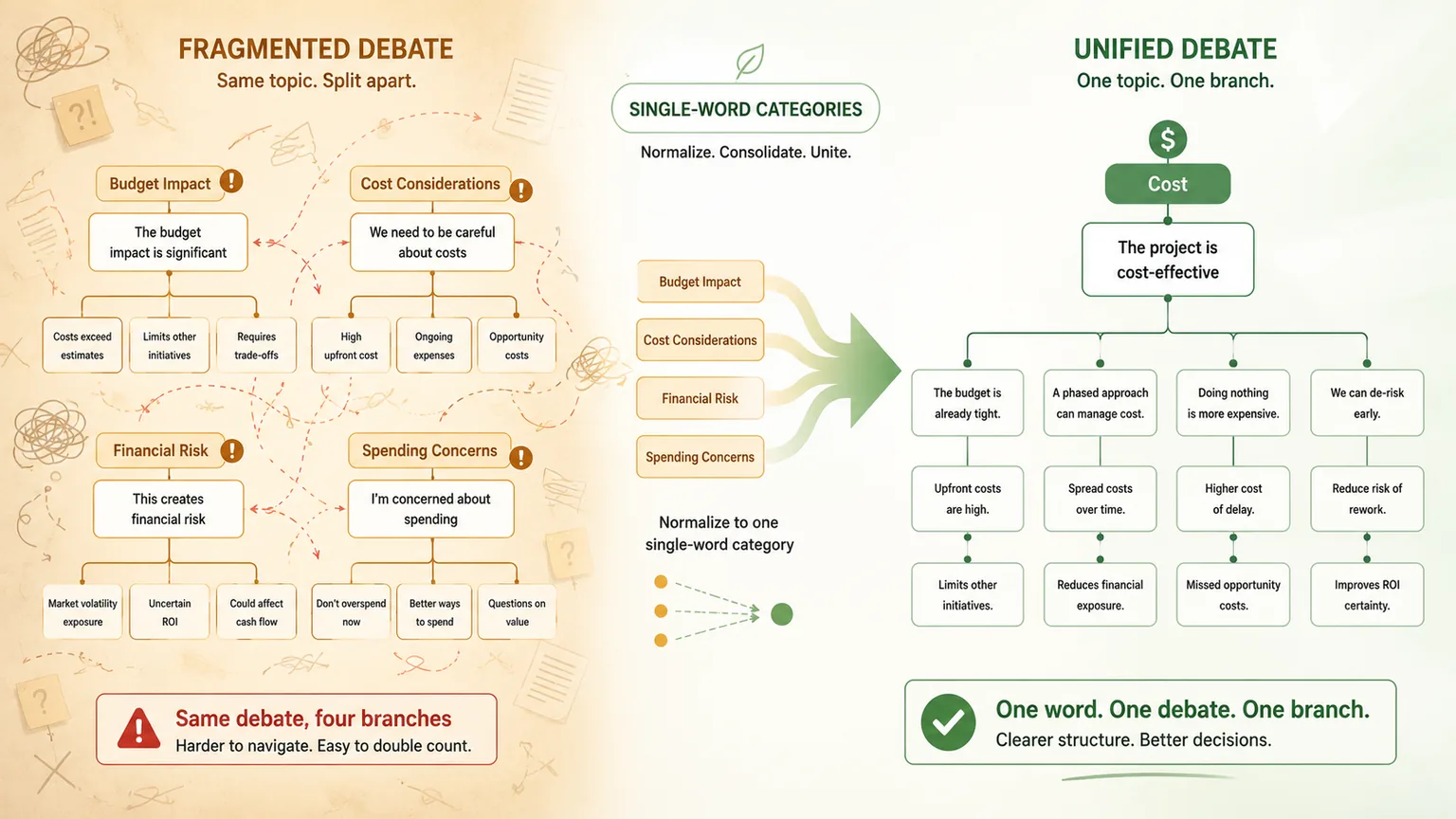
So every extracted argument is tagged with a single-word category — Cost, Risk, Timeline, Legal, Security, Scope. Single word, deliberately. The moment categories become phrases, the same theme fragments into near-duplicates: Budget Impact and Cost Considerations and Financial Risk are one debate wearing three hats, and the tree splits into branches that should have been one.
The constraint is enforced rather than requested. Categories are normalised to a single canonical form, and a category is a property of the top of a branch — everything beneath a main claim inherits that main claim's category. A cost argument does not acquire a child in the Risk category; if the child is genuinely about risk, it belongs under the Risk main claim instead.
One Main Argument Per Category
Within each category, exactly one argument is promoted to be the main claim — the central position that everything else in that category supports or attacks. Everything else in the category becomes a child of it, directly or indirectly.
This is the single most consequential choice in the whole process. Get it right and the branch reads like an argument: here is the position on cost, here are three reasons for it, here is the objection to the second reason. Get it wrong and you get the inversion from the top of this article — a statistic sitting at the top of a branch with the claim it was supposed to support dangling underneath it as though it were a detail.
The obvious approach does not work
The intuitive answer is to promote whichever argument the model was most confident about. This fails, for a reason worth understanding.
Confidence measures how certain the extraction was that it found a real argument. It does not measure how central that argument is to the debate. A crisply worded statistic with a named source is an easy, high-confidence extraction. A vague, hedged sentence that happens to be the actual thesis is a hard, low-confidence one. Ranking by confidence systematically promotes the evidence and demotes the claim.
There is a second problem underneath the first. Work by Saurav Kadavath and colleagues at Anthropic found that language models' verbalized confidence is better calibrated than raw token probabilities — but subsequent evaluation has repeatedly shown it is still not well calibrated in absolute terms. It is a usable signal. It is not a reliable ranking.
What Actually Picks the Main Claim
Instead of one signal, several are combined — and the strongest of them is structural rather than linguistic.
- Centrality. How many other arguments attach to this one? The claim that everything else responds to is almost always the central claim. This is the closest thing to a reliable signal, because it is a property of the argument's position in the debate rather than of its wording.
- Abstractness. Main claims are general; evidence is specific. This one is directly Toulmin: in his 1958 account, the claim is the conclusion and the grounds are the concrete facts underneath it.
- Argumentative language. Discourse markers — therefore, the key issue is, I would argue — signal that a speaker is stating a position rather than supplying a detail.
- Brevity. Central claims tend to be short. A long sentence is usually carrying qualifications, which is what supporting material does.
- Position. A weak signal, but a real one: theses tend to appear early.
Abstractness is measured by looking for the fingerprints of specificity. A percentage, a currency amount, a quantified entity, a citation phrase, a named institution — each one makes an argument less likely to be the main claim, because each is a hallmark of grounds rather than of a conclusion. Remote work improves productivity is a claim. A survey of 500 workers showed 78% satisfaction is what you say when someone asks you why.
Combining several weak signals beats trusting one strong-looking one — which is the same reason a group with diverse perspectives outperforms a confident individual, a pattern explored in why diversity beats ability.
Try this on your own last meeting
Take the last decision your team made. Can you name the single strongest argument against it — and can you name who made it? If you can't, that is not a memory problem. It is a structure problem: your record captured what was decided but not what was argued, which is exactly the gap extraction is trying to close.
Nothing Survives That Isn't In The Source
An argument that sounds plausible but was never actually made is worse than a missing one — it is a false record of what your team said. So every extracted argument carries the exact wording it came from, and any argument whose quoted evidence cannot be located in the source document is removed before the tree is shown to anyone.
This is unglamorous and it is the part that makes the rest usable. A tree you cannot trace back to the transcript is a summary with extra steps.
But Isn't This Just Summarisation With Extra Steps?
It is the obvious objection, and the answer is in what each one throws away.
A summary compresses. It tells you roughly what the meeting covered and, if it is good, what was decided. What it cannot preserve is the shape of the disagreement — that this specific objection was raised against that specific reason, that it was answered, and that a second objection never was. Summaries lose precisely the part that matters when the decision is revisited eight months later and nobody can remember why the obvious alternative was rejected.
The distinction also separates argument mining from sentiment analysis, which measures attitude rather than reasoning. A sentence can be phrased negatively while supporting the point it is attached to — "timeline pressure adds to the risk" strengthens a claim that the project is risky. Score that by tone and you get it backwards every time.
The Output Is A Draft, And That Is The Point
What comes out of extraction is a proposal: here is what we think was argued, here is how we think it fits together. People then correct it — re-parent an argument that was attached to the wrong claim, split one that merged two points, promote something the scoring got wrong, and rate what they find convincing.
That division is deliberate. Building the structure by hand is tedious work that stops teams from doing it at all. Judging whether an argument is any good — whether the evidence holds, whether the unstated assumption is acceptable — is not tedious. It is the actual thinking, and it stays with the group.
What This Means If You're Reading Your Own Meeting Records
- The quotable line is usually not the claim. Precise, well-sourced sentences are typically evidence. The claim they support is often vaguer and easier to overlook.
- Count what attaches to what. The point everyone else responded to is the point that mattered, regardless of who said it most confidently.
- Name the categories. If you cannot say which two or three themes a decision was about, the discussion has not been structured — it has been transcribed.
- Look for the objection nobody answered. It is the most useful thing in any argument record, and the first thing a flat summary destroys.
The Vague Sentence Was The Argument
The statistic was never the point. It was the answer to a question somebody asked about a claim that had already been made — loosely, early, and in the kind of sentence that never makes it into the minutes.
Structuring a discussion means putting that sentence back at the top of the branch where it belongs, with its evidence underneath it and its objections attached to the specific reasons they dispute. That is what a tree is for. And it is why the most confident answer is so often the wrong one.
The argument mining series
This post covers how we apply argument mining. The rest of the series covers where the field came from and why its hard problems are hard.
How a 1958 philosophy book that logicians rejected became the specification for a machine-learning task.
The decade of hand-annotated corpora that turned argument mining from an idea into a measurable task.
Disagreement is rare in the data and depends on context the sentence doesn't contain.
Zero-shot models removed the corpus bottleneck and left the structural problems exactly where they were.
Sources & Further Reading
The standard survey of the field — task definitions, methods, and the open problems.
The annotated corpus that made argument mining a measurable task, and the source of the component/relation F1 figures cited here.
The claim/grounds/warrant model — the source of the principle that claims are general and grounds are specific.
The CDCP corpus, on which relation detection scores around 34% F1 — the harder end of the published range.
On verbalized model confidence — better than raw probabilities, still not a reliable ranking signal.
Frequently Asked Questions
How does Argumentree turn a transcript into an argument tree?
It applies argument mining: finding the spans of text that carry claims or reasons, labelling what each one is, working out which reason attaches to which claim, and deciding whether each link supports or attacks the point above it. The result is a pro and con tree that people then review and correct.
What are argument categories and why single words?
Categories group a discussion into its separate debates — Cost, Risk, Timeline, Legal. They are restricted to single words because phrase-length categories fragment: Budget Impact, Cost Considerations and Financial Risk are one debate wearing three hats, and the tree splits into branches that should have been one.
What does one main argument per category mean?
Within each category, exactly one argument is promoted to be the central claim, and everything else in that category attaches beneath it. This is what makes a branch readable as an argument — a position, the reasons for it, and the objections to those reasons — rather than a flat list of related sentences.
Why isn't the main argument just the one with the highest confidence?
Because confidence measures how certain the extraction was, not how central the argument is. A crisply worded statistic is an easy, high-confidence extraction; the vague sentence that is the actual thesis is a hard one. Ranking by confidence systematically promotes evidence and demotes claims.
How is this different from meeting summarisation?
A summary compresses and tells you what was covered. It cannot preserve the shape of the disagreement — that this objection was raised against that reason, that it was answered, and that another was not. Summaries lose exactly the part that matters when a decision is revisited later.
What stops the AI from inventing arguments nobody made?
Every extracted argument carries the exact wording it came from, and any argument whose quoted evidence cannot be located in the source document is removed before the tree is displayed. An argument that sounds plausible but was never made is worse than a missing one.
Can I change what the extraction produced?
Yes — that is the intended workflow. The output is a draft. People re-parent arguments attached to the wrong claim, split merged points, promote something the scoring got wrong, and rate what they find convincing. The machine builds the structure; the group keeps the judgement.
Argumentree Team
Decision Science
The Argumentree team explores the science of better decisions—from ancient philosophy to modern AI.
See it on your own transcript
Paste a meeting transcript and get a structured pro and con tree you can correct, rate and build on.
Turn your next meeting into an argument tree
Structure the reasoning, not just the record — so the objection nobody answered is still visible in six months.
Start free