
From Toulmin to Transformers: How Argument Mining Became a Technology | Argumentree
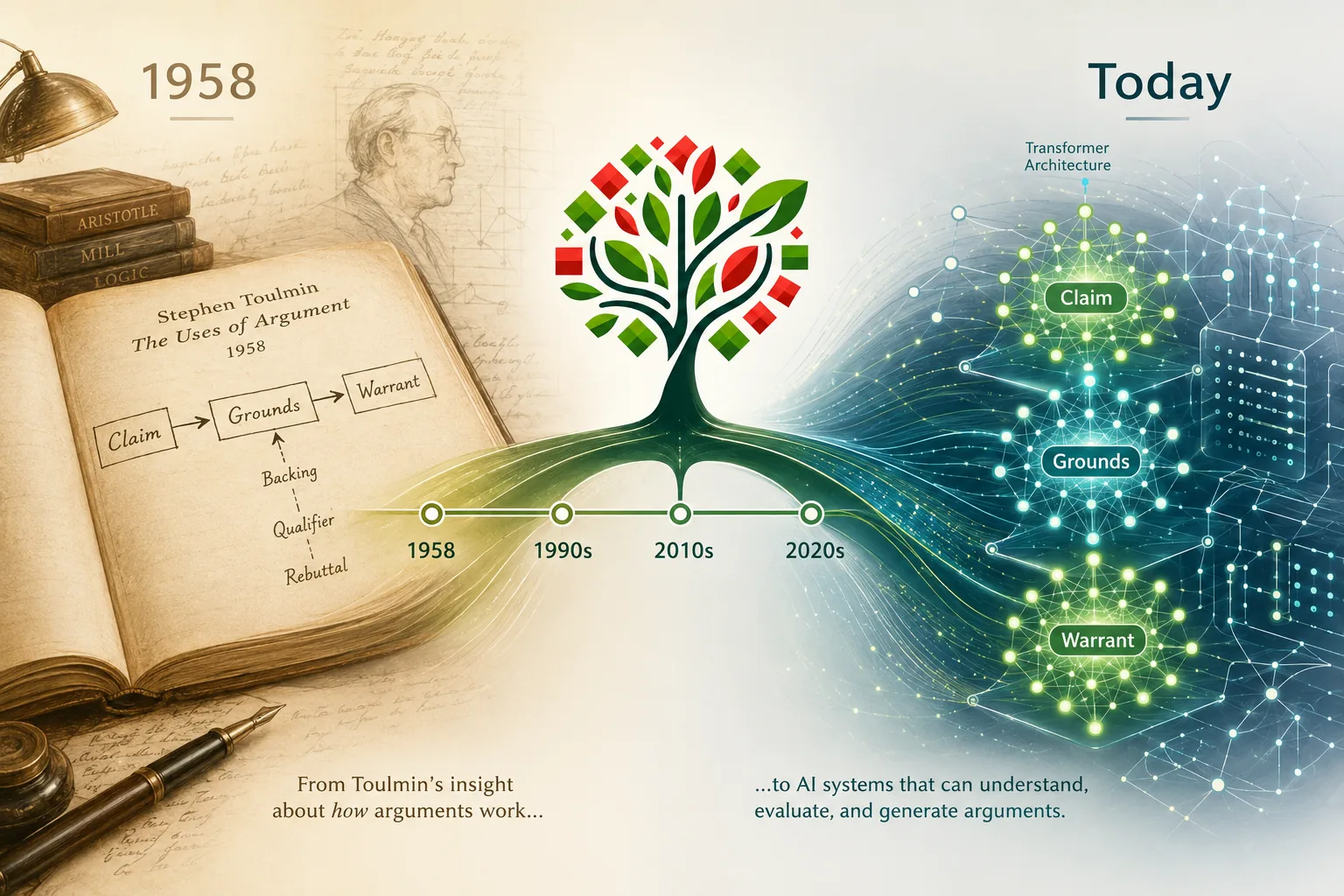
Argument mining is the field of AI that automatically identifies claims, the reasons given for them, and whether each reason supports or attacks what it is attached to. Its foundations are philosophical rather than computational. In 1958 Stephen Toulmin published The Uses of Argument, which broke with formal logic by describing how everyday arguments are actually built — claim, grounds, warrant, backing, qualifier, rebuttal. Formal logicians largely rejected it; the book found its audience instead among scholars of rhetoric and communication, and its vocabulary is still the vocabulary of the field. Douglas Walton later catalogued the recurring patterns of everyday reasoning as argumentation schemes, each with critical questions that expose where it fails. James Freeman distinguished attacking a conclusion from attacking the inference leading to it. Argument mining became a measurable computational task only in the 2010s, when annotated corpora appeared — Christian Stab and Iryna Gurevych's persuasive essays, Andreas Peldszus and Manfred Stede's argumentative microtexts. Neural models followed, and large language models removed the requirement for a hand-annotated corpus in each new domain. What has not changed is which half is hard: finding claims is largely solved, and deciding what attaches to what, and whether it supports or attacks, is not.
A philosophy book that logicians dismissed in 1958 turned out to be the specification for a machine-learning task nobody would attempt for another fifty years.
- Toulmin's 1958 model — claim, grounds, warrant — was rejected by formal logicians and became the working vocabulary of argument mining anyway.
- Walton catalogued how people actually argue, and attached critical questions to each pattern that show where it breaks.
- The field became measurable in the 2010s, when annotated corpora let competing systems be compared on the same texts.
- Large language models removed the corpus bottleneck — you no longer need thousands of hand-annotated examples per domain.
- The hard half never moved. Finding claims is largely solved; deciding what attacks what is not.
The Book That Was Supposed to End a Career
When Stephen Toulmin published The Uses of Argument in 1958, the reception from professional logicians was hostile. He had written a book about reasoning that declined to be about formal logic, and he was told, in effect, that he had wandered off the map. Toulmin later recounted that a colleague took to calling it his anti-logic book.
It did not end his career. What it did was find a completely different audience. Departments of rhetoric and communication — especially in the United States — picked the book up and built curricula on it, because Toulmin had done something formal logic had never bothered to do. He had described what an argument looks like when a real person makes one.
Sixty-odd years later, if you ask a machine to read a meeting transcript and tell you what was argued, it will use Toulmin's vocabulary to answer. That is the story of this series, and this post is the arc of it: how a philosophy book that logicians rejected became the specification for a machine-learning task.
What Toulmin Actually Changed
Formal logic is concerned with validity: given these premises, does this conclusion follow? It is a superb tool and it describes almost nothing people actually say. Nobody argues in syllogisms.
Toulmin's move was to ask a different question — not is this valid but how is this built. He broke a real argument into six parts, and three of them do the heavy lifting:
- Claim — the position being advanced. What you are actually asking someone to accept.
- Grounds — the facts offered in support. The evidence, the data, the example.
- Warrant — the principle that licenses the move from grounds to claim. Almost never stated aloud.
The warrant is the interesting one, and it is the reason argument mining is hard rather than tedious. The bridge is structurally unsound, so we should close it contains a hidden premise: that unsound structures should be closed. Nobody says that sentence. Everybody assumes it. A machine reading the text has to reconstruct a step that is not in the text.
The other three parts — backing, qualifier, rebuttal — handle the hedging and the exceptions. Together they describe an argument as a structure rather than a chain, and that structural view is what made the whole thing computable later.
Walton and the Question That Breaks the Argument
If Toulmin gave the field its anatomy, Douglas Walton gave it a field guide. Working through the 1990s and 2000s, Walton catalogued the recurring patterns of everyday reasoning — appeal to expert opinion, argument from analogy, argument from consequences, argument from sign — as argumentation schemes.
The catalogue is useful. What makes it powerful is the second half: each scheme comes with critical questions, the specific challenges that expose where that pattern fails. For appeal to expert opinion: is this person actually an expert in this field? Are other experts in agreement? Is the claim consistent with the evidence?
This is the single most useful thing in the whole tradition for anyone sitting in a meeting, and it costs nothing to apply. When someone argues from authority, you do not have to disagree with the conclusion. You ask the critical question that the pattern itself invites. It is not aggressive; it is what the argument is asking for.
Freeman and the Distinction That Made It Computable
James Freeman's 1991 work on argument macrostructure added the piece that mattered most for machines. He drew a hard line between two things people casually call disagreement.
You can attack a conclusion — argue that it is false. Or you can attack the inference — accept every fact offered and deny that the conclusion follows from them. Your study is flawed and your study is fine but it doesn't show what you think it shows are entirely different moves, and treating them as one loses most of the information in a real disagreement.
Freeman also separated premises that only work together from premises that each stand alone — the difference between an argument that collapses if you remove one leg and one that merely gets weaker. Once you have those distinctions, an argument is no longer prose. It is a labelled graph, and a labelled graph is something a computer can be scored on.
Then Nothing Happened for Twenty Years
The theory was in place by the early 1990s. The computational field did not arrive until the 2010s, and the reason is unglamorous: there was nothing to measure against.
A research field becomes a research field when competing approaches can be compared on the same data. That required someone to sit down with thousands of documents and mark, by hand, which spans were claims, which were premises, and which supported or attacked which. Christian Stab and Iryna Gurevych did it for persuasive essays. Andreas Peldszus and Manfred Stede built a corpus of short argumentative texts specifically to study structure.
That work is covered properly in the next post in this series. What matters here is the shape it revealed. Once you can score systems, you can see which parts are hard — and the answer was immediate and has never really changed.
The question to ask in your next meeting
When someone next argues from authority — a consultant, a benchmark, a named study — don't challenge the conclusion. Ask Walton's question instead: is this an expert in this specific thing, and do other experts agree? Notice how often nobody has checked.
Finding Claims Is Easy. Everything After That Isn't.
Published benchmarks tell a consistent story. On the persuasive-essay corpus, identifying and labelling the argumentative components reaches roughly 73% F1. Deciding how those components relate to each other — what attaches to what, and whether it supports or attacks — sits near 48%. On the CDCP corpus of public-comment data built by Joonsuk Park and Claire Cardie, relation detection drops to around 34%.
That gap is the field. It is not an artefact of weak models, and it has survived every architecture change since. Detection improved steadily. Relations barely moved.
The reasons are structural rather than technical, and they are the subject of the third post in this series: disagreement is rare in the data, it depends on context the sentence does not contain, and the connective step is usually unstated — Toulmin's warrant, still missing, sixty years later.
But Isn't This Just Natural Language Processing?
It uses the same machinery, so the objection is fair. The difference is in what is being recovered.
Sentiment analysis asks how a text feels. Summarisation asks what it says. Named-entity recognition asks who and what appear in it. All three are about content. Argument mining asks about structure — which sentence is doing argumentative work on which other sentence, and in which direction.
That distinction has a practical edge. A sentence can be phrased negatively while supporting the claim it is attached to: timeline pressure adds to the risk strengthens an argument that the project is risky. Any system scoring by tone gets that backwards, every time. The information argument mining recovers is not in the words. It is in the relations between them.
What Large Models Changed, and What They Didn't
The most recent chapter is the one everyone knows. General-purpose language models can perform argument-mining tasks without being trained on an annotated corpus first, which removes the single biggest practical barrier the field ever had: needing thousands of hand-labelled examples for every new domain.
That is a genuine discontinuity, and it is what made argument mining usable on ordinary business text rather than only on curated essay corpora. It is covered in the fourth post.
What it did not do is close the gap. The structural problems are still structural. A model that has read the entire internet still has to decide whether this objection was aimed at that reason or at the conclusion behind it, and the text still does not say.
What Sixty Years of This Suggests About Your Own Arguments
- The warrant is where the disagreement usually lives. Two people who agree on every fact and still disagree are disputing an unstated principle. Name it and the conversation gets shorter.
- Attacking the inference is not the same as attacking the facts. Deciding which one you are doing — out loud — saves the other person from defending the wrong thing.
- Every appeal to authority comes with its own test question. Walton wrote them down. Using them is not hostility; it is the pattern working as intended.
- Structure is what survives. Six months later nobody remembers the wording. What they need is which objection was raised and whether anyone answered it.
The Anti-Logic Book
Toulmin's critics were right about one thing: The Uses of Argument really was not a book about formal logic. It was a book about how people reason when the stakes are real and the premises are contestable and nobody has time for a syllogism.
That turned out to be the harder problem and the more useful one. Every system that reads a transcript today and tells you what was claimed, on what grounds, and what argued against it is working from his description. Not bad for an anti-logic book.
The argument mining series
Five posts on how machines learned to read arguments — where the field came from, why its hard problems are hard, and how we apply it.
The decade of hand-annotated corpora that turned argument mining from an idea into a measurable task.
Disagreement is rare in the data and depends on context the sentence doesn't contain.
Zero-shot models removed the corpus bottleneck and left the structural problems exactly where they were.
Applying it: argument categories, one main claim per category, and why confidence is the wrong ranking signal.
Sources & Further Reading
The claim/grounds/warrant model — the vocabulary the entire field still uses.
The catalogue of recurring reasoning patterns and the critical questions that test each one.
Attacking a conclusion versus attacking the inference to it — the distinction that made argument structure computable.
The standard survey of the computational field, its task definitions and its open problems.
The annotated corpus that made argument mining measurable, and the source of the component and relation F1 figures cited here.
The CDCP corpus, where relation detection sits around 34% F1.
Frequently Asked Questions
What is argument mining?
Argument mining is the branch of AI that automatically identifies the argumentative structure inside ordinary text: which sentences make claims, which give reasons, and whether each reason supports or attacks the claim it is attached to. The output is a structured map rather than a summary.
Who founded argument mining?
There is no single founder. The theoretical groundwork is Stephen Toulmin's 1958 model of argument structure, extended by Douglas Walton's argumentation schemes and James Freeman's account of argument macrostructure. The computational field took shape in the 2010s once annotated corpora made it measurable.
Why was Toulmin's book controversial?
Because it was a book about reasoning that declined to be about formal logic. Toulmin argued that validity is the wrong question for everyday argument, and described structure instead. Professional logicians largely rejected it; rhetoric and communication scholars adopted it and built curricula on it.
What is a warrant in the Toulmin model?
The warrant is the principle that licenses moving from your grounds to your claim. In "the bridge is unsound, so we should close it", the warrant is that unsound structures should be closed. Warrants are almost never stated aloud, which is precisely why extracting arguments automatically is hard.
What are Walton's argumentation schemes?
Recurring patterns of everyday reasoning — appeal to expert opinion, argument from analogy, argument from consequences — each paired with critical questions that expose where that pattern fails. The critical questions are the practically useful half: they give you a way to test an argument without simply denying its conclusion.
Why is relation detection harder than finding claims?
Because relations depend on context the sentence does not contain, the connecting step is usually unstated, and disagreement is rare in the annotated data. Published benchmarks show component detection around 73% F1 against relation detection near 48% on the same corpus, and around 34% on harder ones.
Did large language models solve argument mining?
They removed the biggest practical barrier — the need for a hand-annotated corpus in every new domain — which made the technology usable on ordinary business text. They did not close the structural gap. Deciding what attaches to what, and in which direction, remains the hard part.
Argumentree Team
Decision Science
The Argumentree team explores the science of better decisions—from ancient philosophy to modern AI.
See the theory applied
Paste a transcript and get a structured pro and con tree — claims, the reasons for them, and what argues against them.
The reference page for the field — tasks, history, and why relations are the hard part.
The six-part anatomy of an everyday argument, in detail.
Before Toulmin: how India, China and Greece each invented structured argumentation.
Turn a discussion into an argument tree
Sixty years of argumentation theory, applied to your next meeting transcript.
Start free