
What is collaborative decision making? Collaborative decision making is a structured process in which a group reaches a decision together by surfacing options, contributing arguments and evidence, evaluating them openly, and converging on a choice that reflects the group's collective reasoning rather than one person's authority.
The history of collaborative decision making spans from the Condorcet Jury Theorem (1785) through Francis Galton's wisdom of crowds experiment (1906), Stephen Toulmin's argument model (1958), Chaïm Perelman's New Rhetoric (1958), the RAND Delphi method (1950s), Irving Janis's groupthink research (1972), Douglas Walton's Argumentation Schemes (2008), James B. Freeman's Argument Structure theory (2011), to Google's Project Aristotle (2012-2015) which found psychological safety is the #1 predictor of team effectiveness. Toulmin's Claim-Data-Warrant-Backing-Qualifier-Rebuttal model provides the theoretical foundation for argument mapping. Walton's 96 argumentation schemes provide the vocabulary for classifying pro/con/support/attack relations. Freeman's linked-convergent distinction and macrostructure diagrams inform argument tree visualization. Christian Stab and Iryna Gurevych's computational argument mining research (2014, TU Darmstadt) enables AI to automatically extract claims, premises, and argumentative relations from text — the technology behind Argumentree's AI extraction feature. The process follows a divergent-convergent model: first opening up possibilities (framing, generating alternatives), then driving to closure (evaluating, converging, recording). Key scientific foundations include Surowiecki's four conditions for crowd wisdom (diversity, independence, decentralization, aggregation), Amy Edmondson's psychological safety research, Kahneman's System 1/System 2 thinking, and Thaler's behavioral economics. Common failure modes are groupthink, the Abilene Paradox, the hidden-profile problem, cognitive biases like anchoring and confirmation bias, and reasoning that evaporates after meetings. Modern collaborative decision making must address remote/hybrid teams (52% of knowledge workers per Gallup 2024), asynchronous participation across time zones, and AI-augmented decision support. Gartner names Decision Intelligence a transformational technology in its 2025 AI Hype Cycle. Argumentree supports collaborative decision making with structured pro/con argument trees, a four-step chain for questions/compromises/reviews, multi-dimensional rating aggregated into consensus scores, real-time and async participation, role-based access controls, AI extraction from meeting transcripts, a full audit trail, and translation across 66 languages.

What Is Collaborative Decision Making?
Collaborative decision making is how a group decides together — surfacing every argument, weighing it openly, and converging on a choice that reflects the group's collective reasoning, not a single person's authority. This guide covers 240 years of research: from the Condorcet Jury Theorem (1785) to AI-augmented teams (2026).
Last updated: 2026-07-02
TL;DR
In collaborative decision making, the people affected by a decision contribute to it. Everyone puts forward arguments for and against, the group evaluates them on their merits, and the outcome is shaped by the strongest reasoning rather than the loudest voice. Done well, it produces decisions with more buy-in, fewer blind spots, and a clear record of why the call was made. Google's Project Aristotle found that the environment enabling this — psychological safety — is the #1 predictor of team effectiveness.
A Brief History of Collaborative Decision Making
The science of group decisions spans centuries. Understanding this history shows why structured tools matter.
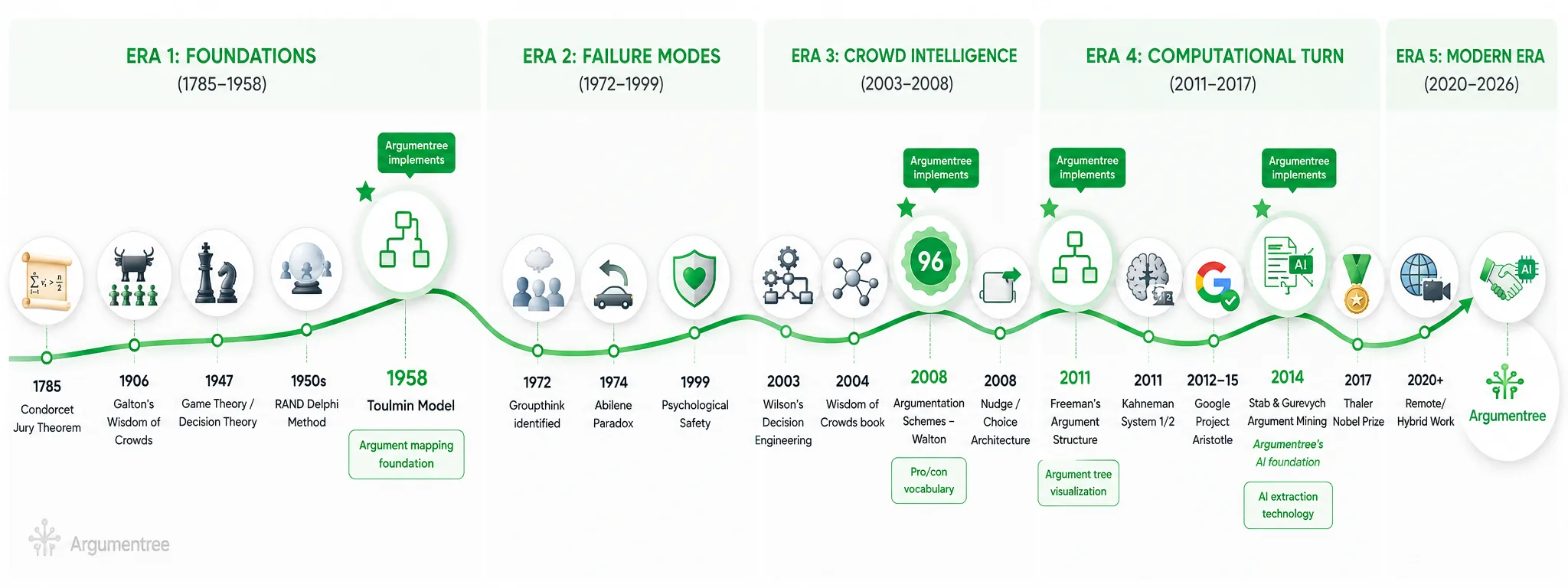
Marquis de Condorcet proves mathematically that if each person is even slightly better than a coin flip, a majority's odds of being right climb toward certainty as the group grows — provided members decide independently.
Francis Galton studies a "guess the ox's weight" contest. The median of 787 guesses (1,207 lb) was within 1% of the actual weight (1,198 lb) — better than the cattle experts. Published in Nature as the founding example of the wisdom of crowds.
Von Neumann and Morgenstern publish Theory of Games and Economic Behavior, establishing the mathematical foundations of rational choice.
RAND Corporation develops a technique to collect expert opinions anonymously and in rounds — protecting independence from rank and social influence.
Stephen Toulmin publishes <em>The Uses of Argument</em>, introducing the Claim-Data-Warrant-Backing-Qualifier-Rebuttal model. This becomes the theoretical foundation for argument mapping and structured reasoning — the architecture Argumentree implements.
Chaïm Perelman and Lucie Olbrechts-Tyteca publish <em>Traité de l'argumentation: La nouvelle rhétorique</em>, reviving classical rhetoric for modern audiences. They distinguish demonstration (formal proof) from argumentation (reasoning to gain adherence) — validating that real-world decisions require persuasion, not just logic.
Irving Janis coins "groupthink" after studying the Bay of Pigs disaster: when the drive for unanimity overrides realistic appraisal, dissent is self-censored and weak options go unchallenged.
Jerry Harvey describes how groups can agree on what no individual actually prefers — "mismanaged agreement" where everyone assumes the others want something nobody wants.
Amy Edmondson publishes groundbreaking research showing that the best-performing hospital teams reported more errors — because they felt safe to surface them.
Mark Wilson presents the collaborative decision engineering method at PMI: frame → generate alternatives → decide, with divergent and convergent phases.
James Surowiecki codifies the four conditions for crowd wisdom: diversity, independence, decentralization, and aggregation. Remove any one and the crowd gets dumber, not smarter.
Douglas Walton, Chris Reed, and Fabrizio Macagno publish <em>Argumentation Schemes</em> (Cambridge), cataloging 96 stereotypical reasoning patterns with critical questions for each. This provides the theoretical vocabulary for classifying argument types — pro, con, support, attack — that computational tools implement.
Thaler and Sunstein introduce choice architecture: how the presentation of options shapes decisions, without restricting freedom.
James B. Freeman publishes <em>Argument Structure: Representation and Theory</em> (Springer), synthesizing Toulmin's model with dialectical methods. His linked-convergent distinction and macrostructure diagrams inform how argument trees represent support relationships — the visual foundation Argumentree builds on.
Daniel Kahneman's bestseller explains System 1 (fast, intuitive) and System 2 (slow, deliberate) thinking — and why most decisions never reach careful analysis.
Google studies 180 teams and finds psychological safety is the strongest predictor of effectiveness — more than individual talent, team composition, or seniority.
Christian Stab and Iryna Gurevych (TU Darmstadt) publish foundational papers on automatic argument mining — identifying claims, premises, and support/attack relations in text using NLP. Their Argument Annotated Essays Corpus becomes the benchmark dataset. This research enables AI to extract structured arguments from unstructured text — the technology behind Argumentree's AI extraction.
Richard Thaler receives the Nobel Prize in Economics for behavioral economics, validating decades of research on how humans actually make decisions.
COVID-19 forces teams online. Asynchronous decision-making becomes essential. Documentation-first cultures emerge.
AI meeting transcription, LLM-powered devil's advocates, and Decision Intelligence platforms transform how teams collaborate. Gartner names DI a "transformational technology" in its 2025 Hype Cycle.
The Collaborative Decision-Making Process
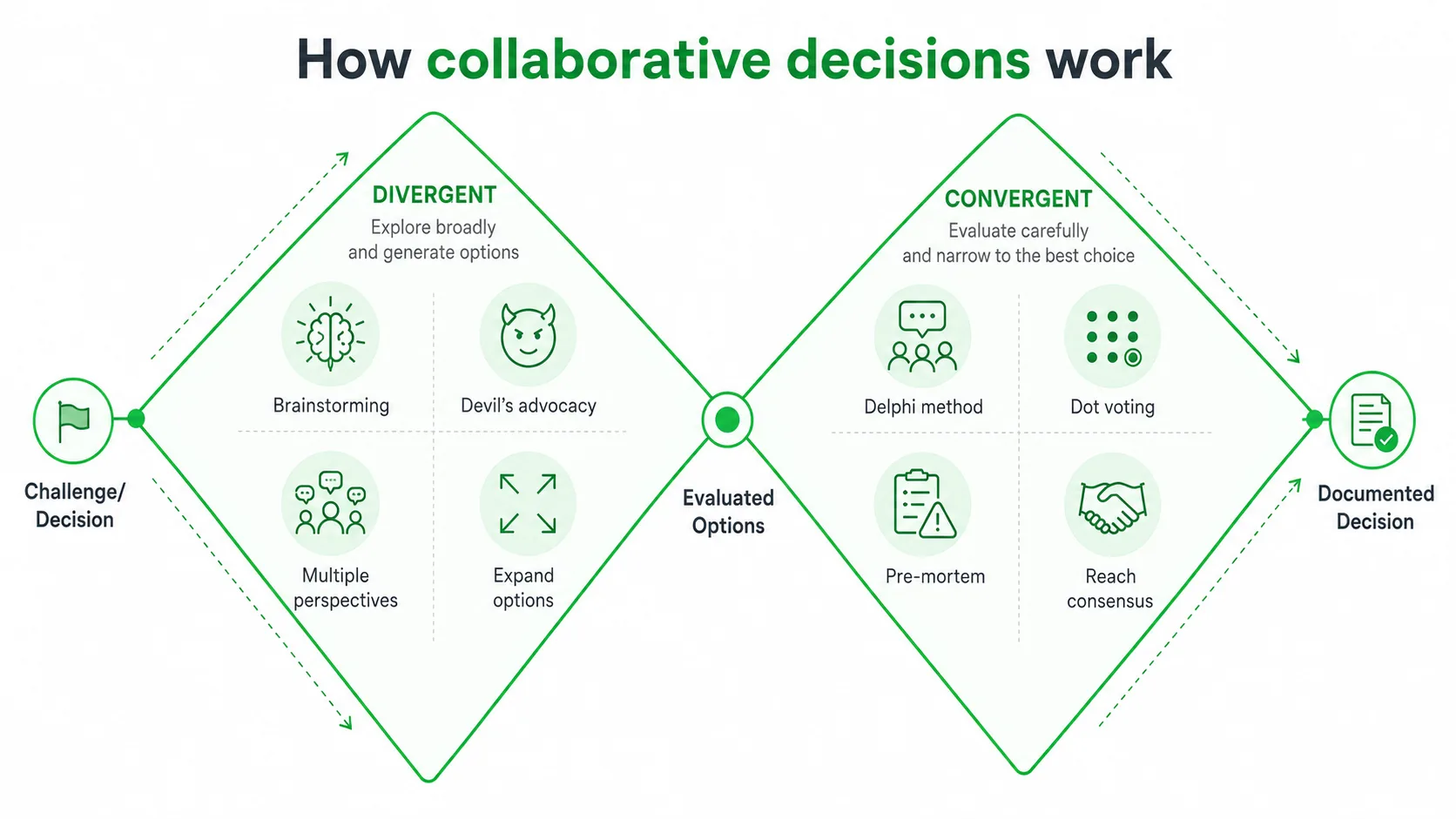
Effective group decisions follow a divergent → convergent model: first opening up possibilities, then driving to closure. This structure, identified by decision researchers since the 1950s, prevents two failure modes: converging too early (missing options) or never converging (endless debate).
First: Diagnose the Decision Context (Cynefin)
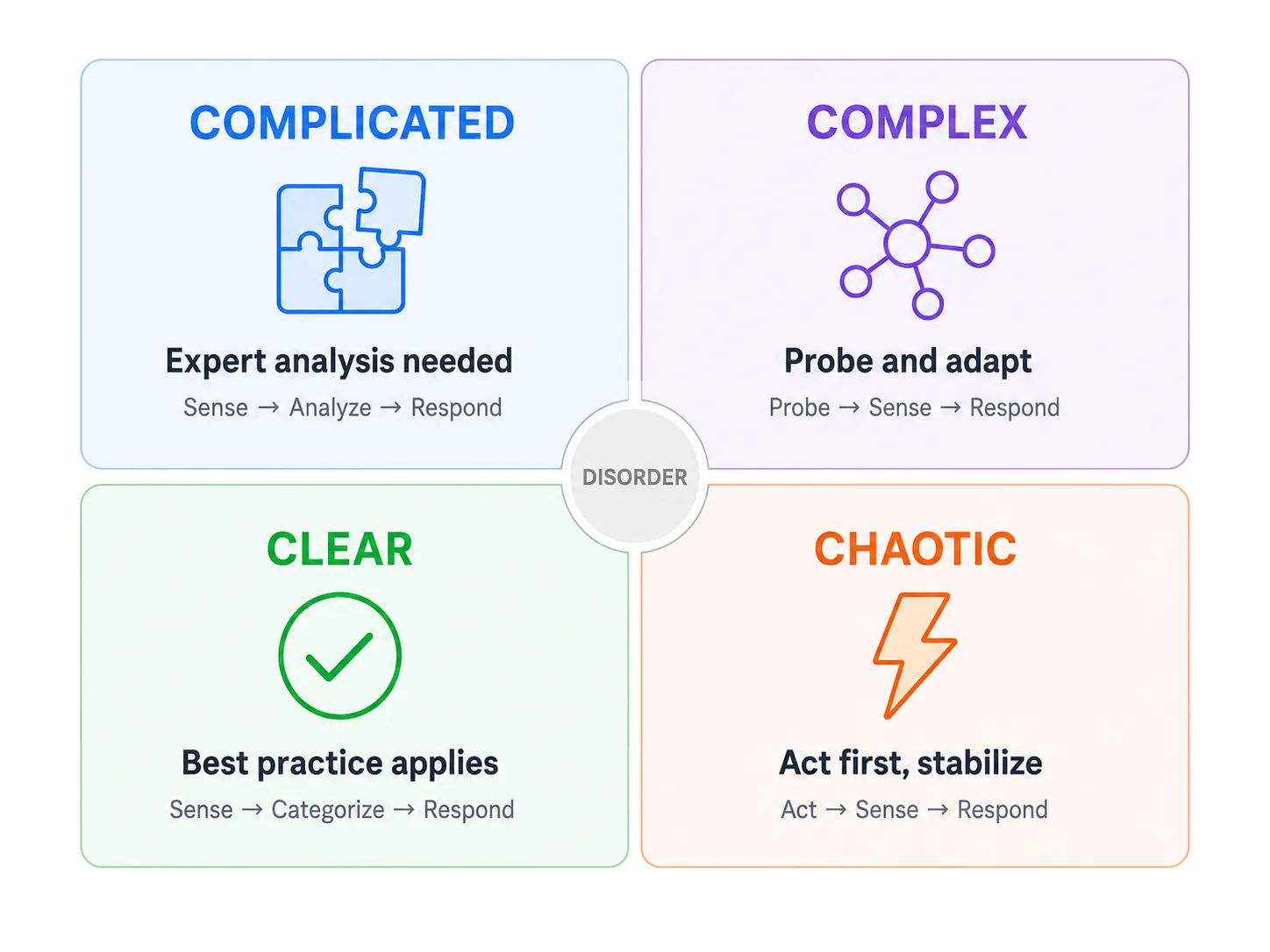
Not every decision deserves the same process. Dave Snowden's Cynefin framework helps teams match their approach to the problem type:
Clear
Cause and effect obvious. Best practice exists. Sense → Categorize → Respond. Don't over-collaborate on routine decisions.
Complicated
Cause and effect discoverable with expertise. Sense → Analyze → Respond. Consult experts, then decide.
Complex
Cause and effect only clear in retrospect. Probe → Sense → Respond. Run experiments, gather feedback, adapt. This is where collaborative divergence adds most value.
Chaotic
No cause and effect discernible. Act → Sense → Respond. Stabilize first, analyze later. A single leader must act; collaboration comes after the crisis.
Most strategic, cross-functional, and innovative decisions are Complex — they benefit from diverse input, structured disagreement, and iterative learning. Routine operational decisions are often Clear — just follow the procedure.
Divergent Phase
Open up possibilities
- 1
Frame the decision
State the question and objectives clearly. Use the "Five Whys" technique to find the root problem — how you define the decision defines the available alternatives. Wilson (2003): "The single most important step is establishing a proper frame."
- 2
Generate alternatives
Create options before evaluating them. Keep idea creation separate from judgment — far more ideas emerge when criticism is deferred. Use brainstorming, scenario planning, or "what would you wish for if anything were possible?" to surface creative possibilities.
Convergent Phase
Drive to closure
- 3
Contribute arguments
Each participant adds reasons for and against — ideally asynchronously and before the group meets, so nobody is anchored by the first or most senior opinion.
- 4
Evaluate openly
The group rates each argument on its merits — helpfulness, clarity, accuracy, completeness — so quality is measured, not assumed.
- 5
Weigh and converge
Use techniques like multi-voting, pairwise comparison, or the decision dominance principle (eliminate options clearly inferior on every criterion). Compare net support against opposition and converge on the option the reasoning best supports.
- 6
Record the reasoning
Capture the decision and the full pro/con trail so it can be explained and revisited months later. A decision without documented reasoning is an unlearnable decision.
Why a Group Can Outsmart Its Smartest Member
In 1906, statistician Francis Galton studied a "guess the weight of the ox" contest at an English country fair. He expected the crowd to be hopeless. Instead, the median of 787 guesses was 1,207 lb — against an actual weight of 1,198 lb, within about 1%, and better than the cattle experts. He published it in Nature as "Vox Populi." It became the founding example of the wisdom of crowds.
The math backs it up: the Condorcet Jury Theorem (1785) proves that if each person is even slightly better than a coin flip, a majority's odds of being right climb toward certainty as the group grows — provided the members decide independently.
James Surowiecki's The Wisdom of Crowds (2004) names the four conditions a group needs to be wise. Remove any one and the crowd gets dumber, not smarter:
Diversity
Each person brings some private information or a different interpretation.
Independence
Opinions aren't dictated by the people around them — the antidote to herding.
Decentralization
People can specialize and draw on their own local knowledge.
Aggregation
A mechanism exists to turn the private judgments into one collective decision.
This is why the Delphi method (RAND, 1950s) collects expert opinions anonymously and in rounds — to protect independence from rank and social influence. Modern collaborative tools serve the same function: capturing independent input before group convergence.
When the Crowd Gets It Wrong
Recent research (2025) shows that collective accuracy can actually decline as groups grow — when individuals share highly correlated information. The wisdom of crowds emerges only when low-correlated individuals form the majority. This explains why:
- Echo chambers destroy crowd wisdom — everyone draws from the same sources
- Opinion leaders can lead groups astray even when they lack expertise in the specific domain
- Diversity of information sources matters more than demographic diversity
The antidote: structure that collects independent input before group discussion, and evaluates arguments on their merits rather than their source.
Theoretical Foundations
Collaborative decision making rests on a body of theory about when and why groups outperform individuals. Three foundations are worth knowing in depth:
Wisdom of Crowds
Why the aggregate of many independent judgments beats most individual experts — from Galton's 1906 experiment to Surowiecki's four conditions, and what breaks when independence is lost.
Collective Intelligence
The measurable science of group smarts: the c factor, why social process predicts performance better than member IQ, and the 2024–2026 turn to human-AI superminds.
Epistemic Diversity
When cognitively diverse teams beat teams of the individually best — the Hong-Page result, its critiques, and the conditions under which diversity genuinely pays.
The Science of Psychologically Safe Teams
In 1999, Harvard professor Amy Edmondson made a counterintuitive discovery: the best-performing hospital teams reported more medication errors, not fewer. Why? They felt safe to surface them. Teams where members hid mistakes learned nothing and repeated them.
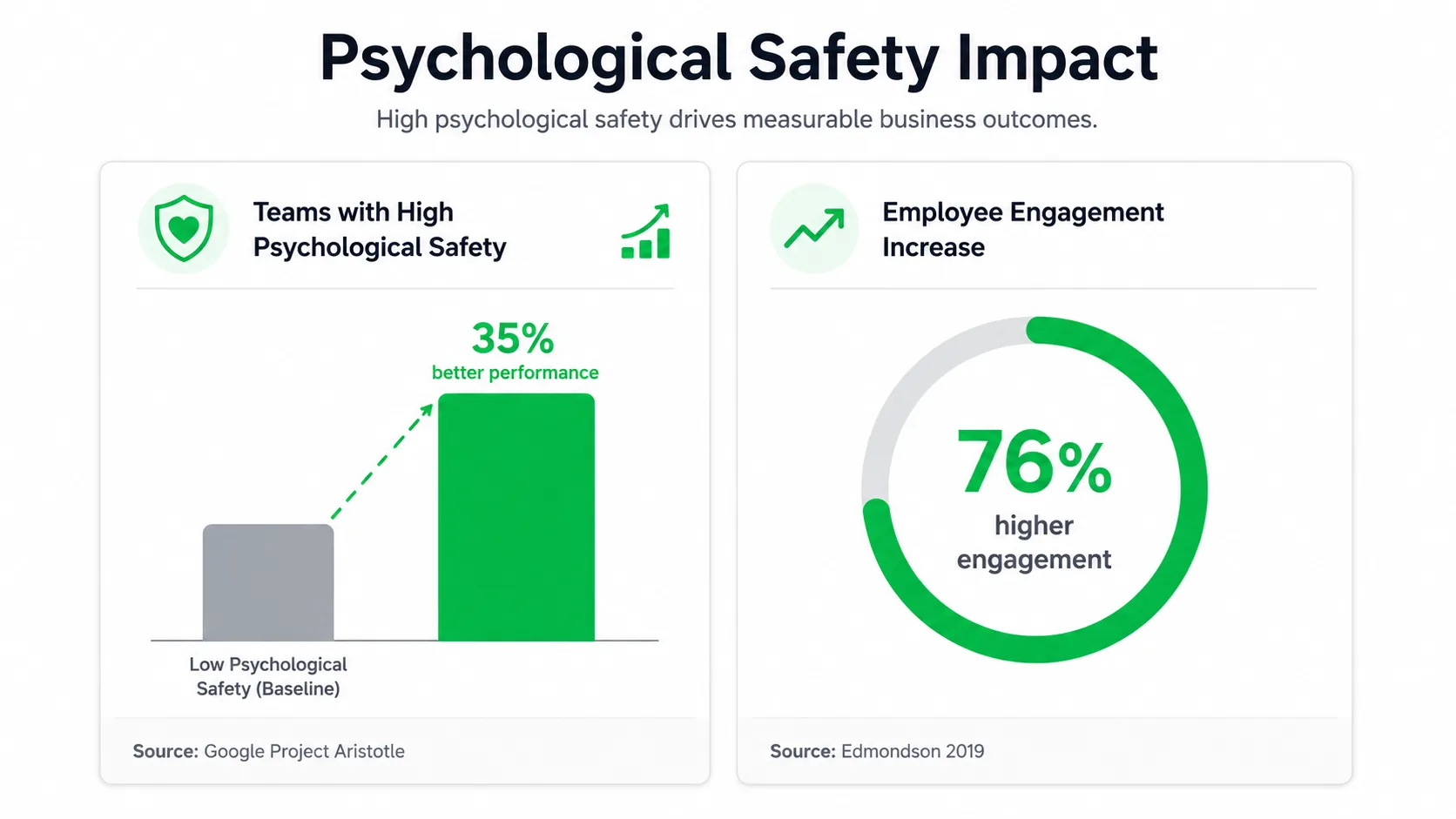
Psychological safety is a shared belief that the team is safe for interpersonal risk-taking — where members can speak up, share ideas, admit mistakes, and challenge the status quo without fear of embarrassment or punishment.
Google's Project Aristotle
Between 2012 and 2015, Google studied 180 teams to discover what makes teams effective. The findings surprised everyone:
Psychological safety was the strongest factor — more important than individual talent, team composition, or seniority.
Psychological safety was correlated with 43% of the variance in team performance.
Teams with high psychological safety were rated as effective twice as often by executives.
Variables that were not significantly correlated with effectiveness: co-location, team size, seniority, consensus-based decision-making, and individual team member performance.
The Five Dynamics of Effective Teams
Psychological safety
Can we take risks without feeling insecure or embarrassed?
Dependability
Can we count on each other to do high-quality work on time?
Structure & clarity
Are goals, roles, and plans clear?
Meaning
Is our work personally important to us?
Impact
Do we believe our work matters?
Psychological safety is the foundation that enables the other four.
What This Means for Collaborative Decisions
- Diversity improves decisions — but only in psychologically safe environments. Without safety to speak, diverse perspectives never enter the conversation.
- Equality in conversational turn-taking and high social sensitivity predict team success.
- Leaders' behavior sets the tone: autocratic behavior, inaccessibility, or failure to acknowledge vulnerability all reduce safety.
Behavioral Economics and Choice Architecture
Traditional economics assumed humans are rational decision-makers ("Econs"). Behavioral economics, pioneered by Kahneman, Tversky, and Thaler, revealed we're actually "Humans" — predictably irrational in systematic ways.
System 1 and System 2 Thinking
Daniel Kahneman's Thinking, Fast and Slow (2011) describes two cognitive systems:
Fast, intuitive, automatic
Operates with little effort, relies on patterns and heuristics, handles ~96% of decisions. Prone to biases: anchoring, availability, loss aversion.
Slow, deliberate, analytical
Requires conscious effort, used for complex reasoning. More reliable but effortful — and "lazy," only engaging when absolutely necessary.
Most group decisions are made by System 1 — people react to who speaks first, how confident they sound, and social cues. Structured argument capture forces System 2 engagement.
Cognitive Biases That Derail Groups
Anchoring
The first number or option mentioned disproportionately influences the final decision.
Confirmation bias
People seek evidence supporting their existing view and discount contradictory evidence.
Availability heuristic
Recent or vivid examples feel more likely — even when they're statistically rare.
Loss aversion
Losses feel roughly twice as painful as equivalent gains feel good — biasing groups toward the status quo.
Status quo bias
The default option wins disproportionately, even when alternatives are objectively better.
Choice Architecture and Nudges
Thaler and Sunstein's Nudge (2008) showed that how options are presented shapes what people choose — without restricting freedom. This is "choice architecture."
- Default options dramatically affect outcomes (opt-in vs. opt-out organ donation)
- Loss framing ("You'll lose $100") is more persuasive than gain framing ("You'll save $100")
- Putting healthy food at eye level increases healthy choices
Collaborative decision tools are a form of choice architecture. Structured argument trees, explicit rating criteria, and visible consensus scores all "nudge" groups toward better reasoning.
Why Group Decisions Go Wrong
Understanding failure modes is essential. These aren't rare — they're the default when groups lack structure.
Groupthink
Irving Janis's term (1972) for when the drive for unanimity overrides realistic appraisal — the failure he traced to the Bay of Pigs invasion. Dissent is self-censored, doubts are suppressed, and weak options go unchallenged.
The Abilene Paradox
Jerry Harvey's 1974 case: a family drives to Abilene for a dinner nobody wanted, each assuming the others did. Groups can agree on what no individual actually prefers — "mismanaged agreement" where silence is mistaken for consent.
The hidden-profile problem
Groups over-discuss what everyone already knows and neglect facts held by just one person — so the answer that only emerges by pooling unshared information stays buried.
Social influence destroying independence
When people start sharing opinions, conversations can produce "groupthink" and destroy crowd wisdom. Penn research: "Opinion leaders were more likely to lead the group astray than to improve it" — even when they had genuine expertise in other areas.
Anchoring on the first speaker
The first opinion expressed disproportionately shapes the final outcome. In meetings, this often means the most senior person — regardless of their expertise on the specific issue.
Arguments never surface
Without psychological safety or structured input, quieter participants don't speak up. Their reasoning — often the most valuable, because it's different — is simply lost.
Reasoning evaporates
Once the meeting ends, nobody remembers why the decision was made. Teams re-litigate settled questions, and new members can't understand past choices.
Collaborative Decisions in Remote and Hybrid Teams
The world of work has changed. 52% of knowledge workers now work hybrid, 26% fully remote (Gallup 2024). Collaborative decision-making must adapt.
The Challenge
- Time zones make synchronous meetings difficult or impossible for global teams
- Video fatigue reduces engagement in long decision meetings
- Informal hallway conversations — where context is often shared — don't happen
- Documentation becomes essential: "If it's not written down, the decision doesn't exist"
Asynchronous Decision-Making
Research shows teams that embrace async decision-making:
Document first
Write the decision context, options, and arguments before scheduling any meeting. Let people contribute on their own time.
Async for input, sync for conflict
Collect independent input asynchronously. Reserve synchronous time only for complex, contentious, or uncertain decisions.
Clear response expectations
Define how quickly team members should respond — this prevents both anxiety and delays.
Transparency over meetings
Shared documents with ongoing arguments beat weekly status meetings. People can contribute during their productive hours.
Hybrid Policy and Team Decision-Making
Gallup found that teams with a formal hybrid collaboration plan are 66% more likely to be engaged and 29% less likely to experience burnout.
Hybrid workers are most engaged when their <em>team</em> works together to determine their hybrid schedules — but only 12% of hybrid employees have this collaborative approach. The most common approach (34%): it's entirely up to the individual, which creates coordination chaos.
AI-Augmented Collaborative Decision Making
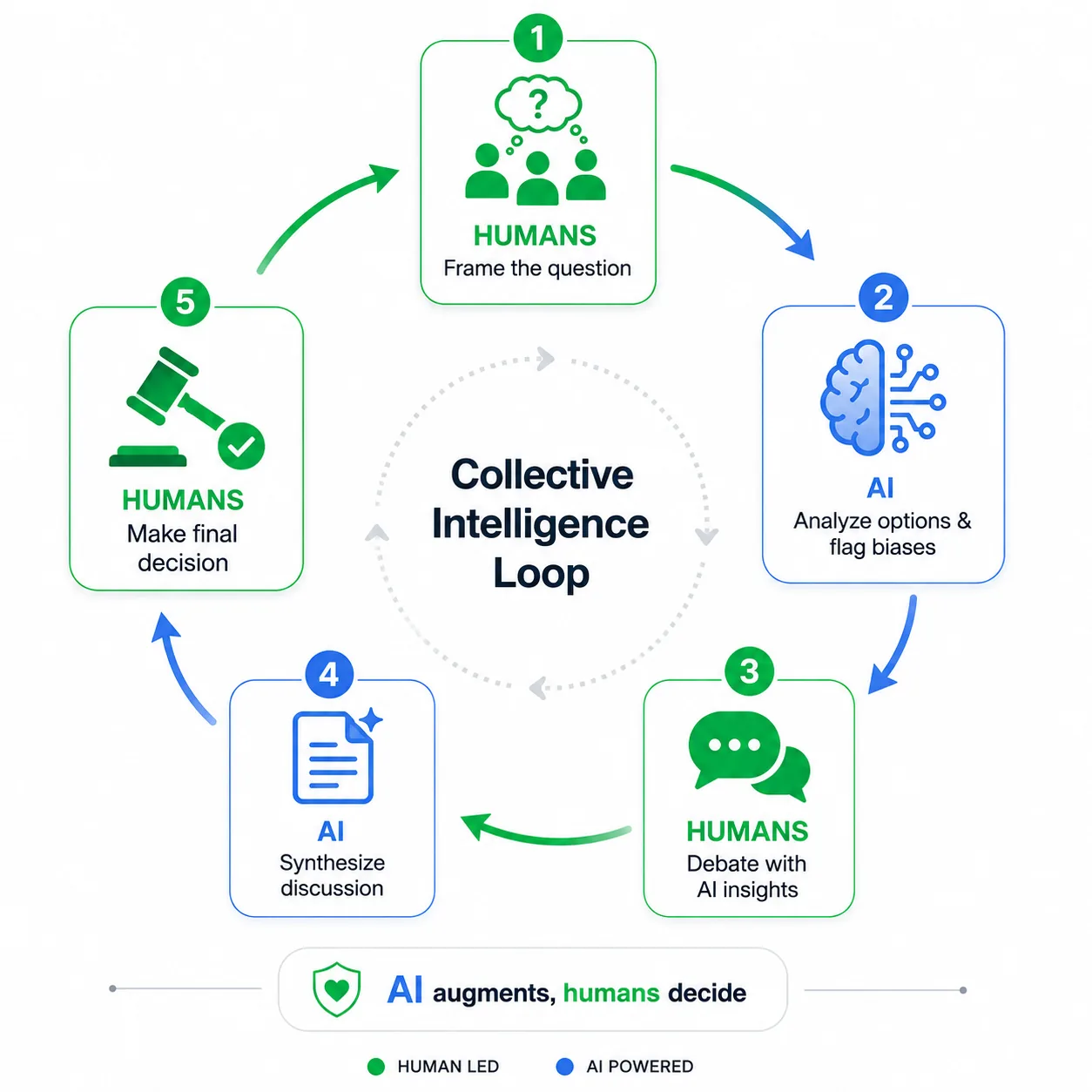
We are in the early stages of a transformation. Gartner names Decision Intelligence a "transformational technology" in its 2025 AI Hype Cycle, with mainstream adoption expected in 2-5 years.
What is Decision Intelligence?
Gartner defines Decision Intelligence as "a practical discipline that advances decision making by explicitly understanding and engineering how decisions are made, and how outcomes are evaluated, managed and improved via feedback." By digitizing and modeling decisions as assets, DI bridges the insight-to-action gap.
How AI Augments Group Decisions
Meeting transcription & decision extraction
AI can transcribe meetings in real-time and automatically extract action items, key decisions, and arguments — reducing administrative overhead by 30+ minutes per meeting in enterprise studies.
AI as Devil's Advocate
Research (ACM 2024) explores LLM-powered Devil's Advocates that challenge group assumptions, helping teams avoid groupthink by surfacing counterarguments humans might suppress.
Human-AI complementary performance
The goal is not AI replacing humans, but combined performance exceeding either alone. Research emphasizes "understanding user behavior and team performance with AI integrated into human teams."
Cross-language collaboration
AI-powered translation lets global teams contribute in their native language while maintaining a shared decision record — essential for the 66% of the world that doesn't speak English.
Why AI Doesn't Replace Human Judgment
AI excels at processing information, finding patterns, and automating documentation. But collaborative decision-making is fundamentally about human buy-in, organizational knowledge, ethical judgment, and accountability. The best AI tools augment human reasoning — they don't bypass it.
When NOT to Use Collaborative Decision Making
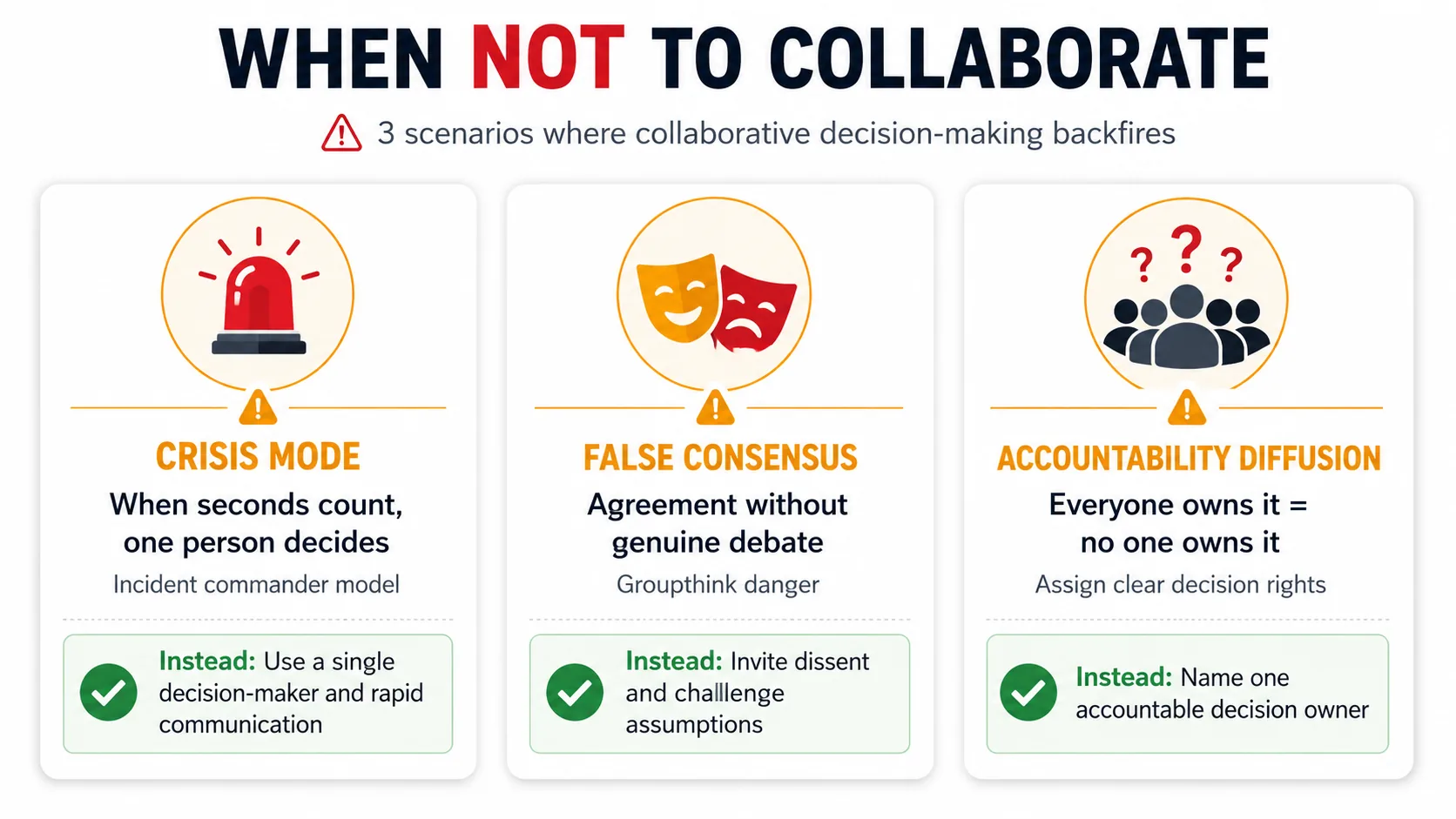
Expertise includes knowing when not to apply a method. Collaboration has costs: time, coordination overhead, and decision fatigue. Use it wisely.
Speed-critical decisions
When bullets are flying — literally or metaphorically — convening a decision meeting will miss the window. The U.S. Marine Corps doctrine: "The intuitive approach is more appropriate for the vast majority of typical tactical decisions."
Clear individual expertise
When one person has unambiguous expertise and others don't, their judgment should carry the decision. Collaboration adds value when perspectives are diverse; it adds noise when they're uninformed.
Accountability must be individual
Some decisions — legal, regulatory, fiduciary — require a single accountable decision-maker. Collaboration can inform, but cannot diffuse responsibility.
Decision-makers aren't affected
If the group isn't affected by the outcome, they won't take the process seriously enough to critically examine options. "Skin in the game" is essential.
The decision is trivial
Not every choice deserves a structured process. Reversible, low-stakes decisions should be made quickly and moved on from.
Collaboration is best when: (a) multiple perspectives add genuine value, (b) buy-in matters for execution — people support what they help shape, (c) the decision is consequential enough to justify the time, and (d) the reasoning needs to be documented for future reference.
Decision Rights: Who Contributes vs. Who Decides
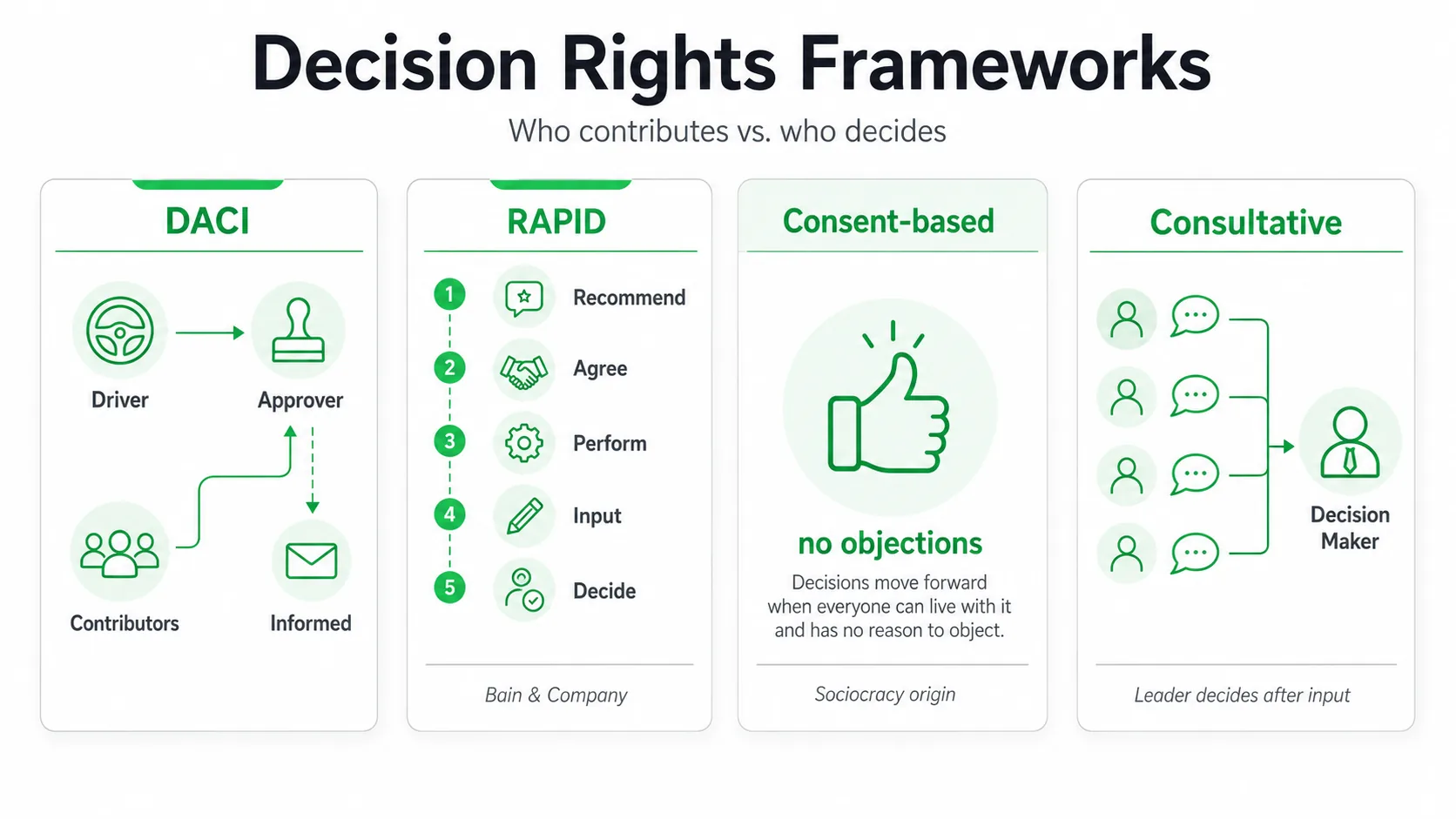
"Collaborative" does not mean "everyone decides." Modern organizations separate input rights (who contributes perspectives) from decision rights (who makes the call). Clarity here prevents both gridlock and exclusion.
DACI
Driver (owns the process), Approver (has veto), Contributors (provide input), Informed (kept in loop). Atlassian's standard for cross-functional decisions.
RAPID
Bain's framework: Recommend, Agree (must sign off), Perform, Input, Decide. Clarifies accountability across stakeholders.
Consent-based
From sociocracy: a decision proceeds when there are no reasoned objections — not full agreement. Faster than consensus, still inclusive.
Consultative
Leader decides after structured input. Contributors shape thinking but don't hold veto. Common for executive decisions with broad impact.
The more irreversible, value-laden, or high-impact the decision, the more transparent and participatory the process should be. But every decision needs a clear owner.
Argumentree enforces this with role-based access: anyone can contribute arguments, but discussion owners control when to close and which resolution to adopt. The audit trail shows who contributed what — accountability without ambiguity.
Techniques for Driving to Consensus
The "convergent phase" is where groups often fail — endless debate without closure, or premature closure that ignores dissent. These techniques help:
Pre-mortem (Gary Klein)
Before deciding, imagine the decision failed spectacularly. Ask: "What went wrong?" This surfaces risks that optimism bias hides and gives permission to voice doubts. Klein's research shows pre-mortems increase ability to identify reasons for future outcomes by 30%.
Red team / Devil's advocate
Assign someone to argue against the emerging consensus — not to win, but to stress-test. Structured dissent prevents groupthink without requiring organic disagreement. Argumentree's AI can generate counterarguments automatically.
Multi-voting
Each person gets N votes (often N = number of options ÷ 3) and distributes them across options. Surfaces group preferences quickly without forcing binary choices.
Nominal Group Technique (NGT)
Silent idea generation → round-robin sharing (no discussion) → clarification → voting. Prevents dominant voices from controlling the early discussion.
Pairwise comparison
Compare each option to every other option in a matrix. Derive weights from the pattern of preferences. Good for small numbers of important options.
Decision dominance principle
If an alternative is clearly inferior to at least one other option on every criterion, eliminate it. "Narrow the competitive range" before detailed evaluation.
Consensus thresholds
Define in advance what level of agreement constitutes "enough" — unanimity, supermajority, majority, or "consent" (no one blocks). Different decisions warrant different thresholds.
Structured rating with aggregation
Each participant rates arguments or options on explicit criteria; ratings aggregate mathematically into scores. Argumentree does this automatically — consensus is measured, not assumed.
How Argumentree Enables Collaborative Decision Making
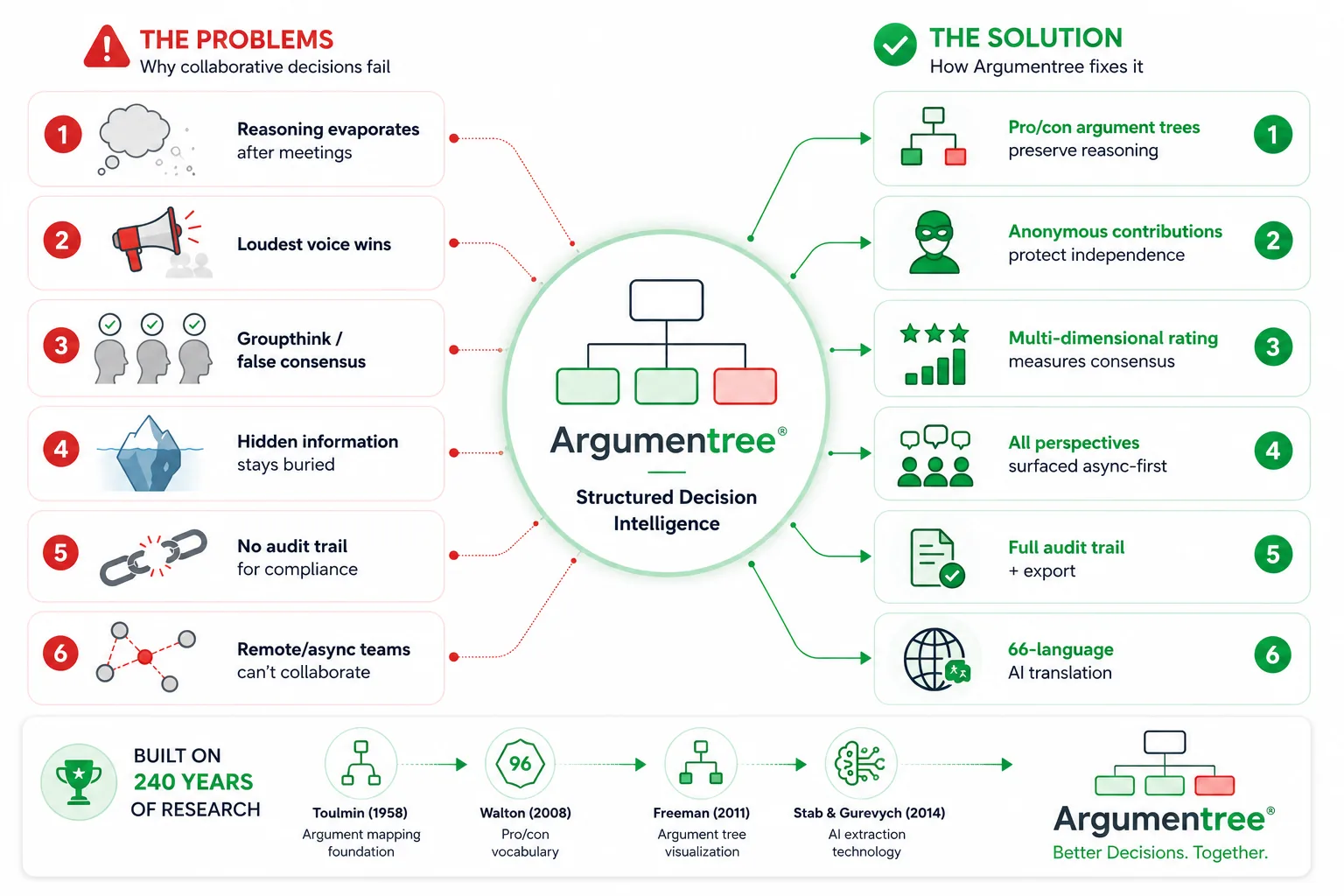
Argumentree gives a group one shared, structured place to argue and decide — built on argument mapping. Every feature addresses a specific failure mode identified in the research:
Shared pro/con argument trees
Everyone's arguments are organized into a hierarchical pro/con structure — forcing System 2 engagement and making reasoning visible. Addresses: reasoning evaporating, arguments never surfacing.
Async-first contribution
Participants add arguments before the group converges, protecting independence. Addresses: anchoring on the first speaker, social influence destroying wisdom.
Structured back-and-forth (4-step chain)
Questions, compromises, and reviews let participants probe and negotiate arguments in turn — surfacing hidden-profile information and testing assumptions.
Multi-dimensional rating → consensus scores
Participants rate arguments (helpfulness, clarity, accuracy, completeness); ratings aggregate up the tree into net pro-versus-con scores. Consensus is measured, not guessed.
Role-based access & psychological safety
Control who contributes and moderates. Anonymous contribution options protect psychological safety for sensitive topics.
AI extraction from transcripts
Upload a meeting recording; AI extracts arguments, decisions, and action items into the structured tree. Addresses: documentation burden, reasoning evaporating.
Full audit trail
Argument versioning and the draft→open→closed lifecycle keep a complete record of how the decision was reached — for compliance, onboarding, and future learning.
66-language collaboration
AI-powered translation lets global teams contribute in their native language while maintaining one shared decision record.
Collaborative decision making is the team-centered form of decision making. See it applied across 12 use cases — from team meetings to DAO governance and public policy. Turning that shared reasoning into a group decision is the work of consensus building.
The Decision Packet: What to Document
A decision without documented reasoning is an unlearnable decision. Borrowing from Architecture Decision Records (ADRs), every significant collaborative decision should produce a decision packet containing:
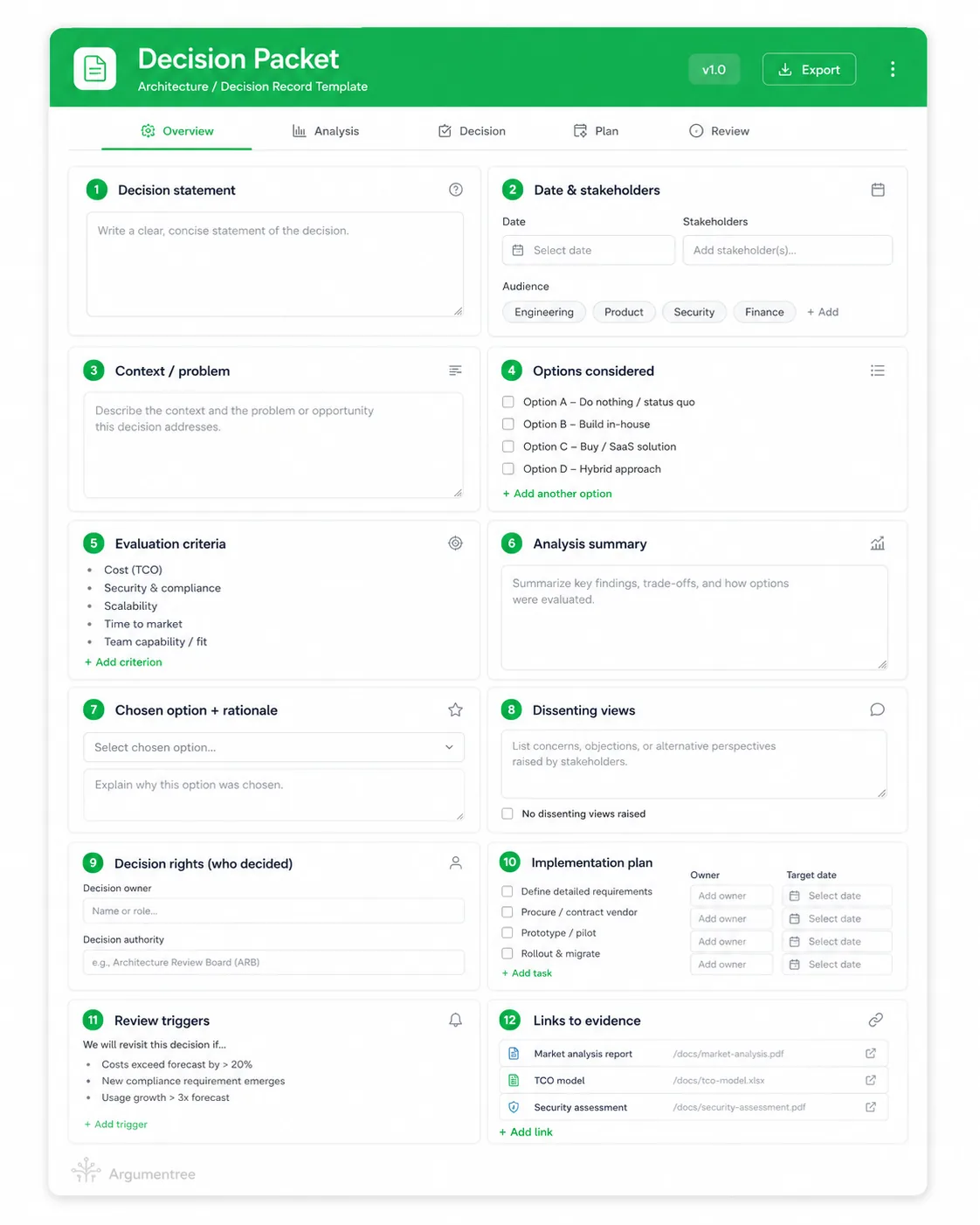
Decision statement
What was decided, in one sentence.
Date and owner
When, and who is accountable for execution.
Context
What prompted the decision? What constraints applied?
Options considered
What alternatives were evaluated? Include rejected options.
Arguments for and against
The reasoning that shaped the choice — captured in the argument tree.
Evidence cited
Data, research, precedents that informed the decision.
Dissenting views
Who disagreed and why? The minority report. Essential for learning.
Assumptions
What did we believe to be true? If these change, reconsider.
Risks and mitigations
What could go wrong? What's the fallback?
Success metrics
How will we know if this decision worked?
Review date
When will we revisit? Prevents decisions from becoming permanent by default.
Reopen triggers
What conditions would invalidate this decision?
Argumentree generates this automatically. The argument tree captures options, reasoning, and dissent; the audit trail records dates, owners, and contributors; the discussion lifecycle (draft → open → closed) enforces review. Export the full decision record for compliance, onboarding, or future reference.
"If the organization cannot remember why it decided something, it cannot learn."
The 12 Benefits of Collaborative Decision Making
Collaboration takes more time than autocratic decisions. But research across decades — from Condorcet (1785) to Google's Project Aristotle (2015) — shows the investment pays off in measurable ways:
Better quality decisions
Every perspective is captured and tested, so blind spots surface before the decision — not after. Condorcet proved mathematically that groups outperform individuals when members are even slightly better than chance. Google found psychologically safe teams were rated effective 2× as often by executives.
Stronger team buy-in
People support decisions they helped shape — collaboration turns a verdict into a shared commitment. Execution improves because the team understands why. This eliminates the "not invented here" resistance that kills top-down mandates.
More creative solutions
Scott Page's diversity prediction theorem proves that cognitively diverse teams outperform teams of high-ability clones. Different mental models generate different solution paths — and the overlap of those paths reveals options no individual would find. Innovation emerges from the collision of perspectives.
Faster problem identification
The hidden-profile problem shows that groups naturally over-discuss shared information while neglecting facts held by just one person. Structured collaboration reverses this — surfacing unique knowledge early so risks are identified before they become costly. One team member's concern, voiced before the meeting ends, can prevent months of rework.
Stronger problem-solving
Complex problems rarely have single-discipline solutions. Collaboration lets specialists from different domains attack the same problem from multiple angles — engineering, design, operations, customer support — and synthesize a solution that accounts for constraints each would miss alone.
Improved communication
Google's Project Aristotle found that equality in conversational turn-taking predicted team success better than individual IQ. When everyone speaks roughly the same amount, information flows more completely. Structured contribution ensures quieter voices aren't drowned out by dominant personalities.
Higher employee engagement
Teams with high psychological safety show 76% higher engagement (Google). When people feel their input matters, they invest more energy. Engagement isn't just a feel-good metric — it predicts productivity, quality, and retention.
Faster execution
Collaborative decisions may take longer upfront, but they execute faster. Teams that embrace async input show 29% higher productivity and save 6 hours per week by cutting unnecessary meetings (Gallup 2024). No one stops to ask "why are we doing this?" because they already know.
Reduced bias
Individual decisions are vulnerable to anchoring, confirmation bias, and availability heuristics — Kahneman's System 1 shortcuts. Group evaluation forces System 2 engagement: arguments must be articulated and defended, not just felt. Structured rating on explicit criteria further reduces the influence of who speaks first or loudest.
Stronger accountability
Clear decision rights (DACI, RAPID) separate who contributes from who decides. When ownership is explicit, accountability follows. Shared process doesn't mean diffused responsibility — it means the decision-maker has access to the best available input and a clear record of what was considered.
Better knowledge sharing
Decisions made in hallways or private meetings leave no trace. When reasoning evaporates, teams re-litigate settled questions and new members can't understand past choices. A documented argument trail becomes organizational memory — onboarding is faster, context survives turnover, and the why is always recoverable.
Stronger team relationships
Working through disagreements together builds trust. Google's research: teams with high psychological safety have 27% lower turnover. People stay where they're heard. The process of structured debate — arguing ideas, not attacking people — creates relationships that survive individual decisions.
Frequently Asked Questions
What is collaborative decision making?
Collaborative decision making is a structured process in which a group reaches a decision together — surfacing options, contributing arguments and evidence, evaluating them openly, and converging on a choice that reflects the group's collective reasoning rather than a single person's authority. It trades speed for buy-in, transparency, and better-tested decisions.
What is the collaborative decision-making process?
The process follows a divergent-convergent model. In the divergent phase, you (1) frame the decision and (2) generate alternatives. In the convergent phase, you (3) contribute arguments for and against, (4) evaluate each argument on its merits, (5) weigh net support versus opposition and converge, and (6) record the decision and reasoning. Structured tools make each step visible and auditable.
What is psychological safety and why does it matter?
Psychological safety is a shared belief that the team is safe for interpersonal risk-taking — where members can speak up, admit mistakes, and challenge ideas without fear of embarrassment or punishment. Google's Project Aristotle found it's the #1 predictor of team effectiveness, correlated with 43% of performance variance. Without it, diverse perspectives never enter the conversation.
Why do group decisions often go wrong?
Common failure modes include: groupthink (unanimity overrides realism), the Abilene Paradox (agreeing on what no one wants), the hidden-profile problem (unique information stays buried), anchoring on the first/loudest speaker, cognitive biases like confirmation bias, and reasoning that evaporates after the meeting. Structure that captures independent input before group discussion addresses most of these.
What is the difference between collaborative and consensus decision making?
Consensus decision making requires the whole group to actively agree (or at least not block) before proceeding. Collaborative decision making is broader: everyone contributes and input shapes the outcome, but the final decision can still be made by a leader, a vote, or a defined rule. Collaboration is about shared input and transparency; consensus is one specific way to conclude it.
How does AI help with collaborative decision making?
AI augments collaborative decisions by: (1) transcribing meetings and automatically extracting arguments, decisions, and action items; (2) acting as a "Devil's Advocate" to challenge group assumptions; (3) translating contributions across languages for global teams; and (4) modeling decision logic for consistency and compliance. The goal is complementary performance — combined human-AI teams outperforming either alone.
When should you NOT use collaborative decision making?
Avoid collaboration for: speed-critical decisions where the window will close, decisions where one person has clear expertise and others don't, decisions requiring individual accountability (legal, fiduciary), trivial or easily reversible choices, and groups not affected by the outcome. Collaboration is best when diverse perspectives add value, buy-in matters for execution, and the decision is consequential enough to justify the time.
How does software support collaborative decision making?
Collaborative decision-making software provides a shared, structured place to argue and decide: it organizes contributions into pro/con argument trees, collects input asynchronously to protect independence, lets everyone rate arguments so consensus is measured rather than assumed, controls access via roles, and keeps a full audit trail. Argumentree adds AI extraction from meeting transcripts and 66-language translation for global teams.
References & Further Reading
Condorcet, M. (1785). Essai sur l'application de l'analyse à la probabilité des décisions rendues à la pluralité des voix.
The original mathematical proof that groups can outperform individuals.
Galton, F. (1907). Vox Populi. Nature, 75, 450-451.
The founding example of the wisdom of crowds.
Janis, I. L. (1972). Victims of Groupthink. Houghton Mifflin.
The classic study of groupthink and the Bay of Pigs.
Harvey, J. B. (1974). The Abilene Paradox: The Management of Agreement. Organizational Dynamics.
How groups agree on what no individual wants.
Edmondson, A. C. (1999). Psychological Safety and Learning Behavior in Work Teams. Administrative Science Quarterly, 44(2), 350-383.
The foundational research on psychological safety.
View source →Wilson, M. A. (2003). Collaborative Decision Making: Building Consensus Group Decisions for Project Success. PMI Global Congress.
The Decision Engineering Method framework.
Surowiecki, J. (2004). The Wisdom of Crowds. Doubleday.
The four conditions for collective intelligence.
Toulmin, S. E. (1958). The Uses of Argument. Cambridge University Press.
The Claim-Data-Warrant-Backing-Qualifier-Rebuttal model — foundation for argument mapping.
Perelman, C. & Olbrechts-Tyteca, L. (1958). Traité de l'argumentation: La nouvelle rhétorique. Presses Universitaires de France.
The New Rhetoric — distinguishing demonstration from argumentation.
Walton, D., Reed, C., & Macagno, F. (2008). Argumentation Schemes. Cambridge University Press.
96 argumentation schemes with critical questions — the vocabulary for pro/con/support/attack relations.
View source →Thaler, R. H. & Sunstein, C. R. (2008). Nudge: Improving Decisions About Health, Wealth, and Happiness. Yale University Press.
Choice architecture and libertarian paternalism.
Freeman, J. B. (2011). Argument Structure: Representation and Theory. Springer.
Synthesizing Toulmin with dialectics — macrostructure diagrams for argument trees.
View source →Kahneman, D. (2011). Thinking, Fast and Slow. Farrar, Straus and Giroux.
System 1 and System 2 thinking.
View source →Stab, C. & Gurevych, I. (2014). Annotating Argument Components and Relations in Persuasive Essays. Proceedings of COLING 2014.
Foundational computational argument mining — enabling AI to extract claims, premises, and relations from text. The technology behind Argumentree's AI extraction.
View source →Google re:Work. (2015). Guide: Understand team effectiveness.
Project Aristotle's findings on psychological safety.
View source →Gallup. (2024). State of the Global Workplace Report.
Hybrid work statistics and team engagement.
View source →Gartner. (2025). Hype Cycle for Artificial Intelligence.
Decision Intelligence as a transformational technology.
View source →Decide together, better
Give your team one structured place to argue and decide — with every perspective captured, every argument evaluated, and the reasoning preserved. Join organizations using Argumentree to transform how they make decisions.
Start Free Trial