

TL;DR
Decision intelligence moves beyond "what does the data say?" to "what should we decide?" It's a systematic approach to improving how organizations make choices: structured frameworks for deliberation, tools for evaluating trade-offs, outcome tracking to validate assumptions, and institutional memory that compounds over time. Organizations with mature decision intelligence make faster, more confident, more defensible decisions — and they get better at it continuously.
The Gap Decision Intelligence Fills
Most organizations have invested heavily in data infrastructure — dashboards, reports, analytics. But they haven't invested in decision infrastructure. The result:
- ✗Decisions happen in meetings with no documentation
- ✗The loudest voice wins, not the best argument
- ✗Similar decisions get re-debated because no one remembers the last one
- ✗Outcomes are never tracked against the original rationale
- ✗Institutional knowledge walks out the door when people leave
Decision intelligence solves this by making the decision process itself a first-class concern — as important as the data that informs it.
Where the Term Comes From
"Decision intelligence" isn't marketing jargon — it's a named, maturing discipline with real founders:
Lorien Pratt — the field's founder, ~2008
Computer scientist Lorien Pratt introduced the concept (first as "decision engineering") in a 2008 Quantellia white paper, and wrote the field-defining book Link: How Decision Intelligence Connects Data, Actions, and Outcomes (2019). Her signature contribution — Causal Decision Diagrams — maps the causal chain from a choice through to its outcomes, so you can actually see how an action produces a result.
Cassie Kozyrkov — Google's Chief Decision Scientist, 2018
Kozyrkov became Google's first Chief Decision Scientist in 2018 and popularized the term, defining it as "the discipline of turning information into better action at any scale" — or, more bluntly, "data science++, augmented with the social and managerial sciences." Her key rule: frame the decision before you touch the data. She trained on the order of 20,000 Googlers in data-driven decision-making before leaving in 2023.
Gartner — the category goes mainstream
Gartner defines decision intelligence platforms as software that supports, automates, and augments decisions through "the composition of data, analytics, knowledge and AI," and has elevated DI into a full Magic Quadrant category — its signal that the shift from a data-driven to a decision-centric organization has gone mainstream.
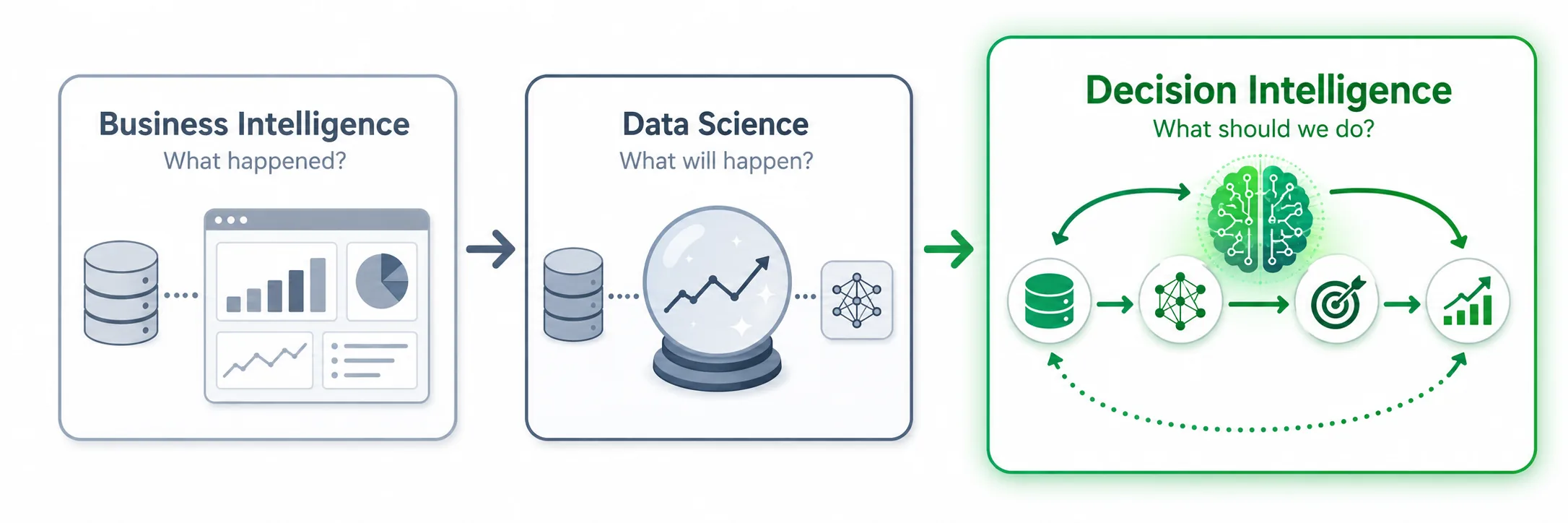
Decision Intelligence vs BI vs Data Science
Business Intelligence
Understand the past. Dashboards, reports, KPIs — what happened and what's happening now. Backward-looking.
Data Science
Predict the future. Models and forecasts — what will happen and what we could do. Forward-looking.
Decision Intelligence
Take and learn from action. The mechanics of actually making the decision and improving from its outcome. Action-oriented.
The Decision Intelligence Lifecycle
Traditional collaborative decision-making focused on the meeting. Decision Intelligence focuses on the whole decision lifecycle — decisions become assets that can be designed, documented, measured, and improved:
Frame
Define the decision clearly before discussing options
Model
Make the decision structure visible — stakeholders, criteria, risks
Generate
Create alternatives through brainstorming, AI ideation, scenarios
Evaluate
Apply criteria, weight evidence, consider tradeoffs
Assign
Clarify decision rights — who decides, who executes
Execute
Implement the decision with clear accountability
Monitor
Track outcomes against expected results
Learn
Feed insights back into future decisions
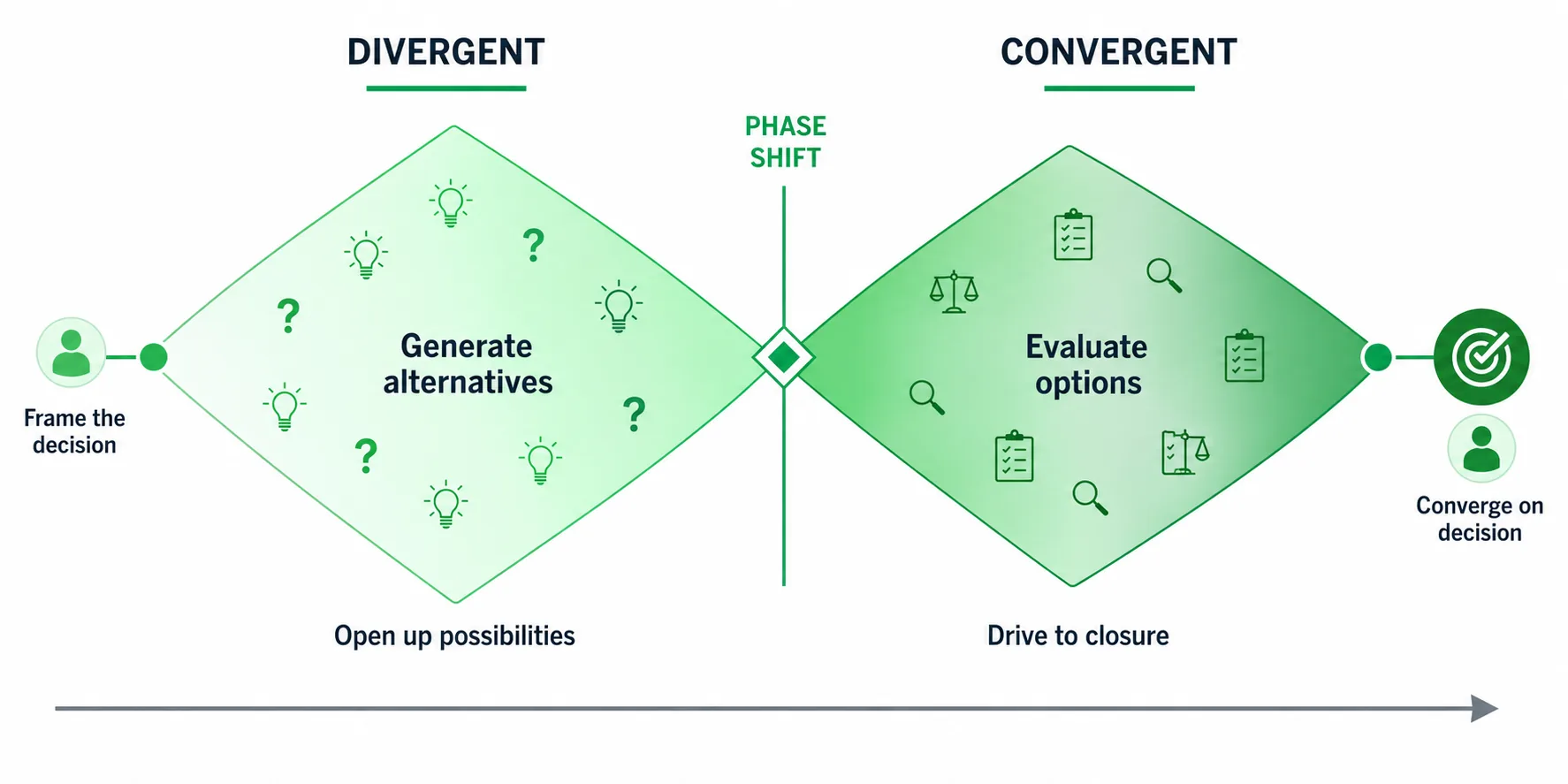
This is the major shift: decisions become organizational assets that can be designed, documented, measured, and improved — not one-time events that disappear into meeting notes.
Step 1: Frame the Decision
Every intelligent decision begins with a clear frame. Before discussing options, teams should ask:
- What decision are we actually making?
- Why does it matter? What's at stake?
- Who is affected by this decision?
- What outcome are we trying to create?
- What constraints do we face (budget, time, resources)?
- Is this decision reversible or one-way?
- What happens if we delay?
- What role should data or AI play?
"Which AI tool should we buy?"
"Which decisions or workflows should we augment with AI, under what governance model, and with what human accountability?"
A poor frame produces poor options. A better frame expands the solution space.
Step 2: Model the Decision
Decision Intelligence makes the invisible structure of a decision visible. A decision model should show:
Decision Owner
Who is accountable for the final call?
Stakeholders
Who needs to be consulted? Who is affected?
Options
What alternatives are being considered?
Criteria
How will we evaluate success?
Evidence
What data supports each option?
Assumptions
What must be true for this to work?
Risks
What could go wrong? What's the downside?
Expected Outcomes
What results do we predict?
Feedback Signals
How will we know if it worked?
A meeting may feel productive, but unless the decision logic is visible, the organization may still not understand why a choice was made.
Decision Rights: Who Decides?
Not every collaborative decision should be made by consensus. Consensus can create commitment, but it can also create delay and blurred accountability. Decision Intelligence requires clarity:
| Role | Responsibility |
|---|---|
| Recommends | Prepares options and analysis for the decision |
| Contributes | Provides input, expertise, or perspective |
| Approves | Must sign off before execution (e.g., budget, compliance) |
| Decides | Makes the final call — owns the outcome |
| Executes | Implements the decision |
| Informed | Needs to know the decision was made |
| Challenges | Has standing to question or appeal the decision |
Good collaboration does not mean everyone decides. It means the right people contribute, the decision owner is clear, and the reasoning is transparent.
Governing AI-Supported Decisions
As AI becomes part of decision-making, organizations need stronger guardrails. For any AI-assisted decision, teams should ask:
AI Decision Checklist
- What data was used to train or inform the AI?
- Is the data reliable, current, and representative?
- Could the model be biased? How would we know?
- Can the AI's recommendation be explained to stakeholders?
- Who is accountable if the AI is wrong?
- Is human oversight required before action?
- Are there legal, ethical, or regulatory risks?
- Can this decision be audited later?
AI can increase speed and scale, but without governance it can also increase risk. Decision Intelligence makes AI-supported decisions more transparent, accountable, and reviewable.
Decision Memory: Ending Decision Amnesia
One of the biggest weaknesses in many organizations is decision amnesia. Teams make decisions, move on, and later forget why they decided, what alternatives were rejected, what assumptions were made, and what would trigger a revisit.
A modern decision record should capture:
- •Decision statement — what was decided
- •Context — why this decision was needed now
- •Owner — who made the final call
- •Contributors — who provided input
- •Options considered — including rejected alternatives
- •Criteria used — how options were evaluated
- •Evidence — data and analysis that informed the decision
- •AI tools used — if any, and how they contributed
- •Risks accepted — known downsides and mitigations
- •Dissenting views — objections and how they were addressed
- •Expected outcomes — what success looks like
- •Review date — when to reassess
- •Reopen triggers — what conditions would change the decision
This turns decisions into organizational knowledge — searchable, referenceable, and improvable over time.
The Leader as Decision Architect
In the past, leaders were expected to make decisions or facilitate consensus. In the age of Decision Intelligence, leaders must become decision architects.
A decision architect designs the conditions for better choices:
Decision Architect Capabilities
- Clear framing — defining the decision before jumping to solutions
- Better evidence — ensuring data reaches the decision, not just the dashboard
- Inclusive input — hearing from those with relevant expertise
- Constructive dissent — creating safety for disagreement
- AI support where useful — knowing when to augment, when to defer to humans
- Transparent decision rights — everyone knows who decides
- Documented rationale — the "why" is preserved, not just the "what"
- Measurable outcomes — defining success criteria upfront
- Continuous learning — feeding outcomes back into future decisions
The best leaders do not simply ask, "What should we decide?" They ask, "How should this decision be made?"
The Four Pillars of Decision Intelligence
Decision Frameworks
Structured approaches to deliberation: argument mapping, pro/con analysis, weighted criteria, and scenario planning. These ensure all perspectives are considered and reasoning is explicit.
Evidence Integration
Connecting data and analysis directly to decision reasoning. Not just "here's a chart" but "here's how this data point supports or challenges this specific argument."
Outcome Tracking
Measuring results across three time horizons: immediate (did we execute?), short-term (did we achieve objectives?), and long-term (were our assumptions validated?).
Institutional Learning
Building a searchable library of past decisions, their rationale, and their outcomes. New decisions can reference precedents. The organization gets smarter over time.
How to Measure Decision Quality
A good decision isn't just one that worked out — luck plays a role. Decision quality is about the process:
Process Quality
- • Were alternatives generated and evaluated?
- • Was evidence considered and documented?
- • Were dissenting views heard and addressed?
- • Is the rationale clear enough to explain to others?
Outcome Quality
- • Immediate: Was the decision executed as intended?
- • Short-term: Did we achieve our stated objectives?
- • Long-term: Were our key assumptions validated?
Learning Quality
- • Can we find similar past decisions when needed?
- • Are we avoiding repeated mistakes?
- • Is decision speed improving over time?
Argumentree: The Decision Intelligence Platform
Most decision intelligence platforms are heavyweight, analytics-led enterprise suites. Argumentree takes the opposite approach: a decision intelligence platform built on structured argument mapping — capturing the reasoning behind every decision, not just the data. It spans the full decision spectrum across four products:
Structured argument mapping for team and organizational decisions — pro/con trees, evidence, and full decision traceability.
AI multi-perspective deliberation — stress-test a decision with distinct AI personas before you commit.
Decision tracing and audit for AI agents — capture, validate, and explain the decisions autonomous agents make.
Multi-LLM research and AI-assisted deliberation — structured analysis across leading models.
Together they cover human decisions, AI-augmented deliberation, and AI-agent decisions — one decision intelligence platform for how organizations actually decide.
Decision intelligence operationalizes decision making, collaborative decision making, and structured decision making — see also the decision-making models behind it.
Explore further
Enterprise decision excellence
The organisational umbrella: how authority, speed, evidence and culture combine into one decision system.
Evidence-based management
Deciding from the best available evidence rather than from precedent, seniority or habit.
Data-driven decision making
The narrower predecessor — what data alone can and cannot settle.
Decision architecture
Classifying decisions by reversibility and exposure, then matching process weight to the class.
Decision audit trail
The record of what was argued and why — the memory layer decision intelligence depends on.
Argument mining
How machines read claims, reasons and objections out of unstructured discussion.
Frequently Asked Questions
What is decision intelligence?
Decision intelligence is the discipline of improving organizational decision-making through better processes, tools, and feedback loops. It combines structured decision frameworks, data analysis, and outcome tracking to systematically improve decision quality over time. The goal is not just making good decisions, but building organizational capability for consistently better decisions.
How is decision intelligence different from business intelligence?
Business intelligence focuses on data visualization and reporting — showing you what happened. Decision intelligence goes further: it provides frameworks for reasoning about what to do, tools for structured deliberation, and feedback mechanisms to learn from outcomes. BI answers 'what is the data?' while decision intelligence answers 'what should we decide?'
What are the key components of decision intelligence?
Decision intelligence has four core components: 1) Decision frameworks — structured approaches like pro/con analysis and argument mapping, 2) Evidence integration — connecting data to decisions, 3) Outcome tracking — measuring whether decisions achieved intended results, 4) Institutional learning — using past decisions to inform future ones.
How do you measure decision quality?
Decision quality is measured through outcome tracking across multiple time horizons: immediate results (did we execute correctly?), short-term outcomes (did we achieve our objectives?), and long-term impact (were our assumptions validated?). Quality also includes process metrics: was reasoning documented, were alternatives considered, was evidence evaluated?
Who needs decision intelligence tools?
Any organization where decisions have significant consequences: governance bodies, executive teams, project management, legal and compliance teams, healthcare committees, and investment committees. Decision intelligence is especially valuable when decisions need to be defensible, repeatable, or auditable.
How does decision intelligence improve over time?
By tracking outcomes against documented rationale, organizations build a database of decision precedents. This enables pattern recognition: which types of reasoning lead to good outcomes? What signals should we weight more heavily? Over time, institutional decision-making improves because you're learning from actual results, not just intuition.
Deep Dive: Decision Intelligence in Practice
Explore the evolution from collaborative decision making to AI-augmented Decision Intelligence. Learn how Google, Netflix, and Amazon operationalize DI at scale, and discover the frameworks that turn data into action.
Read: Decision Intelligence — From Data to Action at Enterprise ScaleReferences & Further Reading
Pratt, L. (2019). Link: How Decision Intelligence Connects Data, Actions, and Outcomes. Emerald Publishing.
The field-defining book; introduces Causal Decision Diagrams.
View source →Pratt, L., & Malcolm, N. (2008). Decision Engineering (Quantellia white paper).
The first articulation of the discipline, originally under the name decision engineering.
Kozyrkov, C. (2019). Introduction to Decision Intelligence.
Google's first Chief Decision Scientist defining DI as turning information into better action at any scale.
View source →Gartner. Market Guide for Decision Intelligence Platforms.
Gartner's recognition of decision intelligence as a named software category.
View source →Simon, H. A. (1960). The New Science of Management Decision. Harper & Row.
Early foundations of treating decisions as a systematic, improvable organizational process.
Build Your Decision Intelligence Capability
Argumentree provides the infrastructure for decision intelligence: structured deliberation, documented rationale, outcome tracking, and searchable decision precedents.