
Teaching Machines to Read Arguments: The Decade of Annotated Corpora | Argumentree
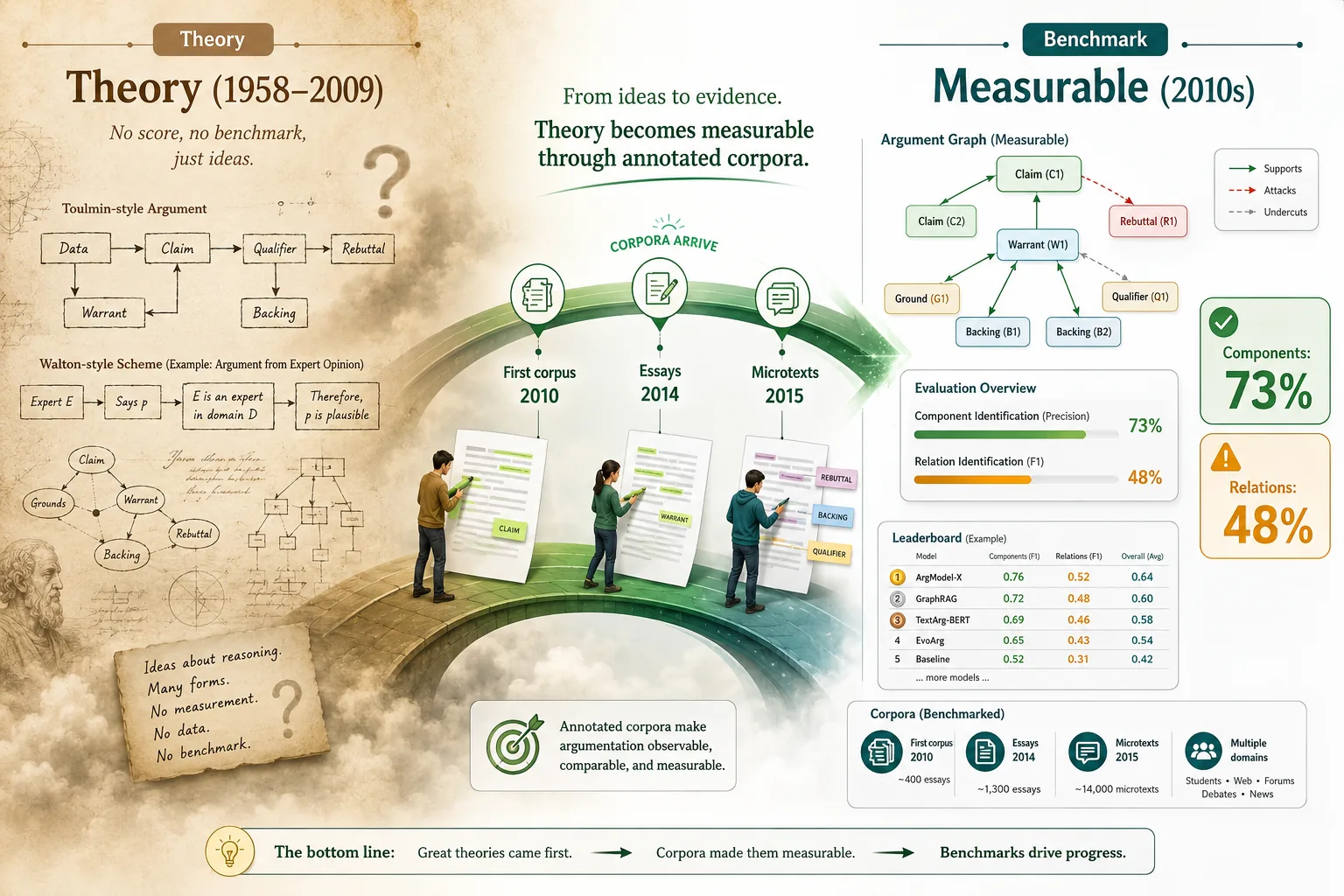
Argument mining existed as a theory for decades before it became a measurable computational task. What changed it was annotation: people sitting down with thousands of documents and marking, by hand, which spans were claims, which were premises, and which supported or attacked which. Christian Stab and Iryna Gurevych annotated persuasive essays in this way, producing the corpus usually called AAEC. Andreas Peldszus and Manfred Stede built a corpus of short argumentative microtexts specifically to study argument structure. Joonsuk Park and Claire Cardie annotated public comments submitted to US rulemaking, a far messier genre. The difficulty was never labelling effort alone — it was that human annotators disagree about what an argument is, and a task humans cannot agree on cannot be scored reliably. Inter-annotator agreement therefore became the gatekeeper of the whole field: it defines the practical ceiling on machine performance, because a model cannot be measured as more consistent than the annotation it is judged against. The corpora also revealed the field's permanent asymmetry — identifying argumentative components proved tractable, while identifying the relations between them did not.
You cannot teach a machine to find arguments until humans can agree on what one is. That turned out to be the hard part, and it shaped everything the field measured afterwards.
- Argument mining became a real field only when people hand-annotated thousands of documents — claims, premises, and the links between them.
- Annotators disagree, especially about relations. Inter-annotator agreement became the gatekeeper, because it caps how well any model can be scored.
- Three corpora shaped the decade: persuasive essays, argumentative microtexts, and public rulemaking comments — clean to messy.
- Every corpus is a genre. A model trained on student essays does not transfer to a meeting transcript, and for a long time nobody had a meeting-transcript corpus.
- The corpora exposed the permanent asymmetry: finding components is tractable, finding relations is not.
Two Experts, One Paragraph, Two Different Answers
Give two trained annotators the same paragraph of a student essay and ask a simple question: which sentence is the claim, and which sentences are the reasons for it? They will often disagree. Not about the topic, not about whether the argument is any good — about where it is.
This is the fact that shaped the first decade of computational argument mining, and it is easy to underrate. Everything downstream depends on it: you cannot build a benchmark for a task that people cannot perform consistently, and you cannot claim a model beats human performance on a judgement humans do not share.
Try it yourself on the last email thread you argued in. Marking the claim is usually easy. Marking which sentence each objection was aimed at is where you will start hesitating — and that hesitation is the whole story of this decade.
Why the Theory Sat Unused for Twenty Years
By the early 1990s the theoretical apparatus was complete. Toulmin had given the field its anatomy, Walton its catalogue of reasoning patterns, Freeman the distinction between attacking a conclusion and attacking the inference to it. As we covered in the first post in this series, an argument had been redescribed as a labelled graph.
A labelled graph is something a computer can be scored on — in principle. In practice you need something to score it against. Without annotated data, two research groups claiming different results have no way to settle it, and a field where results cannot be compared is not a field. It is a collection of demos.
So the decade that turned argument mining into a discipline was not a decade of algorithms. It was a decade of annotation guidelines.
The Three Corpora That Defined the Task
Different research groups annotated different genres, and the genre choice mattered more than anyone initially expected.
- Persuasive essays (Stab & Gurevych). Student argumentative essays, annotated for claims, premises and the support/attack relations between them. Structured writing by people who were explicitly trying to argue clearly — about as favourable as text gets.
- Argumentative microtexts (Peldszus & Stede). Short controlled texts built specifically to study argument structure, each one a compact argument with a deliberate shape. Small, clean, and designed so that structural questions have answers.
- Public rulemaking comments (Park & Cardie). Comments submitted by the public to US regulatory consultations. Real, unedited, frequently rambling — much closer to the text organisations actually have.
That progression from clean to messy is the useful thing to notice. Performance drops as you move down the list, and it drops most on relations. The essays were the friendly case, and even there the relation numbers were modest.
Inter-Annotator Agreement Is the Real Ceiling
Annotation projects report how often independent annotators agree, and in argument mining that number is not a footnote. It is the ceiling.
If two trained humans following the same guidelines agree only moderately about which premise attaches to which claim, then a model scored against one of them cannot meaningfully be described as beating the other. The measurement itself becomes unstable before the model does.
Agreement is consistently higher on components than on relations — people mostly concur about which sentence is a claim, and diverge about what it is responding to. That single asymmetry predicted everything the benchmarks would later show.
Run the annotation test on your own team
Take a decision email thread and ask two colleagues, separately, to mark the single strongest objection and say which specific reason it was aimed at. If they pick different targets, your disagreement was never about the facts — and no summary tool will surface that, because summaries record what was said rather than what it was aimed at.
The Guidelines Are the Theory, Made Operational
An annotation guideline sounds like clerical work. It is closer to a specification. Every ambiguity the theory left open has to be resolved before annotators can start, and each resolution is a real commitment.
Is a rhetorical question a claim? Does a restatement in the conclusion count as a new component or the same one? When a sentence supports two claims at once, does it attach to both, or to the nearer, or to the more general? If someone concedes a point before rebutting it, is the concession an attack on their own position?
None of these have obvious answers, and each corpus answered them slightly differently. That is why models transfer poorly between corpora: they are partly learning a genre, and partly learning one team's answers to those questions.
But Couldn't You Just Annotate More Data?
It is the natural response, and for component detection it broadly worked. More annotated spans produced better span detection. That part of the field improved steadily and predictably.
For relations it did not, and the reason is structural rather than a matter of volume. Relations depend on context outside the sentence — which is expensive to annotate consistently. Disagreement relations are rare, so scaling the corpus scales the imbalance along with it. And the connecting step is frequently unstated, so the annotator is not marking something visible in the text; they are marking their reconstruction of it.
More data multiplies all three problems rather than solving them. That argument is the subject of the next post.
What the Decade Left Behind
Two things, both still load-bearing.
The first is the task definition itself. The four-part breakdown that every argument-mining paper now opens with — find the components, label them, link them, classify the links — is a product of these annotation projects, not of the philosophy. Toulmin never proposed a pipeline.
The second is the benchmark set. When a modern system reports a number, it is usually reporting it on essays or microtexts annotated in this decade. That is worth remembering when comparing figures across papers: the same metric name on two different corpora is not the same measurement, and a great many published comparisons quietly ignore that.
What This Means Outside the Lab
- If humans can't agree where the argument is, no tool will hand you certainty. Treat extracted structure as a draft to correct, not a verdict to accept.
- Genre matters more than volume. A system tuned on tidy essays meets a very different problem in a meeting transcript full of interruptions and half-finished thoughts.
- The disagreement about targets is the real signal. When two people think an objection was aimed at different things, that gap is usually where the decision is actually stuck.
- Compare benchmark numbers only within a corpus. The same metric on a different dataset is a different measurement, however similar the label looks.
Where the Argument Is
The decade of annotation is the least glamorous part of this story and the part everything else rests on. No model, however large, escapes the fact that its scoreboard was built by people who sometimes disagreed with each other about where an argument was.
Which is a useful thing to carry into your own meetings. If finding the argument is hard for two trained annotators with a written guideline, the fact that your team keeps relitigating a decision is not a discipline problem. It is the same problem, without the guideline.
The argument mining series
Five posts on how machines learned to read arguments — where the field came from, why its hard problems are hard, and how we apply it.
How a 1958 philosophy book that logicians rejected became the specification for a machine-learning task.
Disagreement is rare in the data and depends on context the sentence doesn't contain.
Zero-shot models removed the corpus bottleneck and left the structural problems exactly where they were.
Applying it: argument categories, one main claim per category, and why confidence is the wrong ranking signal.
Sources & Further Reading
The persuasive-essay annotation project and its guidelines — the corpus that made the task measurable.
The full parsing treatment of the same corpus, with the component and relation results usually cited from it.
Operationalizing the Freeman model for automated argument mining — the bridge from theory to annotation scheme.
The CDCP corpus of public rulemaking comments — real, messy, and much harder than essays.
The survey that consolidated the decade — task definitions, corpora and evaluation practice.
Frequently Asked Questions
What is an argument mining corpus?
A collection of documents in which people have hand-marked the argumentative structure: which spans are claims, which are premises, and which premise supports or attacks which claim. It is what lets competing systems be compared on identical data, which is what turns an idea into a research field.
What is the AAEC corpus?
The Argument Annotated Essays Corpus, built by Christian Stab and Iryna Gurevych from student persuasive essays. It annotates argument components and the relations between them, and remains one of the standard benchmarks for argument mining.
Why does inter-annotator agreement matter so much?
Because it sets the ceiling on measurement. If two trained humans following the same guideline disagree about which premise attaches to which claim, a model scored against one of them cannot meaningfully be shown to beat the other. The evaluation becomes unstable before the model does.
Why do models trained on one corpus perform worse on another?
Because each corpus is a genre plus a set of guideline decisions. Student essays are structured and deliberate; public comments ramble. A model partly learns the genre and partly learns one annotation team's answers to ambiguous cases, and neither transfers cleanly.
Can you just annotate more data to fix relation detection?
It helped component detection considerably and relation detection much less. Relations depend on context beyond the sentence, disagreement relations are rare so scaling the corpus scales the imbalance too, and the connecting step is often unstated — so the annotator is marking a reconstruction rather than something visible.
Which corpora are used as benchmarks today?
Persuasive essays and argumentative microtexts remain the most common, with public-comment corpora used for harder, messier evaluation. Because each uses different annotation decisions, the same metric name across two corpora is not the same measurement — a frequent source of misleading comparisons.
Argumentree Team
Decision Science
The Argumentree team explores the science of better decisions—from ancient philosophy to modern AI.
Skip the annotation step
Paste a transcript and get a structured pro and con tree you can correct — the draft is automatic, the judgement stays yours.
The reference page for the field — tasks, history, and why relations are the hard part.
The arc of the whole field, from a rejected 1958 philosophy book to today.
What the corpora revealed about disagreement, and why more data doesn't fix it.
Turn a discussion into an argument tree
Structured reasoning from your own transcripts — no annotation guidelines required.
Start free