

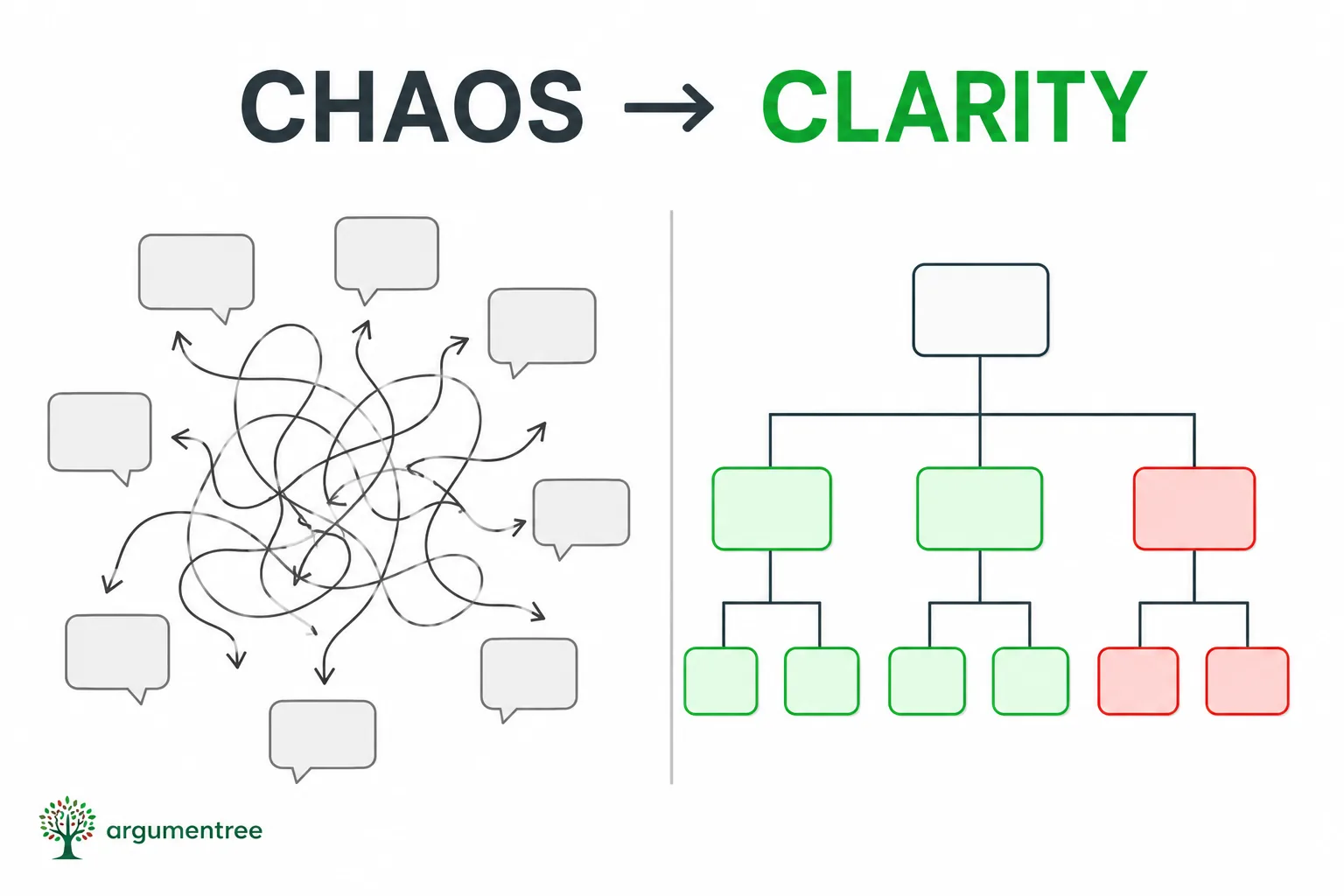
Meeting Intelligence Software: Turn Meeting Transcripts Into Structured, Traceable Decisions
Atlassian research (2024) found 72% of meetings are ineffective, while Harvard Business Review study by Leslie Perlow found 65% of 182 senior managers say meetings prevent them from completing work. Microsoft Work Trend Index shows executives spend 19+ hours weekly in meetings. Argumentree transforms meetings with a 3-phase workflow: (1) Pre-meeting: team members submit YES/NO decision questions and their PRO/CON arguments asynchronously, with optional anonymous submission (AI-verified for quality); (2) During meeting: facilitator walks through submitted arguments, team rates argument strength in real-time, no rambling allowed; (3) Post-meeting: decision captured with full pro/con tree, everyone's positions recorded, searchable archive forever. Decision quality improves because every perspective is captured (not just the loudest voices), nothing gets lost, and full traceability enables learning from past decisions — which arguments were weighted correctly, which were overlooked, and how to improve future choices. Best for: executive teams, product teams, board meetings, strategic planning, vendor selection, budget debates. Sources: hbr.org/2017/07/stop-the-meeting-madness, fortune.com/2024/03/21/meetings-productivity-ineffective-atlassian-report, cbsnews.com/news/unnecessary-meetings-cost-big-companies-100-million-annually.
Atlassian research shows 72% of meetings are ineffective, and 65% of executives say meetings prevent them from completing their work (Harvard Business Review). Companies with 5,000+ employees lose over $100 million annually on unnecessary meetings. Argumentree transforms this wasted time into structured, efficient decisions.
- Pre-meeting argument submission — team members prepare their PRO/CON arguments before the meeting
- Focused in-meeting discussion — only discuss the arguments, no rambling
- Real-time rating — rate argument strength as you go
- Instant documentation — full decision tree archived with reasoning, traceable forever
Meetings aren't the problem.
Losing the decisions made in them is.
— Share this insight
The Real Cost of Broken Meetings
Every day, millions of knowledge workers sit through meetings where critical decisions are made, debated, and supposedly documented. Yet 65% of senior managers report that meetings prevent them from completing their own work, according to a Harvard Business Review study by Leslie Perlow and colleagues, who surveyed 182 executives across industries.
The numbers are staggering: Atlassian research published in Fortune found that 72% of meetings are ineffective at disseminating information, encouraging collaboration, or accomplishing tasks. Nearly 4 in 5 workers (78%) say they struggle to complete their work because of how many meetings they attend. That's not a culture problem. That's a systemic failure.
The problem isn't just too many meetings—it's that we're treating meetings as disposable events rather than sources of institutional intelligence. When a decision is made in a meeting:
- The reasoning behind it is lost within days
- New team members have no context for why things are done certain ways
- Similar decisions get re-debated months later, wasting hours
- Action items are tracked in disparate tools (Slack, email, Asana)
- Knowledge silos form across departments
The Hidden Cost
A company with 100 employees loses approximately $2.5 million per year to unnecessary meetings. Companies with 5,000+ employees? Over $100 million annually. (CBS News)
Tired of Meetings Where People Talk Without Saying Anything?
We've all been there. Someone talks for 10 minutes about "concerns" without ever stating their actual objection. Side conversations derail the agenda. The same points get repeated by different people. An hour passes and nothing concrete has been decided.
What if you could eliminate the rambling entirely? What if every meeting started with the actual arguments already on the table — pro and con — ready for focused evaluation?
The solution isn't fewer meetings — it's smarter meetings.
Argumentree transforms how teams prepare for, conduct, and document decisions. No more rambling. No more "what did we decide?" the next day. Just focused, efficient, traceable decisions.
What is Meeting Intelligence?
Meeting Intelligence goes beyond traditional transcription. It's the automated extraction and structuring of decisions, arguments, and action items from meeting content into a searchable, hierarchical knowledge base.
Think of it as "Business Intelligence for Decisions." Just as BI tools analyze sales data to reveal patterns, Meeting Intelligence analyzes meeting discourse to reveal decision patterns, identify knowledge gaps, and surface institutional wisdom.
The Four Pillars of Meeting Intelligence
1. Automatic Decision Extraction
AI scans transcripts for decision points and extracts them into structured records including what was decided, who decided it, when, why, and what alternatives were considered.
2. Argument Mapping
Pro/con arguments leading to each decision are organized into hierarchical trees, preserving the reasoning chain critical for onboarding and revisiting decisions.
3. Action Item Tracking
Automatically identifies action items from transcripts, assigns ownership, links them to decision context, and tracks completion across meetings.
4. Searchable Archives
Every decision becomes part of a living knowledge base. Find answers in 30 seconds instead of 2-hour archaeology projects through Slack and email.
The promise of meeting intelligence is simple: a new VP should be able to search "Why did we choose vendor X?" and see the full argument tree from two years ago — instead of re-opening a settled debate.
The Structured Meeting Workflow: Pre, During, Post
Here's how high-performing teams use Argumentree to transform every decision meeting into a focused, efficient, fully-documented session:
Phase 1: Pre-Meeting Preparation (Async)
- Meeting organizer poses a Yes/No decision question (e.g., "Should we adopt vendor X?")
- Team members submit their key arguments before the meeting — PRO or CON, with reasoning
- Anonymous option available — submit arguments without attribution (AI-verified for quality)
- Arguments visible to all participants, enabling pre-meeting reflection
Benefit: Everyone arrives having already thought deeply about the decision. No more "catching people up."
Phase 2: During the Meeting (Sync)
- No open-ended discussion — facilitator walks through submitted arguments one by one
- Each argument gets explained by its author (2-3 minutes max)
- Team members rate each argument's strength (agree/disagree/importance)
- Counter-arguments and clarifications added in real-time
Benefit: Discussion stays laser-focused on actual points of contention — no tangents, no repetition, no rambling.
Phase 3: Post-Meeting (Immediate)
- Decision captured with full pro/con tree already structured
- Everyone's positions and ratings are recorded — full transparency
- Action items linked to decision rationale — context never lost
- Searchable archive for future reference and onboarding
Benefit: No more "what did we decide?" the next day — it's already documented with full reasoning.
The best meetings aren't the ones where people speak the most —
they're the ones where every word counts.
When arguments are submitted in advance and discussion focuses only on resolving disagreements, a 60-minute meeting becomes a 25-minute decision.
Perfect for Decision-Heavy Meetings
Strategic Planning Sessions
Product Roadmap Prioritization
Vendor/Technology Selection
Budget Allocation Debates
Hiring Committee Decisions
Board Meetings
Investment Committee Reviews
Architecture Decision Records
Better Process = Better Decisions
Faster meetings are great — but the real value is higher-quality decisions. When every perspective is captured, considered, and preserved, your team makes smarter choices.
Every Perspective Captured
Each team member brings unique expertise, background, and viewpoint. Pre-submission ensures every voice is heard — not just the loudest or most senior. The engineer sees technical risks the CEO misses. The new hire spots assumptions veterans overlook. Anonymous submission removes hierarchy bias entirely.
Nothing Gets Lost
In traditional meetings, great points get buried under tangents and interruptions. With structured argument submission, every consideration is visible. Decision-makers can weigh all factors objectively — cost vs. speed, risk vs. reward, short-term vs. long-term — with a complete picture.
Informed, Not Impulsive
When you see all arguments laid out — pro and con, from every stakeholder — you can't make a knee-jerk decision. The visual argument tree forces deliberate consideration. Teams report feeling more confident in their choices because they've genuinely evaluated the alternatives.
Learn From Every Decision
Six months later, you can review exactly which arguments drove a decision — and which were ignored. Did we underweight the security concerns? Did we overweight the cost savings? Full traceability turns every past decision into a learning opportunity for future ones.
The Hidden Cost of "Loudest Voice Wins"
When meetings favor confident speakers over careful thinkers, you're not getting the best decisions — you're getting the most assertive ones. Critical objections go unspoken. Dissenting data stays hidden. And when the decision fails, no one can trace why.
Argumentree flips this dynamic: arguments win on merit, not volume. Every point is visible, rated, and preserved. Six months later, you can audit exactly what was considered — and what was missed.
The Meeting Problem, by the Numbers
You don't need an invented case study to see the opportunity — the published research is stark enough. These figures come from the sources listed at the end of this article:
What the Research Shows
Where the Time Goes
When meeting time is wasted, it tends to drain away in three predictable ways — each of which structure directly addresses:
- Repeat discussions — teams re-debate decisions because the original reasoning was never captured or made searchable
- Status-update meetings — calls scheduled to re-share context that could simply be looked up
- "Catching everyone up" — time spent re-establishing context at the start of each meeting
An Illustrative ROI Model
This is a worked example with stated assumptions — not a measured result — to show how recovered meeting time translates to value. For a 100-person organization averaging 10 meeting hours per week:
- Meeting volume: 100 people × 10 hours × 50 weeks = 50,000 meeting hours/year
- Assumed loaded cost: $75/hour → roughly $3.75M in annual meeting time
- If you recover even 15% of that time: 7,500 hours ≈ $560K in value
- Against software cost of a few tens of thousands per year, the recovered time is the return
- The bigger payoff is qualitative: decisions that don't have to be re-made, and reasoning that survives turnover
Common Objections (And Rebuttals)
"We already take meeting notes"
Meeting notes are unstructured text dumps. They don't:
- Separate decisions from discussion
- Capture argument structure (pro/con reasoning)
- Link related decisions across meetings
- Surface patterns ("We've debated vendor choice 4 times this year")
Meeting Intelligence transforms unstructured notes into structured, searchable, linked knowledge.
"AI transcription isn't accurate enough"
You're right—but Meeting Intelligence doesn't require 100% accuracy. Even 80% accurate transcripts capture enough decision keywords for extraction. Plus, humans can quickly review and correct the extracted decisions (much faster than writing from scratch).
"Our decisions are too sensitive to record"
Then how do you onboard new executives? How do you avoid re-debating sensitive topics? Meeting Intelligence tools (like Argumentree) support:
- Department-level access controls
- Redaction of sensitive details (names, numbers)
- Private decisions visible only to participants
- Full audit logs of who accessed what
"Won't requiring pre-submission arguments slow things down?"
The opposite. Teams report that 10 minutes of async prep saves 30+ minutes of in-meeting rambling.
Here's why pre-submission actually accelerates decisions:
- Dominant voices must write — Arguments are evaluated on merit, not volume or confidence
- Quieter team members get equal voice — Introverts often have the best insights; writing levels the playing field
- Anonymous option removes politics — Challenge leadership positions without career risk (AI-verified for quality)
- Pre-meeting consensus visible — Facilitator can skip topics where everyone already agrees
- No "catching up" time — Everyone has already read the arguments before walking in
The Anonymous Argument Advantage
When team members can submit arguments anonymously, you get the truth — not what people think leadership wants to hear. A junior engineer might submit the strongest objection to a CTO's proposal. Anonymous submissions are AI-verified to ensure they're substantive (preventing misuse), then presented alongside attributed arguments. The result: arguments judged purely on merit.
Real-World Transformation
Before Argumentree
"Our monthly product review takes 2 hours..."
- ✗Half the time catching people up on context
- ✗Loudest voices dominate the discussion
- ✗Same points repeated by different people
- ✗Vague action items forgotten by next week
- ✗"What did we decide?" the next day
After Argumentree
"Now it takes 45 minutes with better outcomes..."
- ✓PMs submit priorities + arguments beforehand
- ✓Everyone reviews arguments before the meeting
- ✓Only contested items discussed (skip consensus)
- ✓Arguments rated by strength in real-time
- ✓Full pro/con reasoning archived instantly
Result: 2-hour meeting → 45 minutes. Every decision documented with full reasoning. Traceable. Searchable. Permanent.
How Argumentree Delivers Meeting Intelligence
Argumentree implements all five steps of the Meeting Intelligence Framework in a single platform — turning your meeting transcripts into searchable decision archives automatically.
| Framework Step | What You Need | Argumentree Feature |
|---|---|---|
| 1. Capture | Transcripts from any source | Upload from Zoom, Teams, or any platform |
| 2. Extract | AI decision identification | Auto-extract decisions + arguments |
| 3. Structure | Hierarchical argument trees | Pro/con trees with scoring |
| 4. Archive | Context-rich storage | Department-organized archives |
| 5. Search | Instant retrieval | Full-text + semantic search |
Get Started Today
If you're tired of meetings that lead nowhere and decisions that get forgotten, it's time to implement Meeting Intelligence.
Try Argumentree Free for 14 Days
Upload your first meeting transcript and see your decisions extracted into a hierarchical tree in under 5 minutes. No credit card required.
Sources
- Perlow, L.A., Hadley, C.N., & Eun, E. (2017). "Stop the Meeting Madness." Harvard Business Review 95(4): 62–69. — Survey of 182 senior managers finding 65% say meetings prevent them from completing work, 71% find meetings unproductive.
- Fortune (2024). "Meetings are a productivity killer—and 3 in every 4 are totally ineffective, according to a new wide-ranging study." — Atlassian survey of 5,000 knowledge workers across four continents finding 72% of meetings are ineffective, 78% of workers struggle to complete work due to meeting overload.
- Microsoft Work Trend Index (2024). "AI at Work Is Here. Now Comes the Hard Part." — Survey of 31,000 knowledge workers finding executives spend 19+ hours weekly in meetings; 67% of executives say meetings are failures.
- CBS News (2022). "Unnecessary meetings can cost big companies $100 million a year." — Companies with 5,000+ employees lose over $100M annually to unnecessary meetings.
Frequently Asked Questions
What is Meeting Intelligence?
Meeting Intelligence is the automated extraction and structuring of decisions, arguments, and action items from meeting content into a searchable, hierarchical knowledge base. It goes beyond simple transcription to capture not just what was said, but why decisions were made and what alternatives were considered.
How does Meeting Intelligence differ from meeting transcription tools?
Unlike basic transcription tools, Meeting Intelligence creates structured argument maps showing the logical flow of discussions and decision reasoning. It captures pro/con arguments, links related decisions across meetings, and preserves institutional context—not just a text dump of what was said.
What is the ROI of Meeting Intelligence software?
The return comes from recovering meeting time and not having to re-make decisions. Published research provides the backdrop: Atlassian/Fortune (2024) found 72% of meetings are ineffective and Harvard Business Review (2017) found 65% of managers say meetings prevent their own work. The value of structuring those meetings is the time you stop wasting on repeat discussions and lost context — plus the harder-to-quantify benefit of decisions that survive turnover and can be audited later. The ROI model in this article is an illustrative example with stated assumptions, not a guaranteed result.
How long does it take to implement Meeting Intelligence?
Most organizations start with a 4-week pilot focused on executive meetings, then expand to departments over 2-3 months. The software itself requires no setup—just upload transcripts or connect your meeting platform. The key is building the habit of reviewing extracted decisions after meetings.
Do I need to change how I run meetings to use Meeting Intelligence?
No. Meeting Intelligence works with your existing meeting format—it automatically structures the output. However, many teams report that knowing decisions will be archived naturally improves meeting discipline and focus without requiring process changes.
What meeting platforms does Argumentree support?
Argumentree processes transcripts from any platform including Zoom, Microsoft Teams, Google Meet, and Webex. You can auto-sync transcripts via API integration or manually upload recordings and documents. The AI extracts decisions regardless of source format.
Is Meeting Intelligence suitable for remote teams?
Yes—in fact, remote and hybrid teams see the highest ROI because they rely heavily on asynchronous communication and need strong documentation. Meeting Intelligence creates a single source of truth that eliminates the "were you on that call?" problem and speeds up onboarding for distributed teams.
Can teams prepare arguments before meetings?
Yes — this is the most powerful use case. Meeting organizers set up a decision question (e.g., "Should we expand into market X?") and team members submit their arguments asynchronously before the meeting. During the meeting, the facilitator walks through the submitted arguments, allowing focused discussion on each point. Team members can rate argument strength in real-time. This eliminates rambling and ensures every voice is heard — especially quiet team members who think better in writing.
Can arguments be submitted anonymously?
Yes. Team members can choose to submit arguments anonymously, which encourages honest input — especially on sensitive topics or when challenging leadership positions. Anonymous submissions are AI-verified to ensure they're substantive and constructive (preventing misuse), then presented alongside attributed arguments. This levels the playing field: arguments are judged purely on merit, not on who said them.
How does this improve decision quality, not just speed?
Traditional meetings favor the loudest voices, not the best ideas. Argumentree captures every perspective — from the new hire who spots assumptions veterans miss, to the quiet engineer with critical technical insights. Anonymous submission removes hierarchy bias. The visual argument tree forces deliberate consideration of all factors. And full traceability lets you audit past decisions: which arguments drove the choice, which were overlooked, and what you can learn for future decisions. Better process = better outcomes.
Ready to transform your meetings?
Join hundreds of companies using Argumentree to turn meetings into institutional intelligence.
About Argumentree Team
Product Strategy
The Argumentree team is pioneering structured decision intelligence for enterprises worldwide. Our mission is to transform how organizations make, document, and learn from decisions.
Related Articles
Jeff Bezos's 3 Decisions a Day: The Warren Buffett Method Behind Amazon
Warren Buffett's Decision Philosophy: The 20-Slot Punch Card That Built $900 Billion
Elon Musk's $100 Million Decision Hour: The Lex Fridman Clip Every CEO Should See
Across the ecosystemAI Decision Tracing
Turning meetings into traceable decisions is the human side of decision tracing, the same record-keeping applied to AI agents.
This Meeting Could Have Been an Email: A Four-Question Test
Before you capture a meeting reasoning, decide whether it needed to be a meeting at all.
Continue the Debate
Is meeting intelligence worth the investment? Join the structured debate on our public forum — structured arguments, both sides, no fluff.
Join the Debate on forum.argumentree.com →