
Why Smart Teams Make Dumb Decisions (And the One Thing That Reverses It) | Argumentree
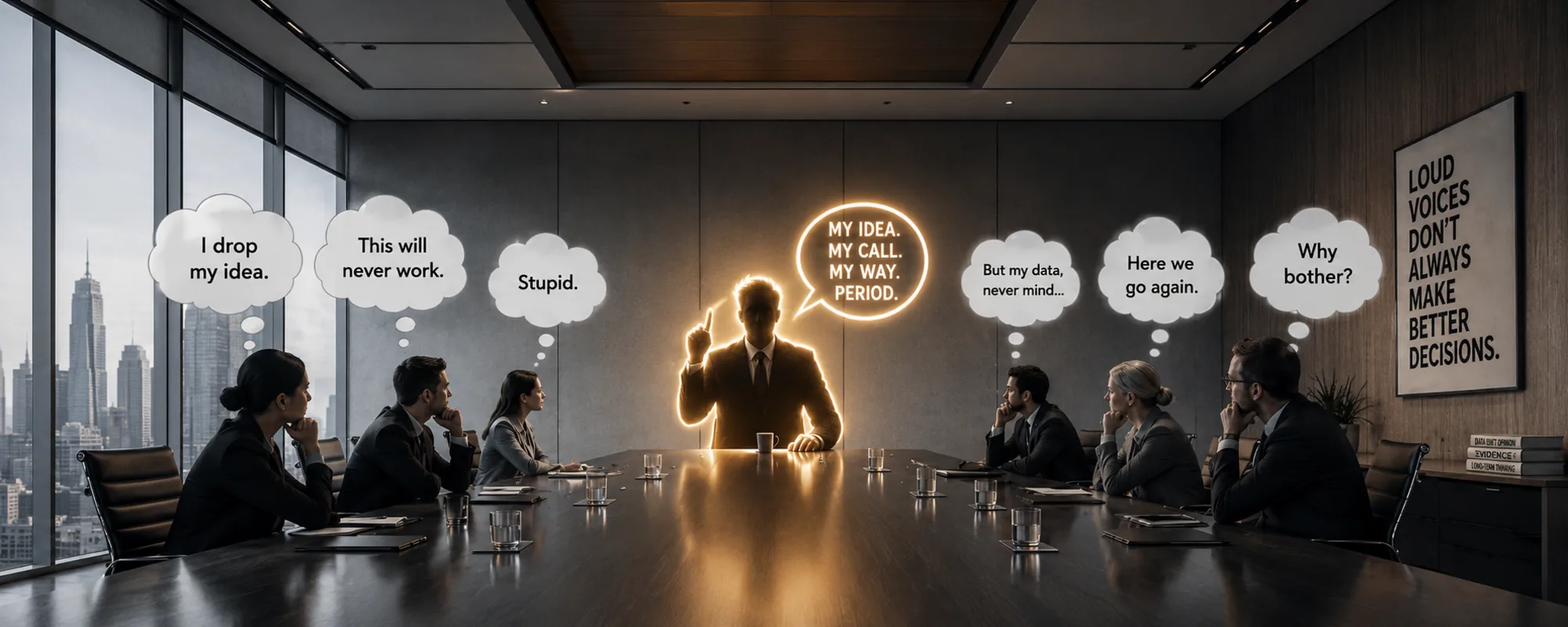
A team of capable people will routinely make a decision worse than its smartest member would have made alone, and unstructured group decisions fail in four predictable patterns. Groupthink lets the pull toward agreement overpower the search for the right answer, so dissent stays quiet because it feels disloyal. The loudest-voice problem lets the most confident or talkative person dominate, so confidence is mistaken for correctness. The HiPPO effect lets the highest paid person's opinion anchor the room, after which everyone discovers they agree. Conformity cascades let the first opinion voiced shape the second and the third, until apparent consensus is only an echo of whoever spoke first. In every case the best argument loses to something irrelevant: volume, status, timing, or the discomfort of disagreement. Groups are not inherently bad at deciding; unstructured groups are. Condorcet proved formally in 1785 that as long as each member is more likely right than wrong, a majority becomes more accurate as the group grows, and a diverse group pooling independent judgments beats a lone expert repeatedly. That result holds only under three conditions: independence, so people form a view before being anchored; diversity, so genuinely different perspectives are present; and structure, so there is a method for surfacing and weighing arguments. The single lever is to make the arguments visible and judge them on merit rather than on who voiced them.
Why Smart Teams Make Dumb Decisions (And the One Thing That Reverses It)
Put brilliant people in a room and they'll often decide worse than any one of them would alone. Here's why — and the fix.
Here's one of the most unsettling findings in decision science:
A team of smart people will routinely make a decision dumber than the smartest person in the room would have made alone.
You've probably watched it happen. A group of capable, well-meaning people walks into a room, and somehow walks out with a choice that, in hindsight, nobody actually thought was the best one. How?
The four ways groups sabotage themselves
Unstructured group decisions fail in predictable patterns:
- ✕Groupthink — the pull toward agreement overpowers the search for the right answer. Dissent feels disloyal, so it stays quiet.
- ✕The loudest-voice problem — the most confident or talkative person dominates, and confidence gets mistaken for correctness.
- ✕The HiPPO effect — the Highest Paid Person's Opinion anchors the room. Once the boss leans, everyone "discovers" they agree.
- ✕Conformity cascades — the first opinion voiced shapes the second, which shapes the third, until "consensus" is really just an echo of whoever spoke first.
Notice the common thread: in every case, the best argument loses to something irrelevant — volume, status, timing, or the sheer discomfort of disagreement.
But groups aren't the problem
Here's the twist that changes everything.
Groups aren't inherently bad at deciding. Unstructured groups are.
Under the right conditions, a group will reliably outperform even its smartest member. It's called the wisdom of crowds — and it's not a new idea. Back in 1785, the mathematician Condorcet proved it formally: as long as each person is more likely right than wrong, a group's majority gets more accurate as it grows.
But — and this is the entire game — only when three conditions hold:
- ✓Independence — people form a view before being anchored by the loudest or most senior voice.
- ✓Diversity — genuinely different perspectives are in the mix, not five versions of the same person.
- ✓Structure — there's a method for surfacing and weighing the arguments, instead of just talking until someone gives up.
Take those away and the crowd gets dumber than an individual. Add them and it gets smarter than anyone. Same people. Opposite outcome. The only variable is structure.
The one thing that reverses it
So what's the single lever?
Make the arguments visible, and judge them on merit instead of on who said them.
That's it. When the actual reasons — for and against — are laid out where everyone can see and weigh them, the irrelevant stuff loses its grip. Status stops standing in for correctness. The quiet person's strong point can't be drowned out. The first opinion doesn't get to anchor the rest. And six months later, you can see why the call was made.
It's the difference between "we talked about it and went with Dave's gut" and "we put the arguments side by side and the strongest one won."
This is exactly why structured, collaborative decision-making beats a room full of smart people winging it. The Challenger engineers were right — they just had no structure that could make "right" win over "convenient."
The lesson isn't "trust groups" or "distrust groups." It's sharper than that: a group is only as smart as the structure you give it. Give it none, and brilliance cancels out into mush. Give it the right structure, and ordinary people make extraordinary decisions together.
So: think of the best group decision you've ever been part of. What was different about how it was made — not who was in the room, but the process?
Let the best argument win
Argumentree makes a team's arguments visible and weighs them on their merits — so volume, status and speaking order stop deciding things for you.
Start Free 14-Day Trial →Related Reading
Collaborative Decision Making Guide
The full method for deciding well with other people, end to end.
The Condorcet Jury Theorem
The 1785 proof behind why groups get more accurate as they grow — and its conditions.
What Is the Wisdom of Crowds?
When a crowd beats the expert, and the three conditions that make it work.