
How to Actually Get Better at Making Decisions | Argumentree
Knowing a decision framework and reaching for it under pressure are different problems, because in the moment the fast automatic system is back in charge and willpower is largely gone by late afternoon. The goal is therefore not to think harder but to build small systems so that good decisions happen by default. Four habits do most of the work. First, protect decision energy: quality degrades across the day before fatigue is consciously felt, which is why effective people strip trivial choices out of their routines through fixed breakfasts, near-uniform wardrobes and standing planning slots. Second, reduce the volume: most daily choices recur, so decide them once as a rule and stop relitigating them, using defaults and simple if-then rules; Warren Buffett credits his record to extreme selectivity, counting only about a dozen truly important decisions in 58 years and spending roughly 80 percent of his day reading rather than deciding. Third, keep a feedback loop: review recent decisions weekly, asking whether what worked was luck or process and where the thinking went wrong, and write the answers down to build a map of how you personally tend to err. Fourth, treat reversible decisions as experiments, which speeds movement, accelerates learning and turns being wrong from a verdict into data.
How to Actually Get Better at Making Decisions
Frameworks are useless if you can't reach for them under pressure. Here's how to make good decisions your default.
There's a gap between knowing and doing, and decision-making lives right in the middle of it.
You can memorize every framework from the last piece and still blow the call on a Tuesday night — when you're tired, the inbox is full, and someone needs an answer now. Because in that moment, the fast, automatic brain is back in charge, and it does not care what you read.
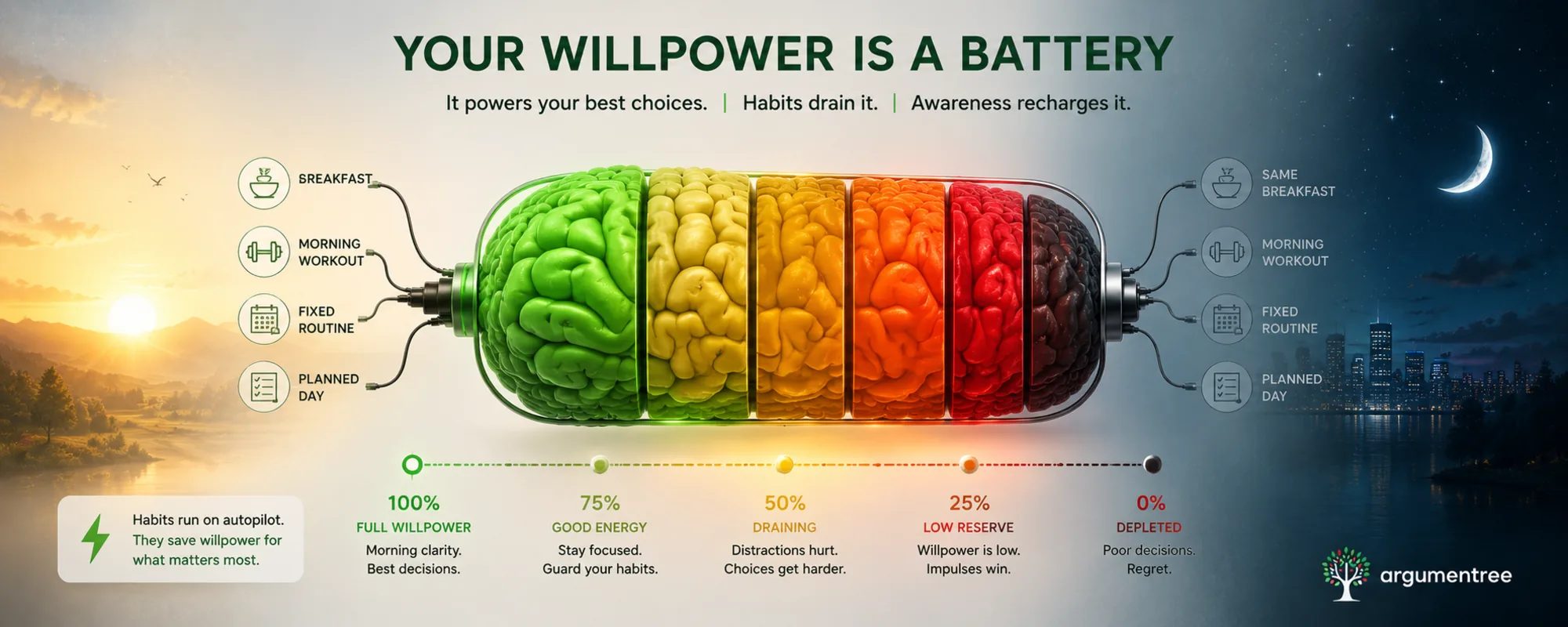
So the goal was never to think harder in the moment. Willpower is the least reliable tool you own; it's mostly gone by 4pm. The goal is to build small systems so that good decisions happen by default — when you're at your worst, not just your best.
Four habits do most of the work.
Protect your decision energy
Decision quality degrades as the day wears on, long before you feel tired.
This is why some of the most effective people deliberately strip trivial decisions out of their day: the same breakfast, a near-uniform wardrobe, a fixed weekly planning slot. It looks like quirk. It's actually capacity management.
Every dumb decision you automate is a smart decision you've bought back.
Reduce the volume
You don't have to decide everything from scratch. Most of your 35,000 daily choices are recurring — so decide them once, as a rule, and stop re-litigating them.
Defaults, routines, and simple if-then rules do the heavy lifting: "If it's under $50 and reversible, I just decide." That single rule converts a thousand tiny agonies into one.
The principle scales all the way up. Warren Buffett credits his record to extreme selectivity — by his own count, only about a dozen truly important decisions in 58 years. His "20-slot punch card" rule captures it: imagine you got just twenty big decisions for your entire life, and you'd weigh each one very differently. Buffett spends roughly 80% of his day reading, not deciding. Fewer decisions, made better.
The less your fast brain has to improvise, the more deliberate capacity you keep for the choices that genuinely matter.
Keep a decision feedback loop
Here's the thing almost nobody does: review their decisions. We obsess over outcomes and ignore the process that produced them — so we repeat the same mistakes with full confidence.
Once a week, two questions:
- •What did I decide recently that worked — and was that luck or process?
- •What didn't work — and where exactly did the thinking go wrong?
Write the answers down. Over a few months you build something most people never have: a map of how you, specifically, tend to get it wrong. That's the whole idea behind a decision log — and behind any tool that makes a decision reviewable later instead of forgotten.
Treat reversible decisions as experiments
Remember the two-way doors? Most of the fear around deciding comes from treating reversible choices as permanent ones.
Reframe a two-way-door decision as an experiment — "let's try it and see; we can change course" — and three things happen at once: you move faster, you learn quicker, and the fear of being wrong mostly evaporates.
Being wrong stops being a verdict. It becomes data.
The unfair advantage
Step back and notice what's really going on here.
Almost nobody works on this. People read shelves of books on productivity, leadership, and communication — and treat the skill sitting underneath all of them as something that just happens to them.
That's exactly why it compounds. A small edge in how you decide, applied across 35,000 daily reps, across a career, across a life, is not a small edge. It's the difference between two people of identical intelligence ending up in completely different places.
You don't need to be perfect. You just need to be slightly more intentional than the people around you — most of whom aren't trying at all.
Start with one habit. Automate one trivial decision this week. That's the entire beginning.
The quality of your decisions becomes the quality of your life. The only real question left is whether you'll keep leaving it to autopilot — or start making the process visible. So: what's the one trivial decision you're going to automate this week to buy back some brainpower?
Make the reasoning reviewable
A decision you can look back on is a decision you can learn from. Argumentree keeps the options, the arguments and the reasoning attached to the call itself.
Start Free 14-Day Trial →Related Reading
Warren Buffett's Decision Philosophy
The 20-slot punch card, and what extreme selectivity actually buys you.
Decision Log Template
The feedback loop in practice — a format for recording what you decided and why.
What Is a Decision Audit Trail?
Why reviewable reasoning beats remembered reasoning, at team scale.