
2,500 Years Ago, Aristotle Figured Out How to Win Arguments | Argumentree
Roughly 2,300 years ago in Athens, Aristotle worked out the mechanics of how people are actually convinced and described them in the Rhetoric so effectively that the framework is still in use. His radical move was to treat persuasion as a craft rather than a gift. Before him, being persuasive was regarded like being tall — something a person either had or lacked. Aristotle insisted it had structure, parts and rules, like carpentry or medicine, and could therefore be studied, taught and practised deliberately. That reframing is the ancestor of every debate class, sales training and writing course, and it is the premise that the things treated as innate, such as deciding, arguing and persuading, are learnable skills. The substance is the three appeals: ethos or credibility, pathos or emotion, and logos or logic, the three levers that move any audience. He saw more besides. He held that you should be able to argue the case against your own position, not to be slippery but because a view cannot be truly defended until its opposite is understood, which is the ancestor of steel-manning. He observed that persuasion is audience-shaped, since the same argument lands differently on different people, so knowing an audience is the difference between being right and being heard. And he treated arguments as built rather than blurted, breaking persuasion into structured parts long before anyone spoke of an argument's anatomy.
2,500 Years Ago, Aristotle Figured Out How to Win Arguments
He treated persuasion as a system instead of a gift. We've never improved on the core of it.
We've spent this series talking about decisions, disagreement, and persuasion as if they were modern problems.
They're not. Roughly 2,300 years ago, in Athens, one man sat down and worked out the mechanics of how humans actually get convinced — and described them so well that we're still using his framework today, mostly without realizing.
His name was Aristotle. The book was the Rhetoric. And it was the moment persuasion stopped being treated as a mysterious talent and became something you could study, teach, and practice.
The radical idea
Before Aristotle, being persuasive was thought of like being tall or beautiful — a gift you either had or you didn't.
Aristotle's move was to insist it was a craft. Something with structure, parts, and rules, like carpentry or medicine. Something you could get good at on purpose.
That reframe is the ancestor of every debate class, sales training, and writing course that exists. It's also the quiet premise of this entire series: the things we treat as innate — deciding, arguing, persuading — are actually learnable skills. Aristotle got there first.
What he actually found
We met the heart of it earlier in this series: the three appeals — ethos (credibility), pathos (emotion), and logos (logic) — the three levers that move any audience. That framework is Aristotle's, and 2,300 years of human progress hasn't dislodged it.
But he saw more than that:
- ✓Argue both sides. Aristotle insisted you should be able to make the case against your own position — not to be slippery, but because you can't truly defend a view until you understand its opposite. (The ancestor of steel-manning.)
- ✓Persuasion is audience-shaped. The same argument lands differently on different people. Knowing your audience isn't manipulation; it's the difference between being right and being heard.
- ✓Arguments are built, not blurted. He broke persuasion into structured parts long before anyone called it an argument's "anatomy."
Why it still wins
Technology changes. Human wiring doesn't. We're persuaded by the same three levers that moved an Athenian crowd, because we're running the same hardware they were.
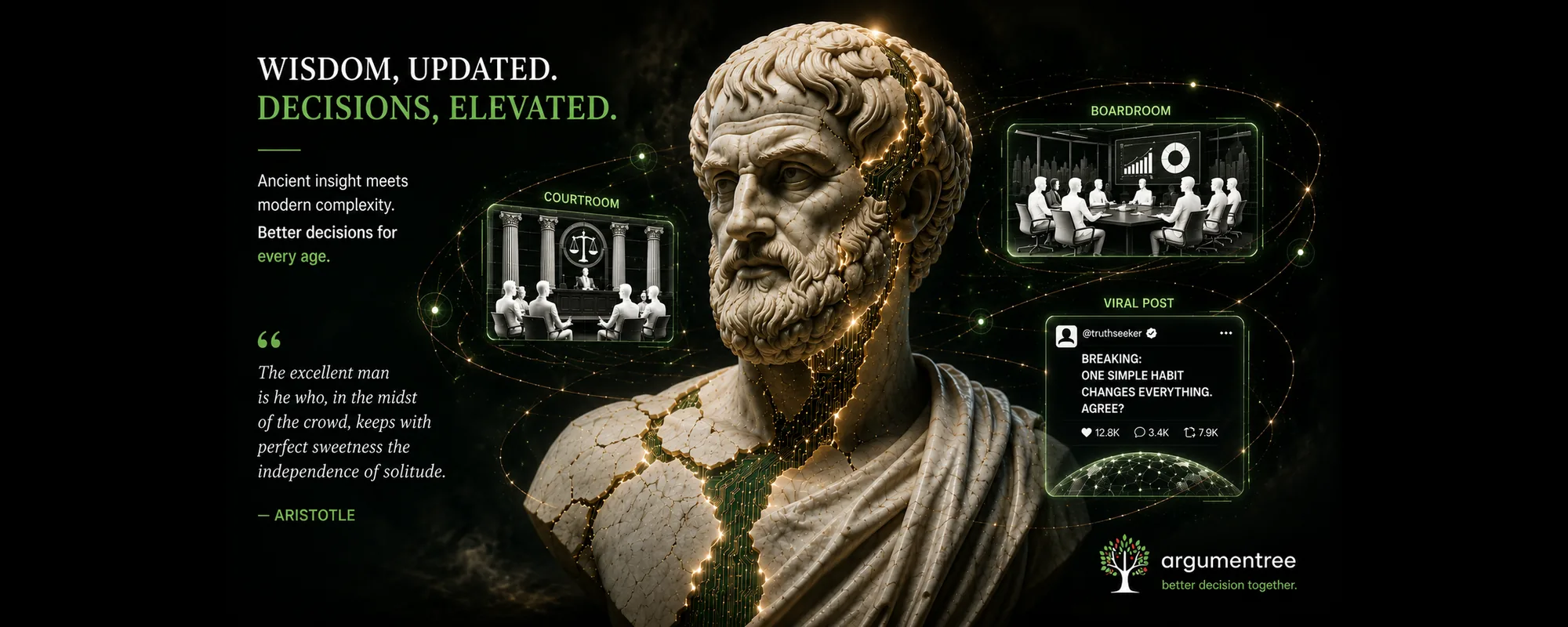
That's why Aristotle still shows up everywhere — in courtrooms, boardrooms, campaign ads, and the most-shared post in your feed this morning. Whoever wrote it was using his framework, whether they'd heard his name or not.
Worth adding one thing the popular telling usually leaves out: Aristotle was neither the first nor the only thinker to systematize argument. Indian debate theory, Chinese Mohist disputation and later Islamicate legal dialectics all built their own machinery, largely independently — and each mapped a part of argument the Greek tradition left thin.
The lesson underneath the history
Here's why this matters beyond trivia.
If persuasion is a craft with structure — if even arguing has an anatomy you can learn — then so does the thing we use arguments for: deciding well, together.
That's the throughline from a 4th-century-BCE scroll to a modern team in a meeting. The best arguments have always had structure. The best decisions have always come from weighing them honestly. Aristotle just wrote the first user manual — and we've been slowly relearning it ever since.
So: who's the most persuasive person you know — and which of Aristotle's three levers, credibility, emotion or logic, is their secret weapon? It's almost never the one they think.
The anatomy, 2,300 years on
Argumentree does what the Rhetoric implied: makes the structure of an argument explicit, so it can be judged on its merits rather than its volume.
Start Free 14-Day Trial →